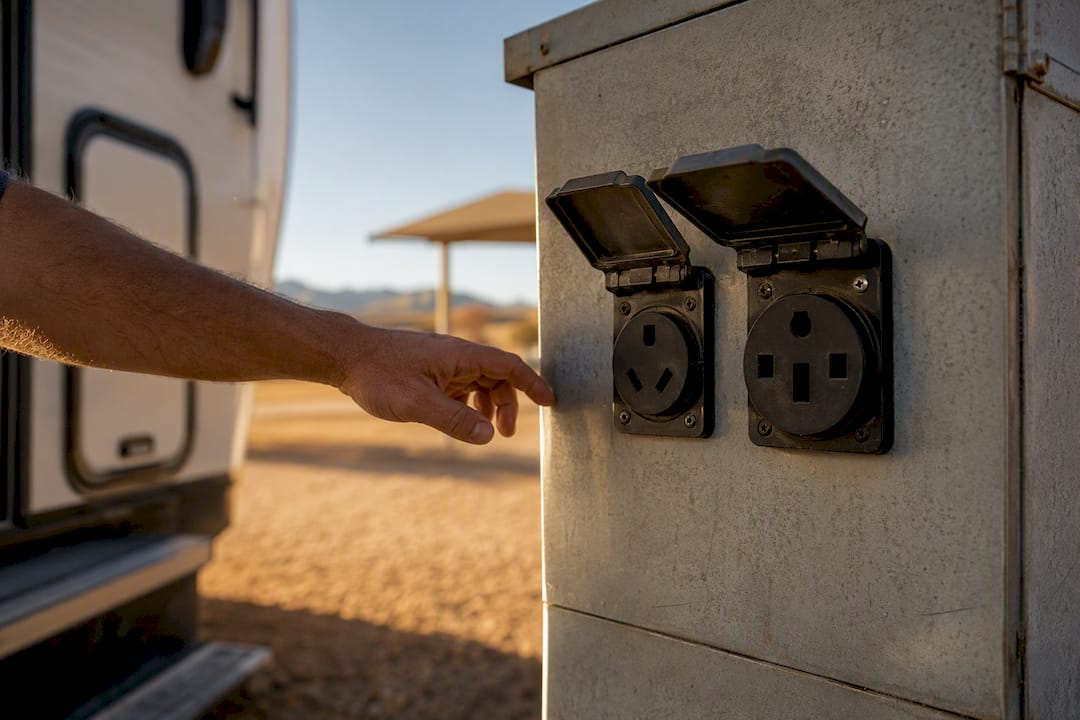
A 30 amp shore cord delivers a maximum of 3,600 watts; a 50 amp cord delivers approximately 12,000 watts, around three times the power. Choose 50 amp if you run two air conditioners, an electric water heater, and a washer/dryer at once. Choose 30 amp if you have a single AC and a smaller trailer. An adapter changes the plug, not the amperage available.
TL;DR:
- A 50 amp RV connection provides roughly three times the power of a 30 amp, capable of running multiple high-wattage appliances simultaneously without tripping breakers.
- 50 amp systems split power across two 120-volt legs, requiring proper load balancing and correctly rated wiring to prevent overheating or electrical hazards.
- Adapters do not increase available power; plugging a 50 amp rig into a 30 amp outlet still limits total draw to about 3,600 watts, regardless of the plug used.
- Moving from 30 amp to 50 amp service involves significant upgrades to wiring, breakers, and possibly internal panels, often costing several hundred dollars to over a thousand.
- Safe operation depends on following code guidelines like the 80% continuous load rule, testing pedestals beforehand, and carefully staggering appliance start-up to avoid overloads.
Table of Contents
- 30 Amp vs 50 Amp Power: The Math Behind the Difference
- Identifying 30A and 50A Connectors and Wiring Rules
- Real Appliance Loads: What 30A and 50A Can Actually Handle
- Do Adapters Actually Give You More Power?
- Upgrading From 30 Amp to 50 Amp: What It Costs and Involves
- Safety Rules Every RV Owner Should Follow
- Why RVs Ended Up With Two Different Power Standards
- How Mesquite Oasis Supports Guests With 30A and 50A Hookups
- Ready to Plug In? Book Your RV Site at Mesquite Oasis
- Sources
- FAQ
30 Amp vs 50 Amp Power: The Math Behind the Difference
The relationship is simple: volts times amps equals watts. Volts measure electrical pressure, amps measure the flow of current, and watts measure the total power you actually get to use. A 30 amp RV cord runs on a single 120 volt leg, so the math is 120 × 30, which gives you about 3,600 watts total. A 50 amp cord is wired differently. It carries two separate 120 volt legs instead of one, and RV panels split appliances across both. That doubles the voltage side of the equation, so the math works out to roughly 12,000 watts, better than three times what a 30 amp hookup provides.
Here’s what that “two legs” setup actually means for your rig:
- Each leg carries its own 120V circuit, each rated for 50 amps.
- Your RV’s distribution panel splits big appliances (like dual ACs) across both legs to balance the load.
- If one leg carries more draw than the other, you can trip a breaker on that leg even while the other sits mostly idle, which is why balancing loads matters daily in larger rigs.
That last point trips up a lot of new 50 amp owners who assume they have one giant pool of power to draw from freely.
Identifying 30A and 50A Connectors and Wiring Rules
You can tell the two systems apart at a glance. A 30 amp plug, known as a TT-30, has three prongs: two flat blades and one round ground pin, usually arranged in a triangle. A 50 amp plug is a NEMA 14-50, with four prongs: two flat blades for the hot legs, a neutral, and a ground. Campground pedestals typically label each outlet clearly, but mislabeled or poorly maintained pedestals do exist, so it pays to look twice before plugging in.
Wiring behind the outlet matters just as much as the plug shape. For a 50 amp circuit, minimum wire gauge is typically 6 AWG copper or 4 AWG aluminum, sized to match the breaker rating.
Statistic Callout: The National Electrical Code’s 80% continuous load rule means a 50 amp breaker should carry no more than 40 amps of continuous draw. That headroom exists to prevent overheating during long AC or heater runs, not just as a paperwork formality.
A few things to watch for:
- Undersized wire behind a pedestal outlet can overheat under sustained load, even if the breaker looks correctly rated.
- Reverse-polarity or miswired pedestals are a real hazard and can damage RV electronics instantly.
- Loose or corroded pedestal connections cause voltage drop, which stresses appliance motors and compressors.
Real Appliance Loads: What 30A and 50A Can Actually Handle
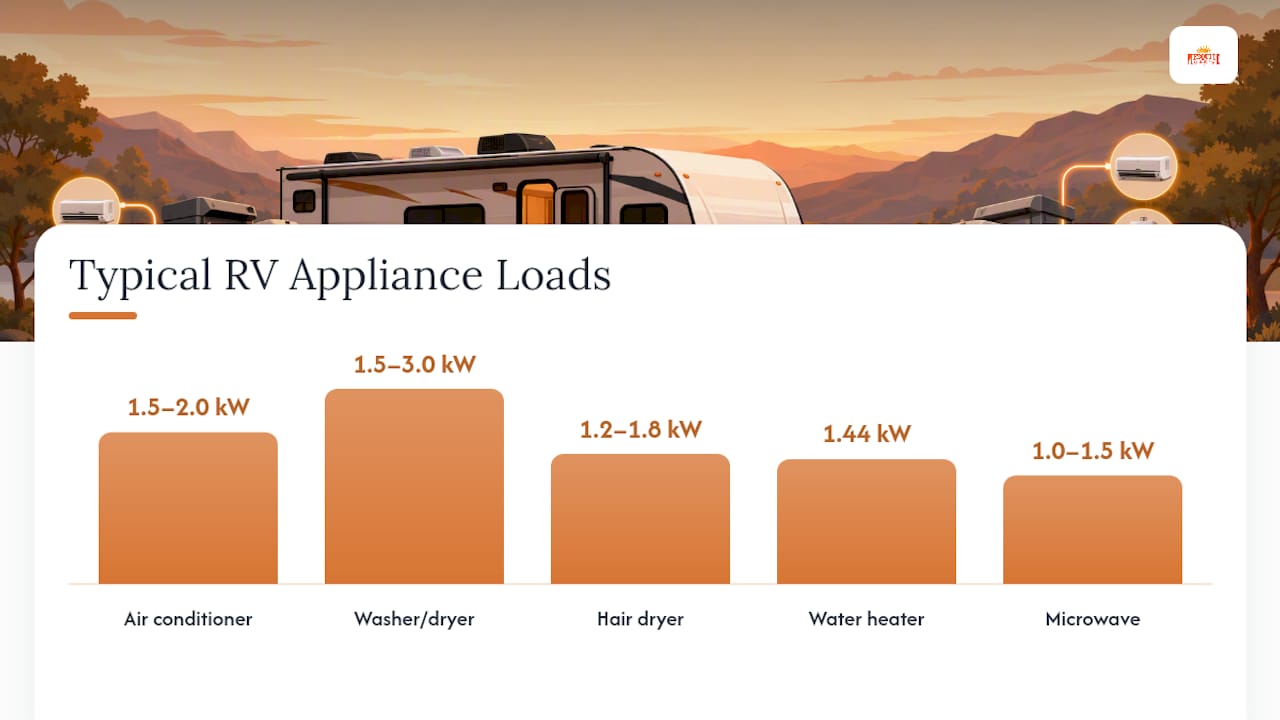
Numbers on a spec sheet only matter once you map them to what you actually plug in. Here are typical draws for common RV appliances:
- Air conditioner (13,500 BTU): 1,500 to 2,000 watts running
- Microwave: 1,000 to 1,500 watts
- Electric water heater: about 1,440 watts
- Hair dryer: 1,200 to 1,800 watts
- Refrigerator: 180 to 600 watts
- Washer/dryer combo: 1,500 to 3,000 watts depending on cycle
A small travel trailer on 30 amp power (around 3,600 watts) can usually run one AC unit, the fridge, and lights comfortably, with limited room for other appliances used simultaneously. A medium rig on 30 amp service needs to manage loads carefully: for example, running the AC and fridge but avoiding running the microwave at the same time as the water heater’s electric element. A large fifth wheel or Class A with two ACs, an electric water heater, and a residential fridge needs 50 amp service to avoid constant breaker trips.
Startup current matters too. Air conditioner compressors and motors draw a surge of extra current for a second or two when they kick on, well above their running wattage. That’s why headroom matters even when your running-watt math looks fine on paper.
Pro Tip: Stagger your big appliances. Start the AC, let it settle for a minute, then turn on the microwave or water heater. Simultaneous startup surges are what trip breakers, not steady running loads.
Do Adapters Actually Give You More Power?
No. An adapter reshapes the plug to fit a different outlet; it never increases the amperage available from that outlet. Plug a 50 amp rig into a 30 amp pedestal using a dogbone adapter, and you still have 3,600 watts to work with, full stop.
Here’s how the common adapters actually behave:
- 30 amp male to 50 amp female (dogbone): Lets a 30 amp cord connect to a 50 amp pedestal, but the RV still only draws 30 amps total.
- 50 amp male to 30 amp female: Lets a 50 amp rig plug into a 30 amp pedestal, capping the entire rig at 3,600 watts, both legs combined.
- 30 amp female to 15/20 amp household plug: Useful in a pinch at a house or garage outlet, but limits you to whatever that household circuit can safely deliver, often far less than 30 amps.
If you find yourself relying on adapters often, invest in an Electrical Management System or a dedicated surge protector. Pedestal wiring at older campgrounds isn’t always reliable, and an EMS catches faults before they reach your appliances.
Upgrading From 30 Amp to 50 Amp: What It Costs and Involves
Moving a rig from 30 amp to 50 amp service isn’t a simple plug swap. It usually means replacing the shore power inlet, upgrading the main breaker and possibly the whole distribution panel, and running new wiring rated for the higher capacity. Some rigs also need a new shore cord and a tester or EMS to confirm everything works safely once the job is done.
Typical cost drivers include:
- Parts: New 50 amp inlet, panel components, and cord run several hundred dollars combined.
- Labor: Dealer or certified electrician rates add up fast, especially if branch wiring inside the RV needs replacing rather than just the inlet.
- Full rewiring: If your rig’s internal wiring can’t handle the added capacity, busbar and branch circuit changes inside the panel push costs meaningfully higher.
Pro Tip: Get a quote before committing. Some techs will price the shore inlet swap without mentioning that your panel’s busbar also needs replacing, and that’s often the bigger job.
If a full upgrade doesn’t make sense for how often you travel, consider alternatives: a larger generator sized to your actual peak draw, disciplined load scheduling using the appliance math above, or living with adapters paired with a reliable EMS.
Safety Rules Every RV Owner Should Follow
Electrical safety on 50 amp circuits comes down to a few non-negotiables. The NEC’s ampacity rules exist to keep wire and connections from overheating under sustained draw, and the 80% continuous load guidance caps a 50 amp breaker at 40 amps of steady use, the same standard that applies to residential 50 amp circuits like those covered in NEMA 14-50 receptacle guides.
Beyond code compliance, a few habits cut real risk:
- Always test a pedestal with a polarity checker or EMS before connecting your cord.
- Never bypass a tripped breaker by forcing a bigger one into the panel.
- Store and inspect your cord regularly. Fifty amp cords run heavier and stiffer than 30 amp cords, and cracked insulation from repeated coiling is a common failure point owners overlook.
Why RVs Ended Up With Two Different Power Standards
The 30 amp standard came first, built for an era when RVs ran a single air conditioner, a few lights, and maybe a small fridge. Thirty amps at 120 volts was plenty of power for that kind of trailer, and it kept shore cords lighter and pedestal wiring cheaper for campground owners to install across thousands of sites.
As RVs grew into multi-slide fifth wheels and Class A motorhomes with dual AC units, residential refrigerators, washer/dryer combos, and electric water heaters, 30 amp service stopped being enough. Rather than redesign a single standard from scratch, the industry adopted the 50 amp NEMA 14-50 connector, borrowed conceptually from the split-phase service already used in American homes. That gave manufacturers a way to deliver roughly three times the usable power without needing to invent an entirely new voltage system.
Campgrounds adapted gradually, which is why older parks sometimes still offer only 30 amp pedestals or a mix of both. The two standards persist today because the demand split never fully resolved. Smaller trailers and pop-ups still only need 30 amps, while large luxury rigs need every bit of that 12,000 watt ceiling. Neither standard made the other obsolete; they just settled into serving different segments of the same market.
How Mesquite Oasis Supports Guests With 30A and 50A Hookups
The RV park offers full-hookup RV sites with both 30 amp and 50 amp service, accommodating a range of RV power needs. Booking, applications, and payments run entirely online, and amenities like laundry and the gym are accessible with a personal PIN once you’re set up.
Ready to Plug In? Book Your RV Site at Mesquite Oasis
Once you know whether your rig needs 30 amp or 50 amp service, the next step is finding a site that actually has the hookup you need, without calling around to confirm availability. Mesquite Oasis runs 241 full-hookup RV sites in Odessa, built specifically for shift workers, contractors, and crews on extended assignments in the Permian Basin, with both 30A and 50A service available depending on the site.

Every part of booking happens online, day or night: you apply, get approved, and pay without a single phone call, which matters when you’re working odd shifts and don’t have time to sit on hold. Companies housing multiple crew members can also arrange block bookings with consolidated monthly invoicing. If you’re ready to check availability, browse open RV sites and current rates and get your rig plugged in on the service level it actually needs.
Sources
- RV Generator Power Basics | Cummins Inc.
- RV Shore Power Guide: 30 Amp vs 50 Amp
- 30-amp vs 50-amp power - RVelectricity
FAQ
Can I put a 50 amp plug on a 30 amp RV?
No. Rewiring a 30 amp RV’s plug to a 50 amp connector doesn’t give it access to more power, since the RV’s internal wiring and panel are still built for 3,600 watts, and doing so is a safety hazard.
How many appliances can run on 30 amps?
A 30 amp connection, at about 3,600 watts, typically handles one air conditioner plus a fridge and lights, but running a microwave or hair dryer at the same time usually trips the breaker.
Is 30 amp enough to run a house?
No. Household electrical service is far larger than a 30 amp RV connection, which was designed for a single trailer’s appliances, not a full home’s heating, cooling, and multiple large appliances running together.
Is 50 amp enough to run a house?
Not typically. While a 50 amp RV service delivers about 12,000 watts across two legs, most homes require a much higher amp panel to run central HVAC, kitchen appliances, and general household circuits simultaneously.


