Many private RV parks enforce breed restrictions, and the lists tend to repeat the same names: Pit Bull and mixes, Rottweiler, Doberman, with “mixes” and management discretion as catch-all clauses. The root cause is almost always insurance, not personal opinion about your dog. Before you drive anywhere, call the park directly and get the policy confirmed in writing.
TL;DR:
- Restricted lists often name Pit Bulls, Rottweilers, Dobermans, German Shepherds, and Mastiff types; mix clauses and staff discretion can extend bans to other dogs.
- Insurance contract exclusions are usually fixed, while managers may consider a dog’s temperament or documented service animal status only where policy allows.
- The ADA exempts task trained service animals from breed bans, while emotional support animals receive no equivalent protection under federal law.
- At national parks and other federal campgrounds, pets must stay on leashes no longer than 6 feet, and unattended animals can lead to eviction.
- Before booking, check pet limits, weight rules, and refund terms; if denied, request written reasons and a referral to a nearby pet friendly park.
Table of Contents
- Which breeds and dog types do campgrounds most often restrict?
- Why do parks enforce breed lists in the first place?
- Service animals and federal leash rules you should know
- How to check a park’s pet policy before you book
- If your dog is on a restricted list, here’s what to do
- Why we publish this guide
- What matters most if you’re traveling with a restricted breed
- A pet-aware stay at Mesquite Oasis and how to book it
- FAQ
- Sources
Which breeds and dog types do campgrounds most often restrict?
If you own a dog that looks like it belongs to a “dangerous” category, the chances of hitting a restriction climb fast. Campground pet policies tend to pull from the same short list, regardless of state or region.
Breeds that show up again and again on RV park restriction lists include:
- Pit Bull (including mixes)
- Rottweiler
- Doberman Pinscher
- German Shepherd
- Mastiff types (including Cane Corso and Bullmastiff)
- Chow Chow
- Akita
- Great Dane
- Rhodesian Ridgeback
- Perro de Presa Canario
- Wolf hybrids
Many policies also include a line that reads something like “and mixes thereof,” which widens the ban to any dog with a visible trace of a restricted breed. On top of named breeds, most parks add a management discretion clause, giving staff the right to turn away any dog they consider aggressive, regardless of breed. Some properties layer on weight limits too, though these vary widely from park to park and are not a nationwide standard.
Why do parks enforce breed lists in the first place?
Breed restrictions rarely come from a park owner’s personal feelings about certain dogs. They’re built into the insurance policy that covers the property, and insurance carrier requirements are the reason nearly identical banned-breed lists show up at parks with no connection to each other.
Insurers write these exclusions into liability coverage, and a park that ignores them risks a denied claim if a dog bites a guest or employee. Past incidents, whether at that specific property or in the surrounding area, can push a park to tighten its list further, and local liability concerns sometimes add breeds that an insurer didn’t originally require. What managers can waive tends to be limited to the parts of the policy that are discretionary, like a specific dog’s temperament assessment or a documented service-animal exception. The named-breed exclusions written into the insurance contract are usually fixed, and no amount of charm at the front desk will override them.
Service animals and federal leash rules you should know
Two separate rule sets affect dogs at RV parks and campgrounds: the Americans with Disabilities Act and federal land management regulations. They don’t overlap as much as people assume.
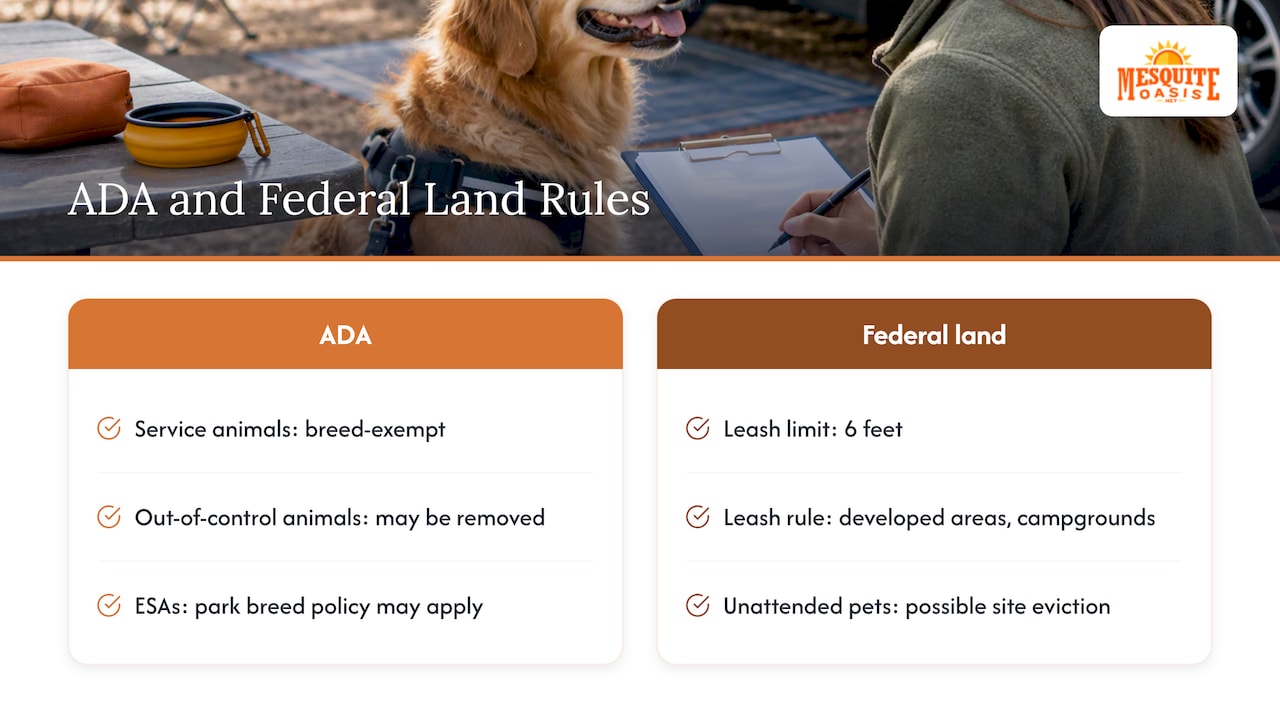
Under the ADA, a service animal trained to perform specific tasks for a person with a disability is not classified as a pet and is exempt from breed-based restrictions. Emotional support animals don’t carry that same federal protection, so a park’s breed policy can still apply to them.
Separately, if your trip includes a national park or other federal land, NPS regulations require pets to stay on a leash no longer than 6 feet in developed areas and campgrounds, and leaving a pet unattended can lead to eviction from the site. Even where a service animal is exempt from breed rules, staff can still ask it to leave if it’s genuinely out of control, since that exclusion is based on current behavior, not breed or past history.
How to check a park’s pet policy before you book
A few minutes of checking before you reserve a site saves you from arriving with a dog and nowhere to put it. Work through this before you pay anything:
- Read the park’s pet policy page in full and search it for the words “breed,” “weight,” “pet fee,” and “number of pets.”
- Check whether the cancellation or refund policy addresses what happens if your dog is turned away for a breed issue.
- Call or email the park directly rather than relying only on the website, since policies change and online listings lag behind.
- State your dog’s breed or mix and approximate weight clearly, and ask whether the park’s insurance mandates a specific banned-breed list.
- Ask if exceptions exist and what documentation they’d accept, such as a trainer’s letter or proof of service-animal status.
- Request written confirmation by email, screenshot the response, and note the staff member’s name and the date.
- Confirm on-site specifics like required leash length, whether there’s a fenced dog area, and any kennel rules for when you’re away from your site.
Pro Tip: Save every written confirmation in one folder on your phone so you can show it at check-in if front-desk staff gives you a different answer than the person you spoke to on the phone.
If your dog is on a restricted list, here’s what to do
A breed on a restricted list doesn’t have to end your trip plans. It just means you need a backup and some paperwork ready before you leave home.
- Book a property that explicitly states no breed restrictions, or line up boarding near your destination as a fallback.
- Bring vaccination records, any trainer certificates, and a few photos or short videos showing your dog staying calm around strangers and other animals.
- Carry a short written behavior summary and a trainer’s contact information if you have one, since this can speed up a manager’s decision.
- At arrival, offer a brief, controlled meet-and-greet with staff rather than demanding entry outright.
- Keep your dog leashed, and muzzled if a staff member asks, during that introduction.
- If a park still refuses entry, ask for the reason in writing and request a referral to a nearby pet-friendly option, then check your refund eligibility under their cancellation terms.
Packing the right gear ahead of time also helps the on-site meet-and-greet go smoothly. A partner guide on road-trip accessories for dogs covers practical items worth having in the RV before you ever reach the gate.
Why we publish this guide
We’ve fielded plenty of pet-policy questions from guests staying at our full-hookup RV sites and furnished lodge rooms in Odessa, and most of them come down to the same uncertainty this article addresses. For details on what hotel and lodging staff can legally ask about a service animal, see our piece on service animal rules at lodging properties. If you’re bringing your dog into shared spaces once you arrive, our dog park etiquette guide covers how to keep visits short and low-stress for every dog on site.
What matters most if you’re traveling with a restricted breed
The biggest mistake dog owners make isn’t picking the wrong park, it’s assuming a website’s pet policy page tells the whole story. Policies get updated after a single incident, insurance requirements shift year to year, and a page that said “all breeds welcome” can read differently by the time you arrive. The phone call matters more than the fine print.
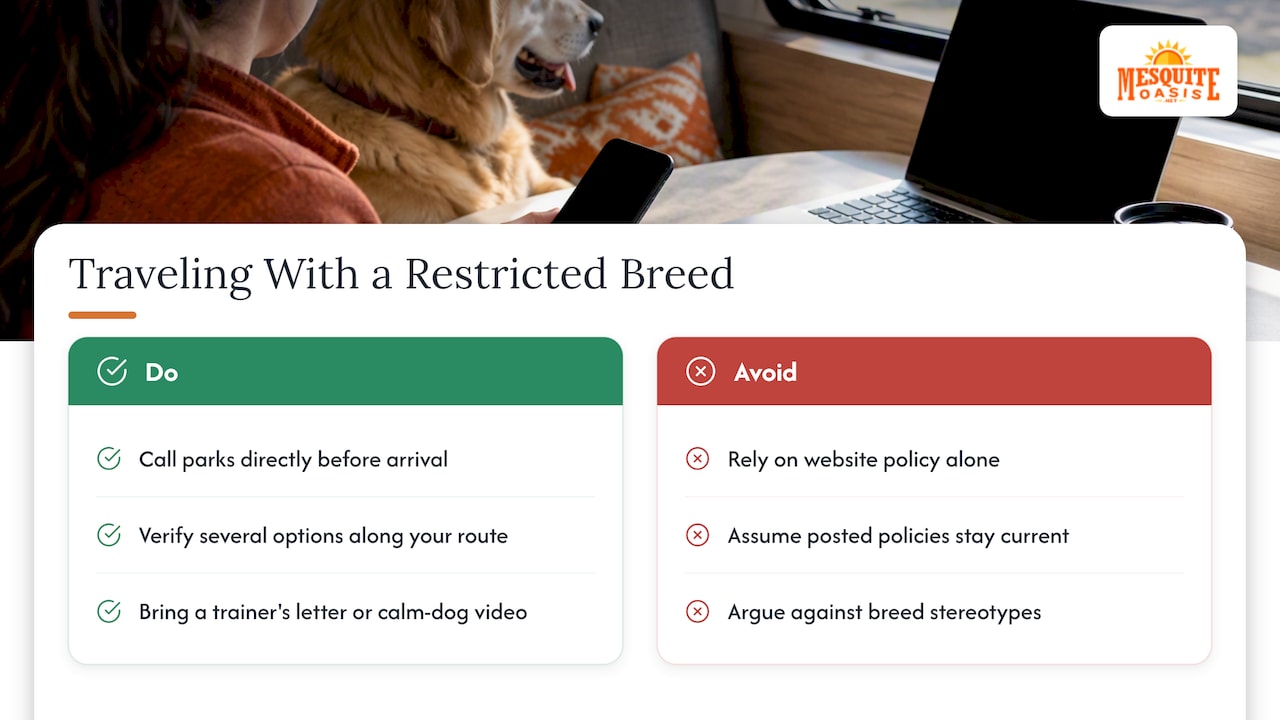
Conventional advice tends to focus heavily on finding the “right” breed-friendly park, as if the goal is to locate a single perfect property. That’s backward. The better strategy is building a small set of verified, pet-friendly options along your route and confirming each one directly, because a park’s actual practice on any given week can differ from what’s posted. Documentation is the other piece people underweight. A trainer’s letter or a short video of your dog behaving calmly around strangers does more to change a manager’s mind at the desk than any argument about breed stereotypes ever will.
Prioritize the phone call and the paperwork over hope. Everything else in this guide supports those two habits.
A pet-aware stay at Mesquite Oasis and how to book it
Our policy and rate pages are available online anytime, so you’re not stuck waiting for office hours to get an answer about pet arrangements.

- Browse our RV sites, including 30 Amp and 50 Amp full-hookup options, with current prices on our rates page.
- Check rates and the pet fee before you commit to a site or room.
- Reserve a lodge room if you’d rather skip the RV setup entirely; current prices are on our rates page.
- Apply and pay online in one sitting, with no phone call required.
If you have breed-specific questions before you reserve, the quickest path is to reach out through our apply and pay page or review our policies page for cancellation and refund terms tied to your stay.
FAQ
What dogs fall under breed restrictions?
Restricted-breed lists most commonly include Pit Bulls and mixes, Rottweilers, Doberman Pinschers, German Shepherds, Mastiff types, Chows, Akitas, Great Danes, and wolf hybrids. Most policies also include a “mixes” clause and a management discretion clause that lets staff deny any dog they consider aggressive, regardless of breed.
What is the 3-3-3 rule for camping?
This isn’t a breed or pet policy rule, it’s a general RV driving guideline about daily driving distance, stopping time, and how long to stay at each destination. It has no connection to breed restrictions or pet policies at campgrounds.
How many dogs can you have at a campground?
Limits vary by property, and there’s no single number that applies everywhere, so this is one of the first things to confirm when you check a park’s pet policy. Some parks cap the number of pets per site, so verify the exact limit with the specific park before booking.
What is the oldest RV allowed in RV parks?
Age limits on RVs vary significantly by park and aren’t tied to breed or pet policy at all. Some parks accept RVs of any age as long as they’re in good condition, while others set a cutoff, so this is worth confirming directly with the property alongside your pet policy questions.
Do service dogs get exceptions to breed bans?
Yes, under the ADA, a service animal trained to perform specific tasks for a person with a disability is not treated as a pet and is exempt from breed restrictions. Emotional support animals don’t carry that same exemption, so a park’s breed-based policy can still apply to them.