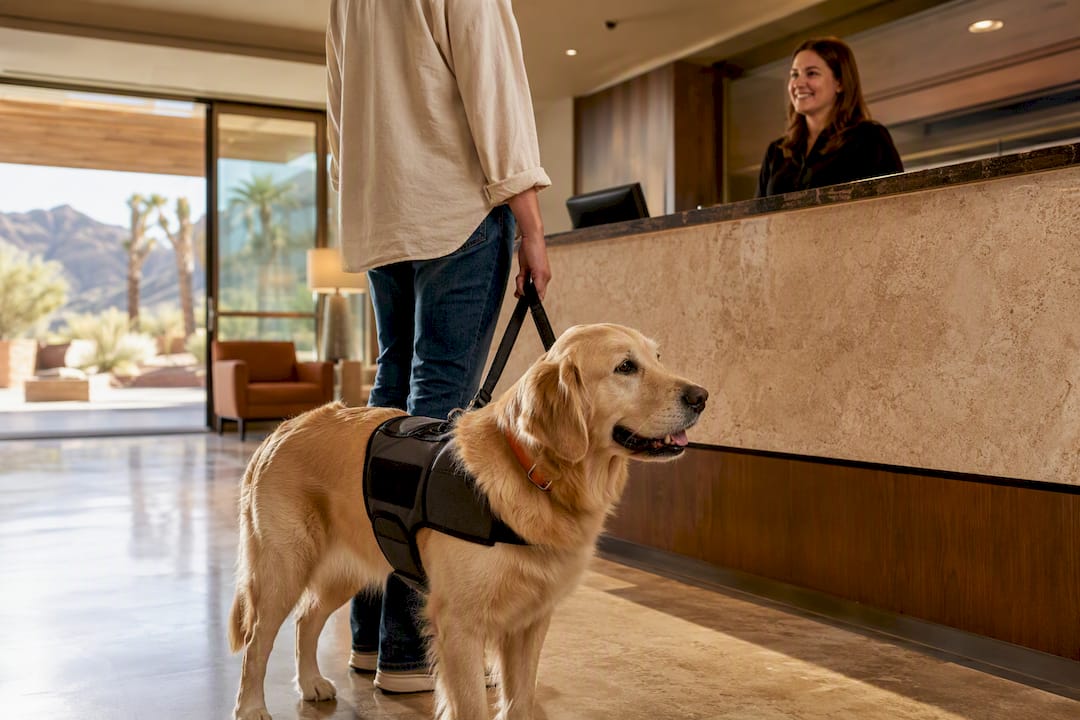
Federal law is unambiguous on this point: the ADA requires hotels, motels, inns, and other places of lodging to allow service animals (dogs, and in narrow cases, miniature horses) to accompany guests in all public areas and guest rooms, with only a couple of narrow exceptions. Pet fees are off the table entirely, though a property can still bill for actual damage the animal causes, the same way it would with any other guest, contrasting with many private jet pet travel services where fees apply to pets but not service animals under ADA.
TL;DR:
- Hotels cannot charge pet fees or deposits for service animals, but can bill for damages caused by the animal, just as they do for any guest.
- A service animal must be a dog trained to perform a specific task related to a disability, with miniature horses covered under a narrower exception.
- Staff can only ask two questions when it’s not obvious: if the dog is needed because of a disability and what task it is trained to perform.
- Service animals are permitted in all public areas and guest rooms of a hotel, except in narrowly defined sterile medical environments or pools, where entry may be restricted.
- States may have laws that extend protections or broaden definitions beyond the ADA, so checking local regulations before travel is advisable.
Table of Contents
- What Counts as a Service Animal Under the ADA?
- Where Can Service Animals Go in a Hotel?
- What Can Hotel Staff Legally Ask a Guest With a Service Animal?
- Can a Hotel Charge a Pet Fee for a Service Animal?
- When Can a Hotel Exclude or Remove a Service Animal?
- How Do Reservation and Accessible-Room Rules Work?
- What Happens When a Guest Requests a Miniature Horse?
- Do State Laws Change Service Animal Rules for Hotels?
- Checklists: What Guests and Staff Should Actually Do
- Why Accessibility Is Core Hospitality, Not an Add-On
- Mesquite Oasis: Built for Guests Who Need Access to Work Without Friction
- Sources
- FAQ
What Counts as a Service Animal Under the ADA?
The ADA’s definition is narrower than most travelers expect. A service animal is a dog individually trained to perform a specific task tied to a person’s disability, from guiding someone who is blind to alerting a diabetic to a blood sugar drop. The task has to be trained, not just comforting. That distinction trips up a lot of front-desk staff and a lot of guests.
There’s one exception worth knowing: miniature horses get limited protection under a separate provision, evaluated case by case rather than automatically covered like dogs.
Here’s the definitional baseline lodging staff and guests both need:
- Service animals: dogs trained to do a specific job for a person with a disability. Miniature horses qualify under a separate, narrower provision.
- Emotional support and therapy animals: not covered under the ADA’s service animal rules, no matter how much comfort they provide.
- Untrained pets: not covered, period, regardless of how well-behaved they are.
This is where a lot of hotel policies get outdated fast. A property that lumps “emotional support animals” in with service dogs, or that tries to apply one blanket “no pets” rule across the board, is misreading the law. Emotional support animals may still get accommodated under separate housing or airline rules in specific contexts, but under Title III of the ADA, which governs hotels, they simply don’t carry the same access guarantee a trained service dog does.
It’s also worth knowing that some states go further than the ADA. A handful of state statutes broaden the definition of a covered animal or add protections the federal rule doesn’t include, so a policy that’s compliant nationally might still fall short of what a specific state requires. More on that later.
Where Can Service Animals Go in a Hotel?
If the public can walk into it, a service animal can walk in with its handler. That’s the practical rule of thumb, and it covers more of a property than most staff realize.
Lobbies, dining rooms, breakfast buffets, fitness centers, business centers, shuttle vans, and guest rooms all fall under this umbrella. The Seeing Eye’s lodging guidance confirms this applies broadly across hotels, inns, motels, campgrounds, and even some vacation rentals, not just traditional hotel chains.
Pools are the one spot that trips people up. A service animal can be on the pool deck with its handler, but it generally isn’t allowed in the water itself, largely for sanitation and safety reasons rather than any exception to access rules.
A few concrete examples of how this plays out at check-in and beyond:
- A guide dog accompanies its handler through a hotel breakfast buffet line, even in a space that would otherwise be considered a food-prep or dining area with strict cleanliness standards.
- A psychiatric service dog rides the hotel shuttle to and from the airport alongside other guests’ luggage.
- A mobility-assistance dog stays in the guest room overnight, with no separate “pet room” assignment required.
- A hearing dog sits on the pool deck while its handler swims, but doesn’t enter the pool.
There’s a narrower category of spaces where access can be legitimately restricted, mainly sterile medical environments (an operating room in an on-site clinic, for instance) where infection control genuinely overrides access. Outside of that kind of specialized space, a “no animals” sign at a hotel amenity almost never holds up as a legal exclusion of a service animal.
What Can Hotel Staff Legally Ask a Guest With a Service Animal?
Front-desk staff have exactly two questions available to them when it isn’t obvious that an animal is a service animal, and no more. According to the ADA’s 2010 revised requirements, those questions are:
- Is the dog required because of a disability?
- What work or task has the dog been trained to perform?
That’s the entire permitted script. Staff cannot ask about the nature or extent of someone’s disability, request medical documentation, demand a certification card, ask for a demonstration of the trained task, or require identification tags. None of those things exist as a legal requirement for a service animal, no matter how many “official” registration websites claim otherwise, because no such registry is recognized under the ADA.
The two-question rule only applies when the answer isn’t already obvious. If a guest walks in with a dog wearing a harness, actively guiding them around obstacles or pulling a wheelchair, staff shouldn’t be asking anything at all. The dog’s function is visible. Save the questions for situations where the task isn’t apparent, like a dog that appears to be simply sitting calmly with its handler, where a psychiatric or medical alert function wouldn’t be obvious just from watching.
Pro Tip: Staff should treat the two questions as a conversation starter, not an interrogation. Asking “what task has your dog been trained to do?” in a normal, friendly tone at check-in resolves nearly every ambiguous case in under a minute, and it keeps the interaction from feeling like a challenge.
Can a Hotel Charge a Pet Fee for a Service Animal?
No. A property cannot impose a pet fee, pet deposit, or any surcharge tied to the presence of a service animal, because a service animal isn’t a pet under the law, regardless of what the front desk’s booking software labels it as.
Lodging cannot charge fees or deposits for service animals, but can bill for actual damage caused by the animal if it applies the same charge structure to all guests.
That distinction between “fee for having the animal” and “charge for damage the animal caused” is the whole ballgame here. A property that charges every guest a cleaning fee for a stained carpet or a broken lamp can charge a service-animal handler that exact same fee under the exact same circumstances. What it can’t do is add a blanket $50 “pet charge” the moment it sees a leash, or require a refundable deposit that non-handlers don’t have to pay.
A few practical examples of where the line sits:
- Not allowed: a flat $75 “pet fee” added to the folio because a service dog is present.
- Not allowed: a mandatory security deposit specifically for guests with service animals.
- Allowed: a standard carpet-cleaning charge applied after documented urine staining, the same charge a non-handler guest would face for the identical damage.
- Allowed: a documented furniture-replacement charge for chewed upholstery, billed at the property’s standard damage rate.
Properties that want to protect themselves here should document damage the same way they’d document any other guest’s incident: photos, a dated incident report, and a charge that matches a pre-published rate on the rates and fees page rather than an arbitrary number invented on the spot. Consistency is the legal safeguard. A charge that only ever gets applied to service-animal handlers is a fee in disguise, and it’s the kind of pattern that turns into a complaint fast.
When Can a Hotel Exclude or Remove a Service Animal?
Exclusion is legal in exactly two situations, and both require the property to prove it, not just assert it.
Under 28 CFR 36.302, a service animal can be excluded if it’s out of control and the handler doesn’t take effective corrective action, or if the animal isn’t housebroken. That’s the complete list. “Some guests are scared of dogs,” “our insurance doesn’t cover animals,” or “we just don’t allow pets” don’t qualify as valid grounds.
Even when exclusion is legitimate, the property’s obligation doesn’t end there. Staff must still offer the guest a way to receive the goods or services without the animal present, whether that means holding the room reservation while the handler makes other arrangements for the animal or continuing to serve the guest at the front desk while the situation gets resolved.
Practical grounds for exclusion and the required follow-up:
- Out of control: the dog is lunging, barking persistently, or otherwise disrupting the property, and the handler isn’t correcting it.
- Not housebroken: repeated, undisputed evidence of the animal relieving itself indoors outside of any accident that could happen to any animal.
- Required next step: offer to complete the transaction, check-in, or service without the animal physically present, rather than turning the guest away entirely.
Pro Tip: If a staff member is genuinely unsure whether behavior crosses the line into “out of control,” the safest move is to speak with the handler directly and calmly first. A tired dog settling after a long drive looks very different from a dog that’s a genuine safety risk, and a two-minute conversation usually clears that up before it becomes a bigger issue.
How Do Reservation and Accessible-Room Rules Work?
Booking an accessible room shouldn’t require a phone call, a special favor, or a manager’s personal intervention, and under 28 CFR 36.302, it isn’t supposed to. Accessible rooms have to be identified with enough detail that a guest can tell whether the room actually meets their needs, and those rooms have to be held for guests with disabilities until every other room of that same type is rented.
That requirement extends across every booking channel a property uses, not just its own front desk. Whether someone books directly, through a third-party travel site, or by phone, the ADA expects equal access to accessible-room information and equal ability to reserve one.
A short list of what that means in practice for guests booking a stay:
- Look for specific accessible-room descriptions (roll-in shower, grab bars, door width) rather than a vague “handicap accessible” checkbox with no detail.
- Book directly with the property when possible, since third-party sites don’t always sync accessible-room inventory accurately.
- Confirm the accessible room is held, not just requested, especially for high-demand dates.
- Ask about accessible-room availability the same way you’d ask about any amenity, at reservation time, not at check-in.
Properties that manage this well tend to build it into their booking process rather than treating it as an exception handled case by case. A transparent terms and reservation-holding policy that spells out how accessible rooms and long-stay bookings are handled removes most of the friction before a guest ever calls to ask.
What Happens When a Guest Requests a Miniature Horse?
Miniature horses get their own separate assessment under the ADA, and it’s genuinely more involved than the dog rule. A property has to weigh four factors before deciding whether it can reasonably accommodate one: the horse’s type, size, and weight relative to the facility; whether the facility can physically accommodate those characteristics; whether the handler has sufficient control over the animal; and whether the horse is housebroken.
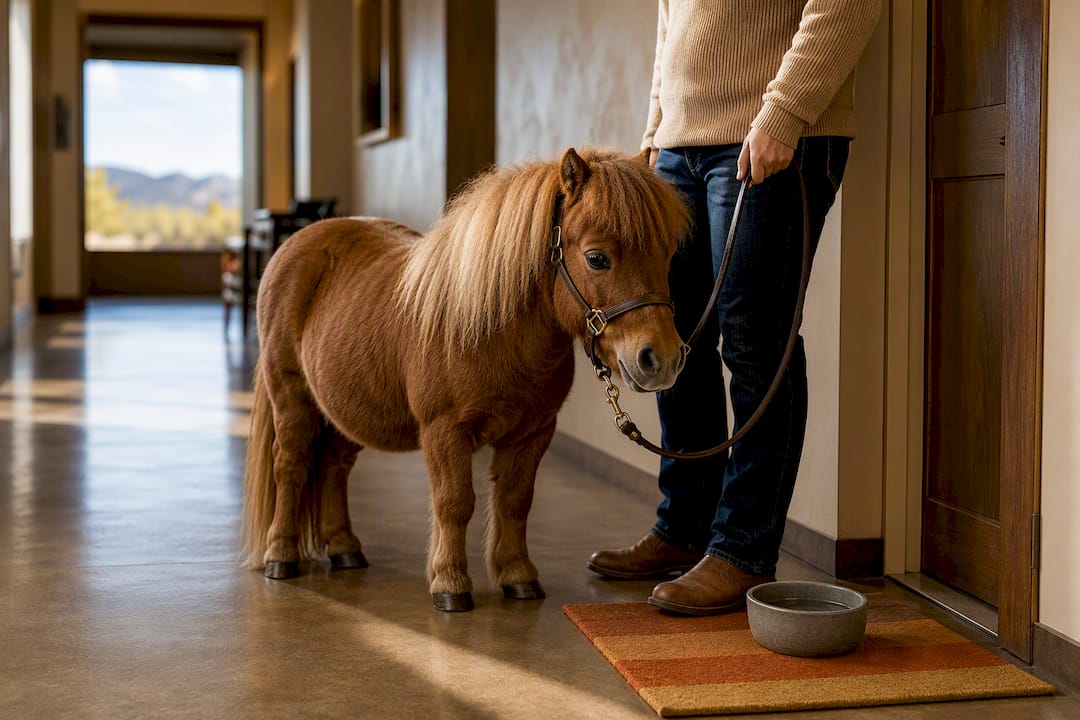
That’s a real assessment, not a formality. A 100-pound miniature horse in a compact guest room raises legitimate space and safety questions that a Labrador simply doesn’t. A property that denies a miniature horse request purely on the word “horse” without walking through those four factors is skipping a legally required step. A property that denies it after genuinely evaluating size, room layout, control, and housebreaking status, and documenting why accommodation isn’t feasible in that specific case, is on much firmer ground.
Room-assignment planning matters here more than staff usually anticipate:
- Type and size: does the specific animal’s dimensions realistically fit the room and common areas being used?
- Facility capacity: can flooring, doorways, and furniture layout accommodate the animal without damage or safety risk?
- Handler control: is the horse reliably controlled through voice, signal, or leash in shared spaces?
- Housebroken status: does the animal have a demonstrated pattern of being housebroken?
When accommodation genuinely isn’t feasible after that assessment, the same follow-up obligation from the exclusion section applies: offer the guest an alternative way to access services, and document the specific factors that drove the decision.
Do State Laws Change Service Animal Rules for Hotels?
Yes, in some states, and the differences matter enough to check before you travel. A number of states extend broader definitions of covered animals, add protections the ADA doesn’t include, or set additional penalties for businesses that wrongfully deny access, and a lodging policy that’s ADA-compliant on paper can still fall short of what a specific state requires.
Common ways state law goes further than the federal baseline:
- Broader definitions of what qualifies as an assistance animal in certain contexts.
- Additional civil penalties for businesses that deny access unlawfully.
- Clarifications around service-animal-in-training status that the ADA doesn’t directly address.
One thing state law consistently does not do: mandate a registration or certification program for service animals. Any website selling an “official” ID card or certificate isn’t backed by state or federal law, no matter how official it looks.
The Animal Legal & Historical Center’s state-by-state table is the most complete public compilation of these differences, and it’s worth a five-minute check before booking a trip, especially if you’re traveling to a state you don’t visit often. Pairing that with a quick look at the destination property’s own posted policies covers both layers, federal and state, before you ever arrive.
Checklists: What Guests and Staff Should Actually Do
Knowing the law is one thing. Having a simple checklist for the actual moment at the front desk is what prevents an awkward interaction from becoming a dispute.
For guests booking or arriving with a service animal:
- Confirm the room type and any accessible features you need at the time of booking, not at check-in.
- Bring a short written note describing your dog’s trained task, not because it’s legally required, but because it speeds up the conversation with unfamiliar staff.
- Don’t leave the animal unattended in the room; ADA control rules expect the animal to stay with the handler, and most properties’ own policies reflect that too.
- If a staff member seems unfamiliar with the rules, ask politely to speak with a manager rather than escalating on the spot.
For lodging staff and management:
- Train every front-desk shift on the two permitted questions, and only those two questions.
- Never ask for documentation, ID cards, or a task demonstration; none of those are legally required.
- Apply damage charges consistently, using the same rate structure for every guest regardless of whether a service animal was present.
- Escalate ambiguous behavior situations to a manager rather than making an on-the-spot denial at the desk.
A property built for long-term guests, shift workers, and crews rotating through extended assignments has a slightly different rhythm than a typical overnight hotel, since the same guest may be interacting with staff dozens of times over a multi-week stay rather than checking out the next morning. That’s part of why clear, published policies matter so much: when booking, applications, and payments happen online and around the clock, guests should be able to find accessible-room details and pet-area information without ever needing to make a phone call.
Pro Tip: If you’re a handler booking an extended stay rather than a single night, ask up front about on-site relief areas for the animal. A property with dedicated outdoor space for service animals cuts down on daily friction far more than any check-in conversation ever will.
Why Accessibility Is Core Hospitality, Not an Add-On
Most of the friction around service animals in lodging doesn’t come from bad intent. It comes from staff who genuinely don’t know the two-question rule exists, or who confuse a service dog with an emotional support animal because both terms get thrown around loosely online. That confusion is fixable with about ten minutes of training, and properties that invest in it save themselves far more in avoided disputes than the training ever costs.
What gets underestimated is how much accessibility overlaps with plain good hospitality. A guest who doesn’t have to explain their rights at check-in, who isn’t asked for a certificate that doesn’t exist, and who isn’t hit with a surprise fee, is a guest who has a smooth stay and comes back. The properties that treat ADA compliance as a baseline operational standard, not a legal minimum to tolerate, tend to be the same ones with fewer complaints across the board, not just from service-animal handlers.
Accessibility built into the booking and policy structure from day one beats a policy patched together after a complaint every single time.
Mesquite Oasis: Built for Guests Who Need Access to Work Without Friction
Mesquite Oasis is the alternative to a traditional hotel stay for crews and contractors working the Permian Basin who need housing that treats accessibility as standard, not an exception someone has to fight for. Our online application and payment process runs 24/7, so a guest booking a room or RV site with a service animal never has to make a phone call to confirm a policy or explain their rights before arrival.

Guests have access to on-site amenities like pet areas, laundry facilities, and a gym through a personal PIN code, without front-desk gatekeeping. The property follows ADA guidance on service animals in public areas and guest rooms and is available to assist guests with questions about accessibility before booking.
If you’re planning an extended stay and want to check RV site availability or look at our furnished lodge rooms, you can apply and pay online in minutes, then reach out through our contact page with any accessibility questions before you arrive.
Sources
The rules covered here come directly from federal regulatory text and the agencies that enforce it. For questions this article doesn’t fully resolve, these are the primary sources worth bookmarking:
- 28 CFR 36.302 — Modifications in policies, practices, or procedures
- Table of State Service Animal Laws — Animal Legal & Historical Center
- Guide Dog Access in Lodging — The Seeing Eye
This article is general information, not a substitute for advice from a qualified lawyer. Consult a qualified legal professional about your own circumstances before acting on anything here.
FAQ
Do I Have to Prove My Dog Is a Service Dog at a Hotel?
No. Hotels cannot require documentation, certification, or ID tags; staff can only ask if the dog is required due to a disability and what task it performs, and only when that isn’t already obvious.
What Are the Rules for Emotional Support Animals in Hotels in 2026?
Emotional support animals are not covered under the ADA’s service animal rules, meaning hotels aren’t legally required to waive pet fees or grant the same access rights they must give trained service dogs.
Are Service Dogs Allowed to Stay in Hotel Rooms?
Yes. Service dogs must be allowed in guest rooms and all other areas where the public is normally permitted, including dining areas and fitness centers, with pool water being one narrow exception.
Is It Legal for a Hotel to Charge a Fee for a Service Animal?
No. Hotels cannot charge pet fees or deposits for service animals, though they can bill for actual, documented damage using the same charges applied to any other guest.
Can a Hotel Ask What Disability I Have Before Allowing My Service Animal?
No. Staff are limited to two questions, whether the animal is required for a disability and what task it performs, and cannot ask about the specific nature of the disability itself.


