Consolidated lodging invoices bundle multiple bookings into a single itemized statement, so your team pays once and allocates costs by project or job code. Each nightly rate, tax and incidental stays visible at the folio level, which keeps audits clean. You get fewer invoices to reconcile and a clear paper trail for every crew member’s stay.
TL;DR:
- Keep the consolidated invoice, each underlying folio, and proof of payment; IRS substantiation requires the amount, date, place, and essential character of lodging expenses.
- Before launch, choose a billing model, set incidental charge rules, agree on weekly or monthly delivery, and pilot one crew for a full billing cycle.
- Capture project or job codes and purchase order numbers in booking requests so invoice lines map to budgets without later reconciliation delays.
- Expense systems should separate room charges, taxes, parking, and incidentals, recording deposits and final balances separately when they post on different dates.
Table of Contents
- What a consolidated lodging invoice is and how it works
- Why consolidated lodging invoices matter for travel and finance teams
- How to implement consolidated invoicing in your travel program
- Recordkeeping and IRS substantiation: documentation to keep and why
- Integrating consolidated invoices with expense systems and accounting workflows
- Practical checklist travel and operations teams can use when requesting consolidated invoices
- Why we think itemized monthly billing beats bundled lump sums
- How we can serve as your consolidated-billing partner for workforce housing
- FAQ
- Sources
What a consolidated lodging invoice is and how it works
A consolidated lodging invoice is a billing statement that combines multiple lodging charges or folios over a billing period. Instead of separate receipts for every stay, accounts payable receives one document that still breaks out every stay.
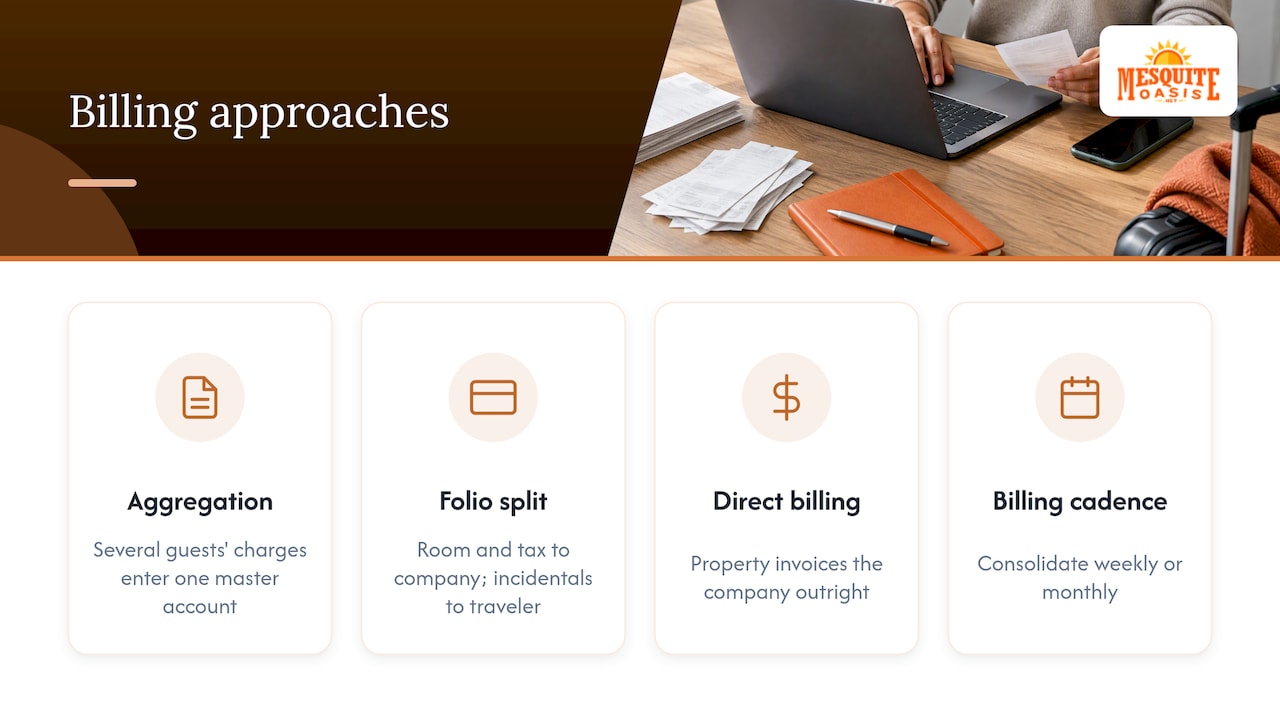
Properties and platforms build these in a few common ways. Single folio aggregation rolls several guests’ charges into one master account. Folio splitting sends room and tax to the company while incidentals go to the traveler’s card. Direct billing lets the property invoice your company outright, and weekly or monthly consolidated billing sets the rhythm.
The line items that should stay visible are the nightly rate, taxes, parking, deposits and incidentals. Itemization matters because auditors and expense systems want the room charge separated from everything else. A lump sum with no breakdown is the fastest way to fail a review.
Why consolidated lodging invoices matter for travel and finance teams
The value shows up in daily finance work. When one statement replaces dozens, your team spends less time matching receipts to travelers and more time on exceptions that need a human.
- Fewer invoices to reconcile: one monthly statement means less manual accounts payable work.
- A single payment stream: one payment replaces many small ones, which lowers processing effort.
- Easier cost allocation: invoices that carry project or job codes and nightly breakdowns let you charge each crew’s housing to the right budget.
- Preserved itemization: folio-level detail supports tax substantiation and audit requests without a scramble.
The benefit is not the bundling itself. It is bundling without losing the detail.
How to implement consolidated invoicing in your travel program
Start with the billing model, then work toward a pilot. Here is a path that works for most programs:
- Choose a model. Pick direct corporate billing, vendor or platform consolidation, or aggregated invoices from a lodging brand, based on how many properties your travelers use.
- Set folio rules with the property. Decide what posts to the corporate account and what stays on the guest’s card, and settle how incidentals are handled before the first stay.
- Agree on cadence and format. Weekly or monthly, PDF alone or with a machine-readable export. Require itemized folios showing nightly rates and taxes.
- Map line items to cost codes. Tie each invoice line to a project, job or department code in your accounting system.
- Pilot before scaling. Run one crew or one site for a full billing cycle, reconcile it, then expand.
Pro Tip: Put the allocation fields, such as project code and PO number, in the booking request itself. Adding them after the invoice arrives is where most reconciliation delays start.
A short, written charge policy also helps both sides stay aligned. This concise travel charge policy shows how compact billing terms can be, and you can borrow its phrasing when you write yours.
Recordkeeping and IRS substantiation: documentation to keep and why
Consolidation does not relax documentation rules. According to the Instructions for Form 2106, business travelers must keep receipts or paid bills for lodging, and the documentation must establish the amount, date, place and essential character of the expense.
In practice, that means keeping:
- The full consolidated invoice plus the underlying folio for each stay.
- Proof of payment tied to the invoice.
- Separate lines for room, tax, parking and incidentals.
- Deposit and final-balance entries recorded separately when they post on different dates, even if one invoice covers both, as shown in this deposit and final charge guidance.
The regulatory backbone is 26 CFR § 1.274-5, which sets the documentary evidence and adequate accounting standards. It treats a hotel receipt as adequate when it includes the name, location, date and separate amounts for lodging and other charges. A consolidated invoice that preserves those fields fits that standard. One that collapses them does not. Store invoices and folios together in a searchable archive so an auditor can find any stay in minutes.
Integrating consolidated invoices with expense systems and accounting workflows
Your expense tool should receive the same detail the invoice carries. Concur-style systems handle this through itemization: you create the lodging expense, attach the receipt and split the nightly room rate and tax into separate lines, as outlined in this lodging itemization guide. Parking and other charges become their own itemizations so every line matches the folio.
- Split charges into lines. Nightly rate, tax and parking each get an expense line.
- Attach the folio to every relevant line. When one invoice covers several charges or transactions, the same document supports each entry.
- Build the right fields. Make sure project or job codes, PO numbers and department codes exist at the invoice level so allocation runs automatically.
- Route incidentals deliberately. Coordinate accounts payable so personal or disputed charges are flagged for traveler payment or chargeback instead of buried in the total.
Some tools also let you enter a deposit as a negative itemization when it appears on the folio, which keeps totals honest.
Practical checklist travel and operations teams can use when requesting consolidated invoices
Bring this list to your next vendor conversation or pilot kickoff:
- Request a sample consolidated invoice that shows nightly itemization, taxes and deposit handling.
- Confirm billing cadence, either weekly or monthly, along with payment terms and delivery formats, ideally PDF plus a machine-readable export.
- Specify the allocation fields you need: project or job code, PO number and traveler name.
- Agree on a dispute and adjustment workflow for incidentals, including who approves corrections and how fast.
- Write the invoice requirements into your housing terms. Our post on procurement clauses for a company housing policy covers the language worth including.
- Pilot with one crew, reconcile every line, then roll out company-wide.
If your crews are on longer assignments, it also helps to understand which contractor lodging types carry hidden fees before you choose a billing model.
Why we think itemized monthly billing beats bundled lump sums
We see the same mistake often: teams chase a single payment and give up the detail that makes the payment defensible. Our view is that a consolidated invoice is only as good as its line items. For crews on long assignments, we handle online applications and consolidated monthly billing for block bookings. Because our rates are all-inclusive and guests pay online at any hour, the invoice stays simple. Our rates and fees page lists what can appear on a statement.
How we can serve as your consolidated-billing partner for workforce housing
We offer furnished lodge rooms and full-hookup RV sites in Odessa, with online application and payment, and we support consolidated invoicing for company bookings.

- Furnished lodge rooms and RV sites for crews on long assignments
- Online application and payment, available at any time
- Consolidated monthly invoices for block bookings
Procurement teams can review our workforce housing options.
FAQ
What does consolidated invoice mean?
A consolidated invoice combines charges from several stays or transactions into one statement. It is issued for a set billing period. Itemized lines usually remain so each charge can still be traced.
What does lodging mean in expenses?
Lodging is the cost of overnight accommodation during business travel, such as hotel or extended-stay rooms. IRS guidance notes there is no optional standard lodging amount, so the actual cost is substantiated. Room rate, taxes and incidentals are typically recorded separately.
What does consolidated billing mean?
Consolidated billing means a provider groups multiple charges or accounts into one bill and one payment. For lodging, that often covers several guests or properties over a week or month. It simplifies payment while folio detail supports allocation.
How do I record a deposit and final charge on one invoice?
Record the deposit and the final balance as separate expense lines when they post on different dates. The same invoice can be attached to both entries, as described in the expense guidance linked above. This keeps each line matched to its payment.
Sources
- Instructions for Form 2106 (2025) | Internal Revenue Service
- 26 CFR § 1.274-5 - Substantiation requirements. | Electronic Code of Federal Regulations (e-CFR) | US Law | LII / Legal Information Institute
- Itemizing Lodging Expenses
- EXPENSE REPORT: HOTEL/LODGIN ITEMIZATION – Deposit and Final Charge on One Invoice