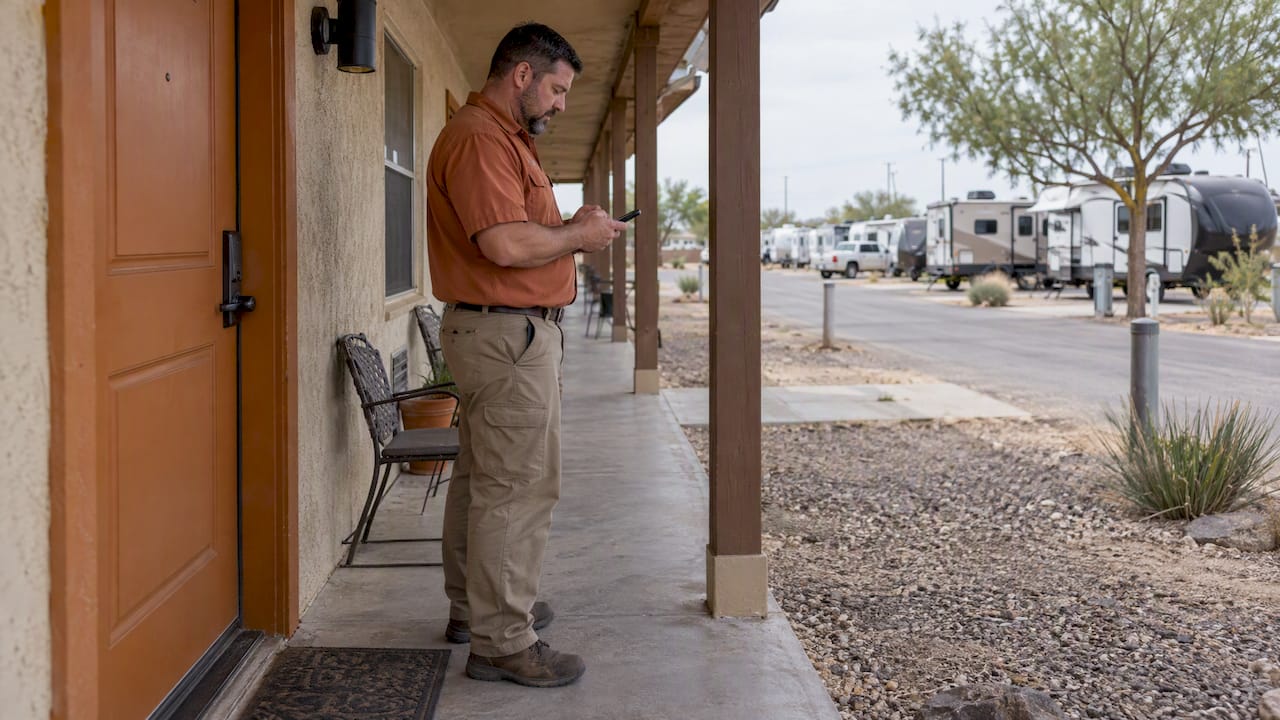
The best practical workforce housing options for crews on assignment are full-hookup RV sites and furnished lodge rooms, both of which handle multi-week stays better than hotels once you factor in kitchen access, laundry, and parking for trucks or trailers. Secure block bookings 30 to 60 days before deployment, since local inventory in industrial markets fills up fast. Budget above the federal per diem rate, since remote and oilfield ZIP codes often run higher than the baseline.
TL;DR:
- Crews with RVs or trailers can use full hookup sites; workers without rigs need furnished lodge rooms, while hotels suit rotations or a few supervisors.
- For extended stays, verify that kitchens include a stove and refrigerator, then prioritize on site laundry, PIN access, reliable WiFi, and separated sleeping areas.
- For crews of ten or more, assign one housing coordinator, reserve a roster buffer, confirm amendment terms, and request consolidated monthly invoicing.
- OSHA generally treats travel from temporary lodging to a fixed job site as ordinary commuting, but required housing or transport can change recordkeeping treatment.
Table of Contents
- 1. What are the realistic lodging options for extended crew stays?
- 2. How should companies budget beyond the federal per diem rate?
- 3. What OSHA rules apply to employer-provided crew housing?
- 4. What amenities actually matter for multi-week crew stays?
- 5. How far ahead should companies book crew housing?
- 6. Does Mesquite Oasis match the crew housing checklist?
- 7. What should companies know about long-term guest policies?
- 8. How do RV sites, lodge rooms, and hotels compare for different crews?
- 9. How can companies coordinate housing for large crews?
- 10. What security and access control features matter for workforce housing?
- 11. What do crews on assignment actually need to stay functional?
- How to book Mesquite Oasis for your crew’s next assignment
- FAQ
- Sources
1. What are the realistic lodging options for extended crew stays?
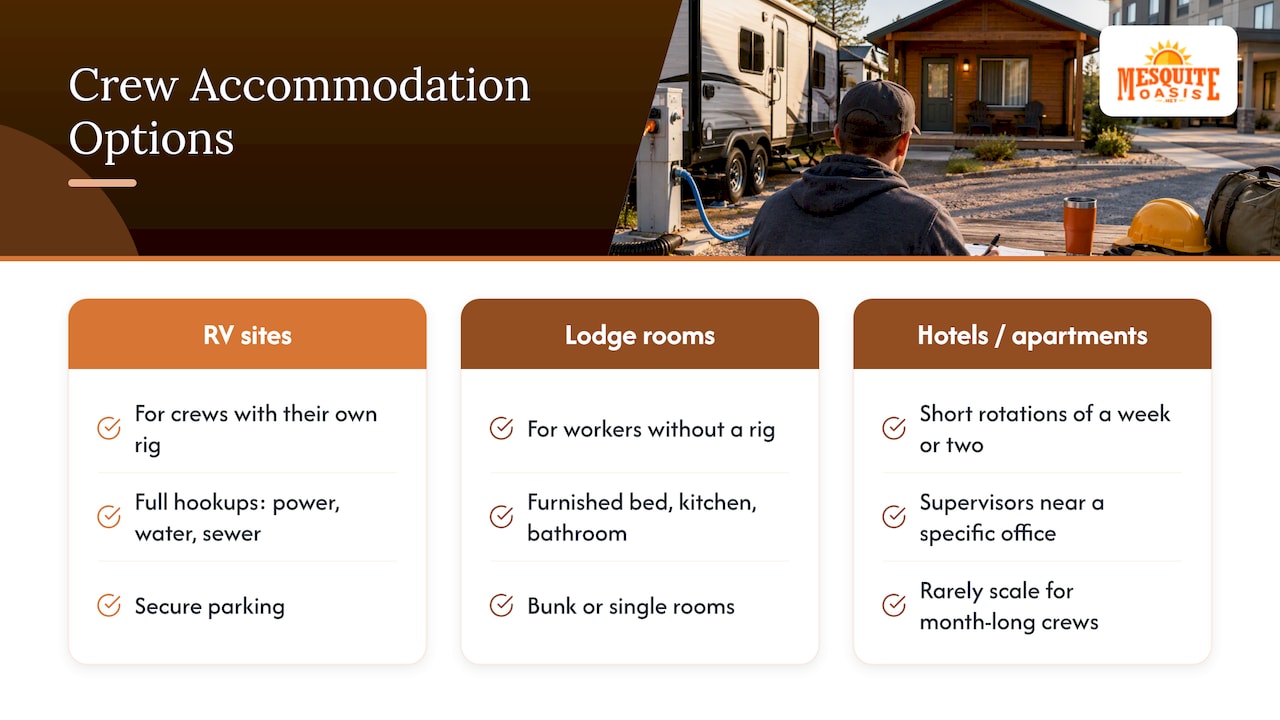
Crews on multi-week assignments generally choose between three categories, and each one fits a different job length and crew size.
- Full-hookup RV sites give crews power, water, and sewer connections plus access to on-site laundry, showers, and recreation areas, making them a strong fit for crews with their own rigs or trailers.
- Furnished lodge rooms come as single rooms or bunk-style setups with utilities included and private or shared bathrooms, suited to workers who need a turnkey room without hauling equipment.
- Extended-stay hotels or corporate apartments can work for short rotations or when a company needs a handful of rooms near a city center, but costs climb fast and inventory thins out in oilfield or industrial corridors.
This article focuses on extended-stay lodging for crews, not AMI-based affordable housing programs for residents, which is a separate subject entirely. For a side-by-side look at how assignment length should drive the choice between a hotel, apartment, or lodge and RV setup, our planning guide breaks down the trade-offs by stay duration.
2. How should companies budget beyond the federal per diem rate?
The FY2026 GSA CONUS per diem rate serves as a baseline for federal travel reimbursements, covering lodging and meals and incidental expenses, according to the GSA’s FY2026 per diem release. That figure works as a federal travel baseline, not a guarantee of what a room costs in a tight industrial market.
Local inventory scarcity is the real driver of lodging cost in oilfield and remote regions. When a handful of properties serve hundreds of incoming crew members, nightly rates climb well past the standard lodging allowance, and procurement teams that budget strictly to the per diem rate often get caught short when it is time to book. A useful planning exercise: if the GSA lodging baseline allows $110 a night, but the nearest extended-stay inventory in a busy drilling region runs closer to $150 to $180 a night once demand spikes, a company housing 20 workers for a month would need to budget several thousand dollars more than the per diem math alone suggests. Building a contingency margin into the housing line item, rather than treating per diem as a hard ceiling, keeps a project from scrambling for rooms at the last minute. Our per diem versus company housing comparison walks through this math in more detail for Permian Basin assignments.
3. What OSHA rules apply to employer-provided crew housing?
OSHA’s recordkeeping guidance treats a worker’s temporary residence as a “home away from home” once they check in, meaning the commute between that residence and a fixed job site is generally treated like a normal commute rather than work-related travel, according to OSHA’s standard interpretation on travel status. That changes, however, when housing is required as a condition of employment or when the employer mandates a specific mode of transportation.
- Housing or transport that a company requires as a condition of employment generally remains work-related for recordkeeping purposes, a point also addressed in OSHA’s guidance on employer-furnished accommodations.
- A required company bus or shuttle can shift otherwise normal commuting into work-related travel.
- Companies should put housing acceptance terms and transport policies in writing and loop in safety managers early, which our crew housing OSHA checklist covers in practical terms.
4. What amenities actually matter for multi-week crew stays?
Not every amenity carries equal weight for crews living on-site for weeks at a time. Prioritize these in order:
- A true kitchen with a stove and refrigerator, since a microwave-only kitchenette pushes crews toward expensive takeout and erodes per diem budgets fast.
- On-site laundry so crews are not hunting for a laundromat after a twelve-hour shift.
- Secure, PIN-controlled access to the property and common areas.
- Reliable WiFi, since crews rely on it for shift scheduling, family calls, and downtime; our WiFi performance guide for RV parks outlines realistic speed expectations for extended-stay properties.
- Dedicated parking for trucks and trailers, plus pet areas for crews traveling with animals.
- Clear separation between sleeping areas and social or work spaces, along with quiet-hour policies that support recovery.
- Gym or recreation access to help workers unwind between shifts.
- A 24/7 online booking and access system rather than office hours that do not match shift schedules.
Pro Tip: Ask every property directly whether the “kitchen” includes a full-size stove and fridge, since a microwave and mini-fridge billed as a kitchenette can quietly wreck a crew’s food budget over a month.
5. How far ahead should companies book crew housing?
Booking 30 to 60 days ahead is the practical window for securing crew lodging in a busy industrial market, since inventory in these corridors tends to book out well before a project’s start date.
- Block bookings lock in guaranteed inventory and typically allow more flexibility for amendments than booking rooms one at a time as crew rosters shift.
- Compare deposit requirements, cancellation terms, and amendment policies before committing, since crew rotations change and a property with rigid terms can cost more in the long run.
- Ask about consolidated monthly invoicing so one bill covers the whole crew instead of dozens of individual folios.
- Request an online registration process and individually assigned PIN codes so each worker has secure access without the property needing to issue physical keys.
Our guide to booking an RV site online and our guide to the 30 to 60 day booking window both cover the staging and inventory issues that make early booking worthwhile.
6. Does Mesquite Oasis match the crew housing checklist?
Mesquite Oasis Lodge & RV Park in Odessa, Texas, lines up closely with the checklist above: 241 full-hookup RV sites and 110 furnished lodge rooms, both bookable and payable entirely online, without needing to call an office during business hours.
- Full-hookup RV sites and furnished single or bunk lodge rooms cover the two primary lodging types commonly used by crews.
- Amenities include laundry facilities, a gym, recreational areas, pet-friendly zones, and community spaces, some accessed through a personal PIN code.
- Companies can request block bookings, consolidated monthly invoicing, and online registration for crews, which can help with payroll and per diem reconciliation.
| Checklist item | How it is addressed |
|---|---|
| Full kitchen access | Furnished lodge rooms and RV hookups support real cooking, not just microwave setups |
| Secure access | PIN-controlled entry to the property and amenities |
| Booking process | Online application, payment, and management, available 24/7 |
| Company billing | Consolidated monthly invoicing for crew housing |
7. What should companies know about long-term guest policies?
Long-term workforce stays run differently than a one-night hotel booking, and the terms reflect that. Expect a written agreement covering the length of stay, renewal terms for extending a booking as a project runs longer than planned, and the process for adding or swapping crew members on an existing reservation.
Pet policies matter for crews traveling with animals, and a published pet fee is standard practice at extended-stay properties rather than a surprise added at check-in. Late payment terms are also worth confirming upfront, since a company managing housing for a dozen or more workers wants to know exactly how billing cycles and late charges work before the first invoice arrives. Our own rates and policies page lays out pet fees and late payment charges clearly so there are no surprises mid-assignment.
Cancellation and amendment terms deserve the same scrutiny as price. Crew rosters shift: a worker gets reassigned, a project timeline slips, or a crew needs an extra room added mid-month. A property with workable amendment terms saves a housing coordinator from renegotiating every time a schedule changes, while a rigid one can turn a minor roster change into a logistical headache. Reviewing the terms and conditions and cancellation and park policies before signing a block agreement avoids most of these friction points.
8. How do RV sites, lodge rooms, and hotels compare for different crews?
The right accommodation depends on what the crew is hauling, how long the assignment runs, and how many people need housing at once.
Crews traveling with their own RV or trailer get the most value from a full-hookup site, since they already have living space and just need power, water, sewer, and secure parking. Workers without their own rig do better in a furnished lodge room, where the bed, kitchen access, and bathroom are already set up. Bunk-style lodge rooms suit crews on a tighter budget or companies housing junior workers who do not mind sharing a room, while single rooms fit workers who want privacy after a long shift.
Extended-stay hotels or corporate apartments can work for a short rotation of a week or two, or for a handful of supervisors who need to be near a specific office rather than a job site, but they rarely scale well for a full crew over a month or more. Our comparison of short-term rental platforms versus extended-stay lodging digs into why platforms built for travelers often fall short on the practical needs of a working crew, from kitchen access to monthly billing.
9. How can companies coordinate housing for large crews?
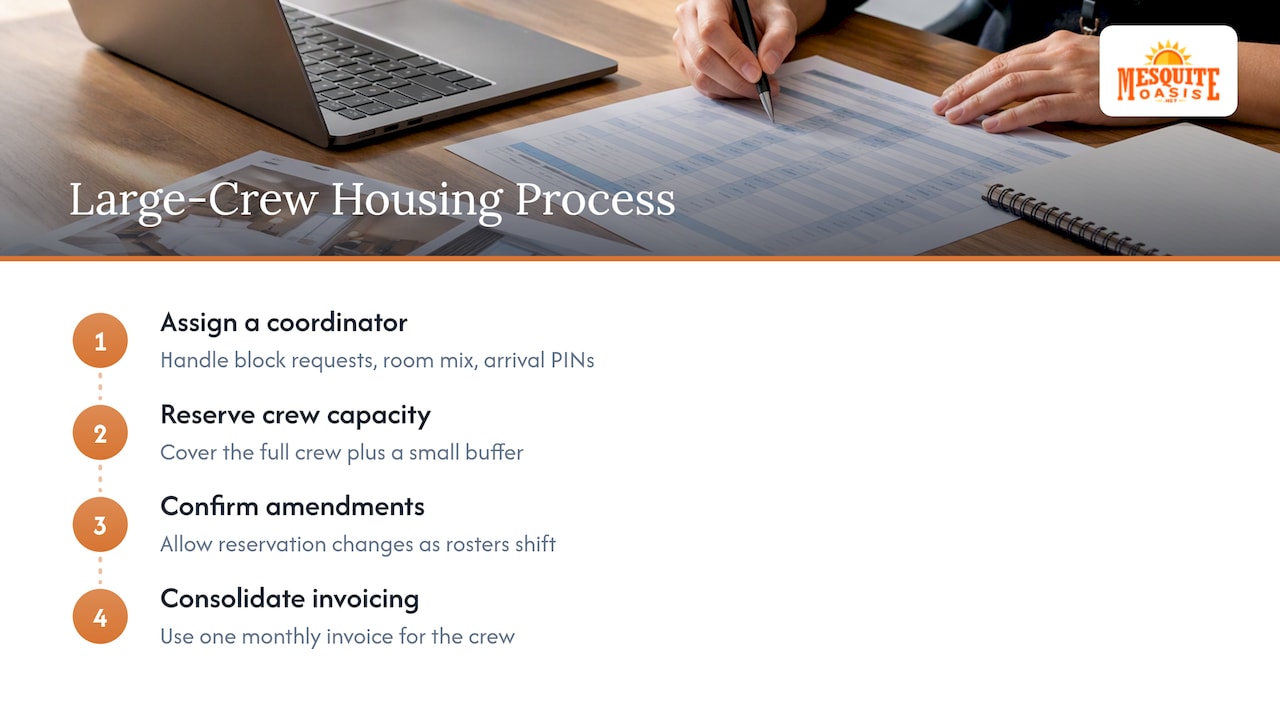
Housing ten or more workers at once requires a different process than booking individual rooms one at a time. Start with a single point of contact, usually a company housing coordinator, who handles the block booking request, confirms the mix of RV sites and lodge rooms needed, and manages PIN-code distribution once the crew arrives.
Request a block of rooms or sites large enough to cover the full crew plus a small buffer, since crew rosters shift and a short-notice replacement worker should not trigger an emergency booking scramble. Ask the property whether block reservations can be amended as the roster changes, since a crew of 15 rarely stays exactly 15 people for an entire assignment. Consolidated monthly invoicing is the other piece that matters for group bookings: one invoice covering the whole crew is far easier for payroll and per diem reconciliation than dozens of separate folios. Our online registration system is built to handle this kind of group booking without phone calls back and forth.
10. What security and access control features matter for workforce housing?
Crews living on-site for weeks at a time need more than a locked front door. Personal PIN-code access is the standard that matters most: it lets each worker move between their room or RV site and shared amenities like laundry, the gym, and recreational areas without a shared key that can be lost or duplicated.
A gated property adds another layer of control over who comes and goes, which matters for crews working odd hours and returning to the property late at night or early in the morning. Pet areas with their own access controls keep shared outdoor space manageable for a property housing dozens of workers at once. Combined with 24/7 online management for bookings and payments, PIN-controlled access means a crew housing coordinator does not need to coordinate key handoffs or office hours to get workers checked in and settled. Our amenities page details exactly how PIN access works across the property.
11. What do crews on assignment actually need to stay functional?
Booking windows matter more than most project managers expect going in.
Transportation policy deserves a second look too. Making transport voluntary where possible, or at minimum documenting the policy clearly, keeps the OSHA recordkeeping picture cleaner and avoids ambiguity about whether a commute counts as work travel.
Fatigue is the quiet variable that gets overlooked. A crew member who cannot cook a real meal or get a quiet room to sleep in loses recovery time that shows up later as safety and performance risk. Prioritizing a property with a full kitchen and separated sleep spaces does more for a crew’s long-term output than almost any other single decision in the housing plan.
How to book Mesquite Oasis for your crew’s next assignment
We built Mesquite Oasis around the exact gaps crews run into elsewhere: real kitchens, PIN-secured access, and a booking process you finish online in minutes instead of chasing an office by phone. Check availability on our RV sites or lodge rooms, or head straight to our workforce housing page to request a block booking for your crew.

- RV sites: 50 Amp and 30 Amp full-hookup options, billed weekly or monthly.
- Lodge rooms: single rooms and bunk bedrooms, utilities included.
- Billing: online payment or consolidated monthly invoicing for company accounts.
Companies arranging housing for a crew should also weigh workers’ compensation coverage for mobile teams; our partner at DiamondBack Insurance offers instant online quotes built for staffing and transportation companies.
FAQ
What is the difference between full-hookup RV sites and lodge rooms?
Full-hookup RV sites provide power, water, and sewer connections for a crew’s own RV or trailer, while furnished lodge rooms are move-in-ready single or bunk rooms with utilities already included. The right choice depends on whether the crew already has a rig or needs a fully furnished room.
How far in advance should a company book crew housing?
Booking 30 to 60 days before a crew’s start date is the practical window, since inventory in busy industrial markets fills up quickly. Building in a small buffer beyond the exact headcount helps absorb last-minute roster changes without an emergency booking.
Does employer-provided housing count as work time under OSHA rules?
Generally, OSHA treats a worker’s temporary residence as a “home away from home,” meaning travel between that residence and a fixed job site is treated like a normal commute, according to OSHA’s standard interpretation. Housing or transportation required as a condition of employment can remain work-related for recordkeeping purposes.
How much should companies budget for crew housing beyond per diem?
The FY2026 GSA CONUS per diem baseline serves as a federal travel reimbursement reference, covering lodging and meals and incidental expenses, per the GSA’s FY2026 release. Remote or industrial markets with limited inventory often run above that baseline, so a contingency margin in the housing budget avoids last-minute shortfalls.
What amenities should companies prioritize when choosing crew housing?
A full kitchen with a stove and refrigerator, on-site laundry, secure PIN-controlled access, and reliable WiFi top the list for multi-week crew stays. Separated sleeping and social spaces, plus dedicated parking for trucks and trailers, round out the amenities that matter most for crew recovery and daily logistics.
Sources
- GSA releases FY2026 CONUS per diem rates for federal travelers
- Determining work-relatedness for injuries while on travel status | Occupational Safety and Health Administration


