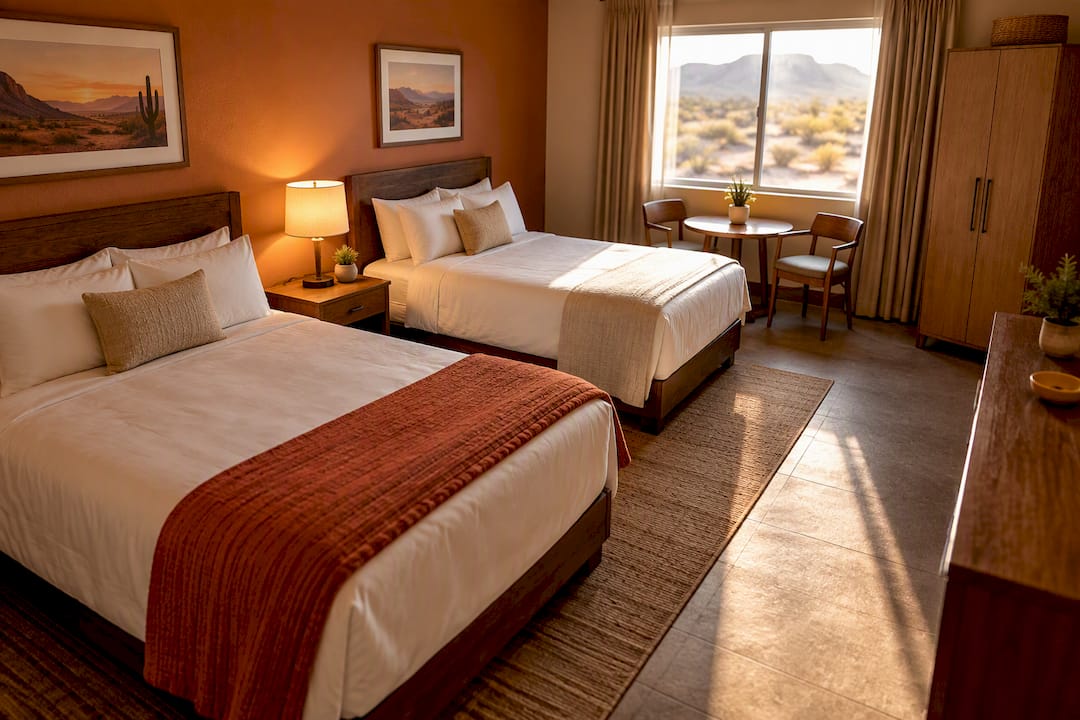
The fastest way to cut crew downtime is simple: write a one-page housing brief, verify OSHA and ADA compliance before you book anything, then lock a flexible block booking with clear reduction terms. Crew housing planning that skips the regulatory check first almost always costs more later, whether that’s a fine, a mid-project scramble for beds, or a crew that quits over bad sleeping conditions. Mesquite Oasis Lodge & RV Park in Odessa is one example of a workforce housing option built around exactly this sequence.
TL;DR:
- Ensuring crew housing complies with OSHA 1910.142 requires a detailed housing brief covering occupancy patterns, special needs, and transportation constraints before booking.
- Mobile units, including RVs and modular camps, must meet the same OSHA standards as fixed structures, with inspection certificates and floor plans requested upfront.
- The best housing options depend on crew size and project duration, with flexible, online-managed bookings and clear service terms preferred for efficiency and compliance.
- Budgeting should account for utilities, transport, meals, and administrative costs, with lead times of several weeks and contingency buffers essential for planning.
- A flexible, online booking system like Mesquite Oasis offers self-contained units and consolidated invoicing, reducing scheduling complexity and ensuring regulatory and safety standards are met.
Table of Contents
- What Goes Into Crew Housing Planning First?
- What Do OSHA and ADA Require for Crew Housing?
- Which Crew Housing Options Fit Your Project?
- How Do You Budget and Schedule Crew Housing?
- How Should You Structure Contracts and Payments?
- How Do You Manage Crew Housing Day to Day?
- How Mesquite Oasis Maps to the Crew Housing Checklist
- Why Crew Wellbeing Protects the Schedule
- Reserve Block Housing at Mesquite Oasis
- Primary Regulations and Guidance to Consult
- Sources
- FAQ
What Goes Into Crew Housing Planning First?
Before you call a single vendor, you need a document that answers every question a housing provider will ask. Construction crew lodging deals fall apart when project managers show up with a headcount and nothing else. Suppliers need occupancy patterns, not guesses.
Start with these data points:
- Total headcount, plus peak versus average night counts across the project timeline
- Occupancy mix: singles, doubles, bunk arrangements, and any family units
- Shift patterns and how they affect quiet hours, meal timing, and shuttle scheduling
- Transport constraints, including distance tolerance from the jobsite
- Special requirements: ADA access, medical equipment, dietary restrictions, pet allowances
Turn this into a one-page brief with four columns: dates, headcount, unit type, and special needs. That single sheet becomes your negotiating tool and your compliance checklist rolled into one.
- List every crew rotation with start and end dates.
- Note occupancy mix per rotation.
- Flag special needs per person, not per crew.
- Attach it to every vendor inquiry you send.
Pro Tip: Build the brief in a shared spreadsheet, not a static PDF. Rotations shift constantly, and a live document saves you from resending corrected versions to five vendors at once.
What Do OSHA and ADA Require for Crew Housing?
OSHA 1910.142 sets the sanitation and space floor for temporary labor camps, and it applies whether the housing is a fixed structure or a trailer. The standard requires 50 square feet per occupant in sleeping rooms, or 100 square feet per person when a unit is used for cooking, living, and sleeping combined. It also sets minimum ratios for toilets, showers, and laundry facilities, and requires 35 gallons of water per person per day.
Here’s where a lot of project managers get tripped up: mobility does not lower the bar. OSHA’s own interpretation on mobile housing units confirms that RVs and modular units must meet the same 1910.142 minimums as any fixed camp, and the agency treats an entire mobile unit as one room for enforcement purposes. Don’t assume a compact RV lets you squeeze in an extra bunk.
Before signing anything, request:
- Floor plans showing square footage per sleeping room
- A written sanitation and cleaning schedule
- Documented water supply capacity
- Recent inspection certificates
- Confirmation of accessible routes, and toilet/shower access for ADA compliance
If crews cook on-site in shared kitchens, check that stove-to-person ratios and food-prep sanitation meet the same standard.
Which Crew Housing Options Fit Your Project?
Workforce housing strategy usually comes down to five formats, each suited to different crew sizes and durations.
Hotel blocks work for short assignments or when a platform like Engine Groups negotiates group rates and handles rooming lists on your behalf. Corporate housing providers, such as those offering mixed studio and multi-bed inventories through platforms like Roadmap Lodging, suit mid-length projects that need consolidated invoicing. Crew houses fit smaller teams needing a home base with shared common areas. RV parks and lodge combinations suit long assignments where kitchen access and self-contained sites cut daily meal costs. Modular camps make sense for remote sites with no nearby lodging inventory.
Score each option against your brief using this checklist:
- Occupancy fit against your headcount and mix
- Secure storage for tools or personal gear
- Meal provisioning: shared kitchens, on-site dining, or none
- Transport time to the jobsite
- Security controls, including access systems
- Billing terms and cleaning cadence
Whichever option scores highest, request a site visit or full documentation before committing block dates.
How Do You Budget and Schedule Crew Housing?
Nightly rate is the smallest line item most project managers underestimate. Total cost includes transport, meals, utilities, administrative time, and incidentals that rarely show up in a vendor’s headline price.
Build your budget around these categories:
- Nightly or monthly housing rate per unit type
- Transport: shuttle service or mileage reimbursement
- Meals, whether catered or self-prepared
- Utilities, if not bundled into the room rate
- Administrative hours spent managing rooming lists and invoices
- Incidentals: damage deposits, pet fees, late charges
Lead times matter as much as line items. Block bookings for temporary housing for crew typically need several weeks of notice, and you should build in a contingency buffer for schedule slips, since project timelines rarely hold exactly as planned.
Turnover procedures deserve their own checklist:
- Assign one person to manage keys, linens, and PPE inventory at each rotation
- Confirm check-out and check-in overlap windows with the housing provider
- Reconcile asset counts before releasing a departing crew’s rooms
Pro Tip: Push for consolidated monthly invoicing tied to a single PO number. It turns a stack of individual receipts into one document your finance team can reconcile in minutes instead of hours.
How Should You Structure Contracts and Payments?
Crew lodging for contractors runs into trouble most often at the contract stage, not the booking stage. A block reservation with no flexibility clause becomes a liability the moment a schedule shifts.
Ask for these terms in writing before you sign:
- Flexible block sizes with defined windows for short-notice reductions
- Clear penalty or credit structure if headcount drops
- Cancellation windows stated in days, not vague language
- A signed rooming list before arrival
- Proof of sanitation inspection reports and current insurance certificates
- A deposit policy that matches your project’s cash flow timing
Negotiate schedule-change credits or holdbacks up front rather than after a delay happens. Providers are far more willing to build in flexibility during the initial contract conversation than after a crew has already checked in.
How Do You Manage Crew Housing Day to Day?
Once crews arrive, daily operations decide whether the housing plan holds up. Check-in should run off the rooming list you built during contracting, with access control assigned by PIN code or keycard rather than shared keys.
Set clear cadences for:
- Cleaning schedules and laundry access hours
- Maintenance request workflow, with a named point of contact
- Quiet hours that respect overlapping shift patterns
- WiFi reliability and secure storage for crew belongings
Designate an on-call manager and post the nearest medical facility at check-in. Document every incident, no matter how minor, since that record protects both the crew and the project if a dispute comes up later.
Pro Tip: A five-minute orientation walkthrough on arrival day, covering laundry hours, quiet hours, and the maintenance request process, prevents most of the complaints that otherwise land on your desk in week two.
How Mesquite Oasis Maps to the Crew Housing Checklist
A local RV park and lodge in Odessa combines self-contained and indoor accommodations under one roof. Applications, payments, and bookings may be handled online, aiming to offer flexibility for coordinators managing multiple rotations.
Here’s how the property lines up against the checklist covered above:
- Laundry facilities and a gym are among the amenities that can affect crew retention on long assignments
- Access controls with PIN codes can be used for security and convenience in day-to-day management
- Block booking and consolidated invoicing may be offered to simplify reconciliation for companies housing multiple crews
Before booking, request floor plans and sanitation schedules through the apply page the same way you would with any other vendor, and confirm consolidated invoicing terms up front.
Why Crew Wellbeing Protects the Schedule
Every disruption on a project, from a missed shift to a resignation mid-rotation, traces back to something upstream. Housing that meets regulatory minimums and treats crew comfort as a planning input, not an afterthought, prevents more schedule slippage than any recovery plan built after the fact. Planning discipline here is cheaper than the alternative.
Reserve Block Housing at Mesquite Oasis
Most crew lodging options force a coordinator to choose between flexibility and simplicity: a hotel block requires constant rooming-list updates, while a modular camp locks you into fixed capacity for the full project. Mesquite Oasis skips both problems. Every application, payment, and stay adjustment happens online, 24/7, with no phone calls required to add a room or extend a rotation.

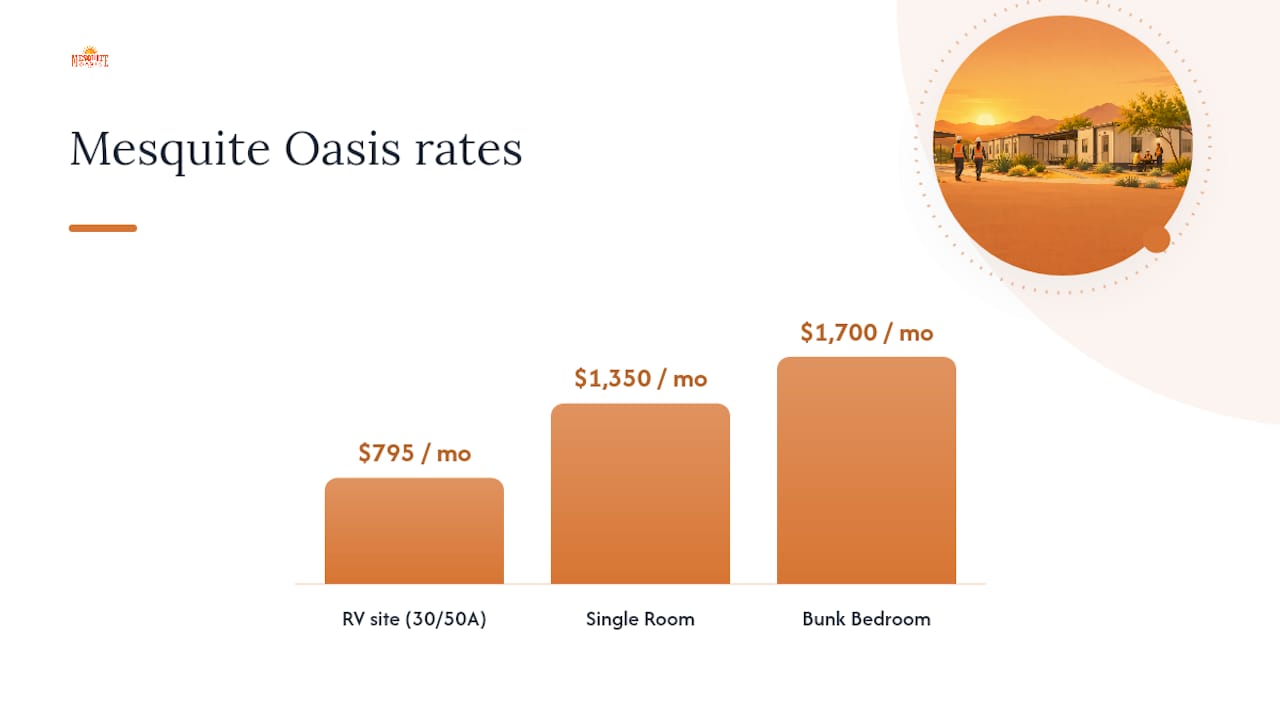
For crews needing self-contained units, the RV sites run $300 per week or $795 per month for a 50 amp or 30 amp hookup. Crews preferring indoor lodging can book a Single Room at $400 per week or $1,350 per month, or a Bunk Bedroom at $550 per week or $1,700 per month. All units include utilities, WiFi, and PIN-secured access to laundry, gym, and recreation areas. Pet owners should check the rates page for the applicable pet fee before arrival.
To secure a block reservation, submit your housing brief through the apply page, request sanitation documentation, and confirm consolidated monthly invoicing for your crew rotation.
Primary Regulations and Guidance to Consult
Verify these sources directly before finalizing any crew housing contract:
- OSHA 1910.142 for space, sanitation, and water supply minimums at temporary labor camps
- OSHA’s interpretation on mobile housing units confirming RVs and modular units must meet the same standard
- NVIC 02-13 MLC guidance for maritime crew accommodation standards
Sources
- 1910.142 - Temporary labor camps. | Occupational Safety and Health Administration
- All mobile housing units without exception, must comply with the general provisions for 1910.142. | Occupational Safety and Health Administration
FAQ
What Is a Crew House?
A crew house is a shared residential property, typically a house or set of apartments, rented for a work crew to live together during a project or assignment. It differs from hotel blocks in that crews usually share common kitchens and living spaces rather than isolated rooms.
What Are the Three Types of Housing Typically Used for Work Crews?
The three most common formats are hotel blocks, corporate or crew housing with shared units, and self-contained options like RV parks or modular camps. Each fits a different combination of project duration, crew size, and budget, as covered in the housing options section above.
Are There Crew Housing Options in West Odessa or the Permian Basin Area?
Yes. Mesquite Oasis Lodge & RV Park operates in Odessa, Texas, offering full-hookup RV sites and furnished lodge rooms designed for contractors and shift workers in the Permian Basin. Booking, applications, and payments run entirely online through the apply page.
What Are the Crew Requirements for a Yacht or Maritime Vessel?
Maritime crew accommodations fall under Maritime Labour Convention standards, which set minimum requirements for sleeping quarters, recreational space, and catering facilities. The NVIC 02-13 MLC guidance from the U.S. Coast Guard outlines these standards along with inspection recordkeeping requirements.
How Much Does Crew Housing Cost at Mesquite Oasis?
RV sites run $300 per week or $795 per month depending on hookup type, while lodge rooms range from $400 per week for a Single Room up to $1,700 per month for a Bunk Bedroom. Exact current rates and any applicable fees are listed on the rates page.


