
Take employer-arranged housing for long, steady-shift assignments. Take per diem for short or unpredictable work. Housing wins on predictability and beats the region’s tight rental market; per diem wins on flexibility for workers who value autonomy or move often. A facility like Mesquite Oasis in Odessa gives employers a booked-and-ready option rather than a plan that depends on the local rental market cooperating.
TL;DR:
- Employer-arranged housing offers more certainty for long-term assignments due to limited local rental supply and diverging permit activity.
- Per diem provides greater flexibility and control but risks higher costs if regional rents spike or the supply chain is unreliable.
- Accurate cost comparison should include rent, utilities, commute, and tax implications, with housing generally preferred for stays longer than a few weeks.
- Quick booking systems and amenities like laundry and secure access significantly influence operational efficiency and worker retention.
- Using a fixed, written policy for housing versus per diem prevents disputes and ensures compliance with tax and employment regulations.
Table of Contents
- Per Diem vs Housing: Weighing the Tradeoffs
- How to Calculate the True Cost of Each Option
- What Actually Decides the Choice on the Ground
- Setting Up a Per Diem or Housing Policy That Holds Up
- Does Housing or Per Diem Affect Benefits and Insurance?
- Legal and Compliance Rules Employers Need to Know
- How the Permian Basin Compares to Other Housing Markets
- A Local Read on the Housing Decision
- Book Employer Housing Without the Rental Market Guesswork
- Sources
- FAQ
Per Diem vs Housing: Weighing the Tradeoffs
The comparison isn’t cost alone. It’s cost versus certainty, and certainty is worth more in Midland and Odessa than it is almost anywhere else in Texas.
A cash per diem hands the worker control. They pick where to stay, what to eat, and how to spend what’s left over if they find something cheap. That autonomy has a price: in a market where housing demand remains strong and new supply is uneven, a worker with a per diem check can still end up hunting for a room on a Sunday night with nothing available. Employer-arranged housing removes that gamble entirely, because the bed is already reserved.
Here’s how the main tradeoffs typically break down:
- Cost predictability: Housing locks in a known rate for the stay; per diem exposes workers to whatever rents spike to during a hiring surge.
- Flexibility: Per diem lets workers choose neighborhoods, roommates, or move on short notice; housing ties them to one property for the term of the booking.
- Availability risk: With single-family permits diverging across Midland and Odessa, rental inventory doesn’t always keep pace with crew growth, which favors pre-booked housing.
- Privacy and pets: Extended-stay lodge rooms and RV sites with dedicated pet areas beat a shared “man camp” bunk for workers relocating with a dog or family.
- Commute: Housing near the work site cuts drive time; per diem workers sometimes settle for whatever’s affordable, even if it’s 40 minutes out.
- Employer admin: A per diem is a flat line item on payroll. Housing means invoices, occupancy tracking, and vacancy risk if a crew member leaves early.
- Turnover: Reporting on temporary workforce housing shows that employer-paid lodging is common during booms precisely because it keeps crews from quitting over housing stress.
For a six-week callout, per diem usually makes sense. For a six-month assignment with a fixed schedule, housing almost always wins.
How to Calculate the True Cost of Each Option
Numbers settle this argument faster than opinions. Both sides need to run the same math before choosing.
For workers, the honest per diem comparison adds up:
- The daily or weekly stipend amount, before tax withholding
- Realistic room or rental cost in the actual town, not a statewide average
- Commute cost: fuel, mileage, and wear on a personal vehicle
- Meals, since some per diem structures bundle food and some don’t
- Utilities, if the rental doesn’t include them
- Any tax liability, since cash per diem can be treated as taxable income depending on how it’s structured
For employers, the housing-side math is different: nightly or monthly rate per worker, any admin or booking fee, and the vacancy risk if a crew member rotates out early.
Statistic Callout: Reporting from the Permian Basin notes that shift patterns like 10-on/5-off raise the effective cost of short-term consumer rentals, since a worker paying nightly rates for five off days a month often loses money compared to a flat weekly or monthly housing rate.
A quick break-even test: if a worker’s realistic all-in rental cost (rent, utilities, commute fuel) lands within $50 to $100 a week of the per diem amount, housing usually wins because it removes the search risk. If per diem clears the local rental cost by a wide margin and the worker has a stable living situation already, cash wins.
What Actually Decides the Choice on the Ground
Cost math sets the baseline. Day-to-day logistics usually make the final call.
Permian Basin schedules complicate things fast. A worker on 10-on/5-off doesn’t want to sign a full monthly apartment lease for time they’re not even in town, but they also don’t want to pay nightly hotel rates during the ten days they are. That’s the exact gap a full-hookup RV site or a furnished lodge room with utilities included is built to fill.
A few operational factors tend to decide the outcome in practice:
- Commute time and company transport availability change the value of a housing location dramatically.
- Amenities like laundry, a kitchen, and gym access reduce the daily friction that drives worker turnover.
- PIN-secured facility access matters more to crews than most employers expect, especially for workers coming off night shifts alone.
- Booking speed matters when a company needs ten beds filled by Monday, not next month.
Pro Tip: Ask any housing vendor how fast they can confirm a block booking. If the answer involves a phone call and a callback, that’s a bottleneck. A 24/7 online booking and payment system means an employer can lock in rooms at 11 p.m. on a Friday without waiting for an office to open.
Setting Up a Per Diem or Housing Policy That Holds Up
A vague housing or per diem policy causes more disputes than a strict one. Employers need written answers before the first crew member asks.
Set these terms in writing before anyone signs on:
- Eligibility rules: who qualifies for housing versus per diem, and whether workers can choose
- Payment timing: per diem paid with payroll or separately, and on what schedule
- Damage and cleaning responsibility for anyone in employer-arranged housing
- Cancellation and early-departure terms if a worker rotates out before the booking ends
For vendor housing contracts specifically, negotiate guaranteed availability windows so a hiring spike doesn’t leave crews stranded, and ask about consolidated invoicing so one monthly bill covers the whole crew instead of a dozen separate charges. Internally, settle who pays utilities, how meals factor into the housing arrangement, and who fields a dispute if a worker damages a room. Communicating these terms clearly up front, before a crew member’s first night, cuts down on the confusion that drives early quits.
Does Housing or Per Diem Affect Benefits and Insurance?
Cash per diem generally doesn’t touch unemployment eligibility or benefits calculations unless it’s structured as disguised wages, in which case tax authorities can treat it as regular income. Employer-provided housing, by contrast, is usually treated as a non-cash fringe benefit, and whether it counts toward wage calculations depends on how the employer values and reports it.
This matters most for workers near income thresholds for benefit programs. A per diem that gets classified as taxable wages can push someone’s reported income up enough to affect eligibility for certain assistance programs, while properly structured employer-provided lodging often doesn’t count the same way. Insurance eligibility tied to hours worked or wage minimums isn’t usually affected by the housing-versus-per diem choice itself, but payroll classification can shift the numbers on paper.
Employers should get clarity from a payroll or tax professional before assuming either structure is automatically neutral. Misclassifying per diem as a flat non-taxable allowance when it doesn’t meet IRS substantiation requirements is a common, expensive mistake. Workers should ask their employer directly how the per diem is coded on their pay stub, since that answer determines whether it shows up as income for benefit-eligibility purposes down the line.
Legal and Compliance Rules Employers Need to Know
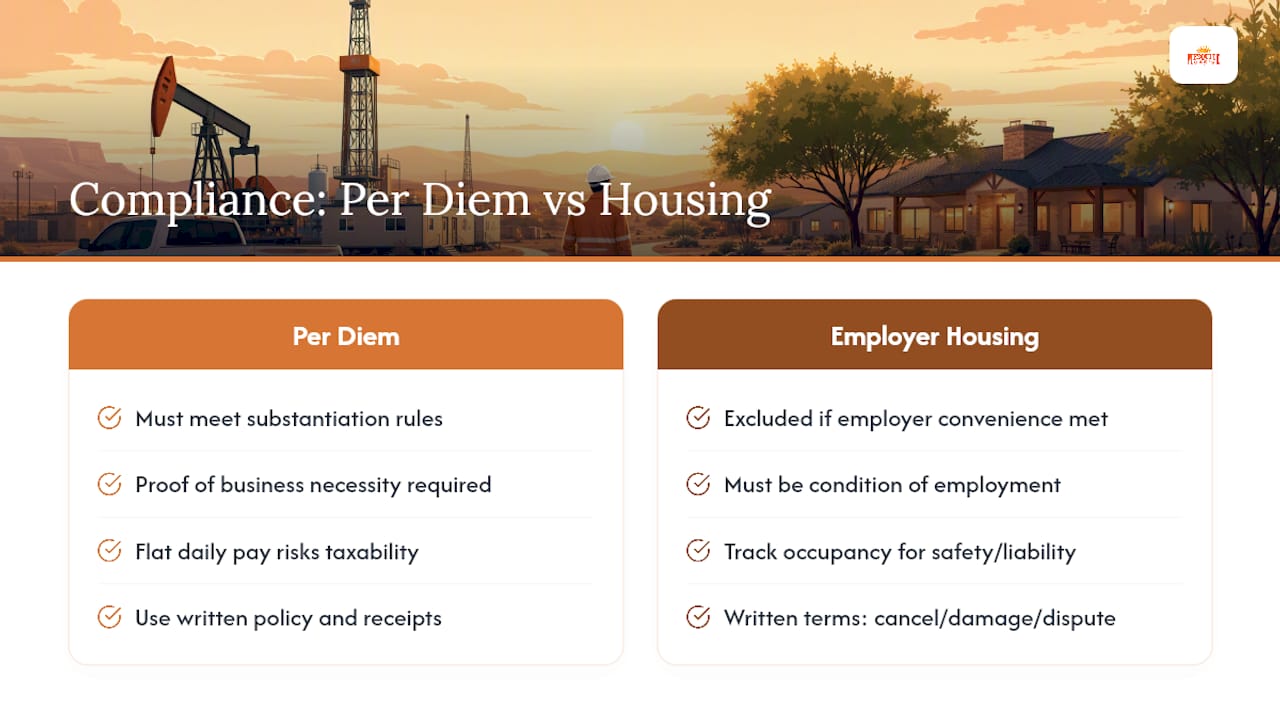
Per diem isn’t automatically tax-free. To qualify as a non-taxable reimbursement rather than wages, it generally has to meet substantiation rules tied to business necessity and reasonable amounts, not just be labeled “per diem” on a pay stub. Employers who hand out a flat daily rate without documentation risk having the IRS treat the whole amount as taxable income, with back taxes and penalties following.
Employer-provided housing carries its own compliance layer. If housing is provided as a condition of employment and for the employer’s convenience, it can often be excluded from taxable wages, but the rules are specific about what qualifies. Employers also need to track occupancy for safety and liability reasons, particularly with RV sites and shared facilities, and should have clear terms and policies on file that cover cancellation, damage, and dispute resolution.
None of this is a substitute for a tax attorney or accountant reviewing a specific policy. But employers who treat per diem as a simple cash handout, or housing as an informal handshake arrangement, are the ones who end up with audit exposure or worker disputes. Written terms, documented eligibility criteria, and a paper trail on payments protect both sides. A basic partner resource on business traveler allowances covers how daily allowances are commonly structured to cover both lodging and meals, which is useful background before drafting an internal policy.
How the Permian Basin Compares to Other Housing Markets
Context helps here. The Permian Basin isn’t the only place where employers weigh per diem against housing, and other boom-and-bust labor markets have run this exact calculation for years.
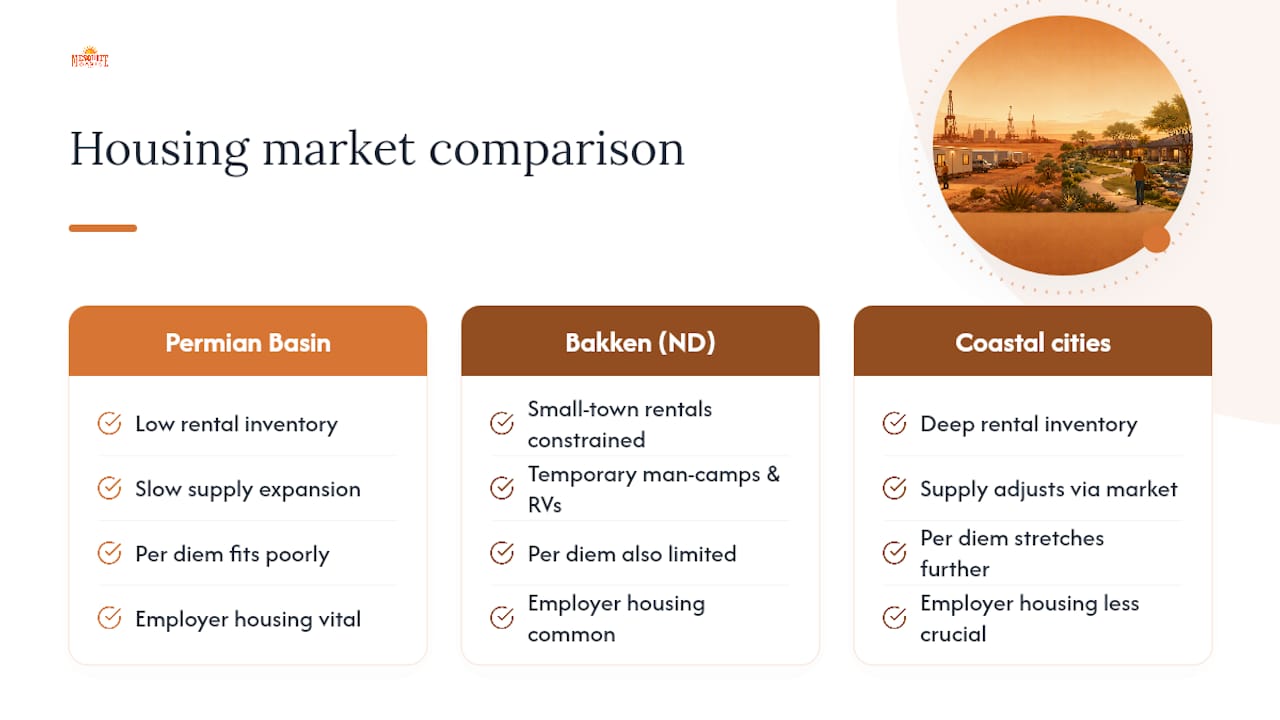
Construction crews on federal contracts elsewhere in the country often work under GSA per diem rate schedules that set a specific lodging and meal allowance by city and county, adjusted annually. Those rates are designed for short-term travel, not the months-long assignments common in oilfield work, which is part of why they translate poorly to Permian Basin conditions. North Dakota’s Bakken region went through a similar squeeze during its own boom, where temporary man-camp housing and RV parks filled the same role Permian Basin facilities fill now, because rental markets in small towns like Williston simply couldn’t absorb thousands of new workers overnight.
Coastal markets tell a different story. In cities with deep rental inventory, a per diem often stretches further because workers have more options and more competition among landlords keeps prices in check. The Permian Basin doesn’t have that luxury. Housing demand tracks energy investment cycles too closely, and uneven permit activity in Midland and Odessa means supply doesn’t expand fast enough to keep pace. That gap is exactly why employer-arranged housing carries more weight here than it would in a market with slack in the rental supply.
A Local Read on the Housing Decision
Predictability wins in this market more often than flexibility does, because a per diem is only as good as the housing it can actually buy, and Permian Basin inventory doesn’t always cooperate. Employers should default to arranging housing whenever an assignment runs longer than a few weeks or the schedule is fixed. Workers should ask themselves four questions before choosing: how long is the assignment, how predictable is the shift rotation, how far is the commute, and does the situation involve a pet or family that needs stability, not just a bed.
Book Employer Housing Without the Rental Market Guesswork
Mesquite Oasis is the alternative to chasing scarce rental listings for crews working the Permian Basin. With 241 full-hookup RV sites and 110 furnished lodge rooms that include utilities, employers get inventory that’s already built for shift work, not a hope that a landlord answers the phone.

Every amenity, from laundry to the gym, is accessible through a personal PIN code, and the entire booking, application, and payment process runs online, 24/7, so there’s no waiting on an office to open. For companies staffing multiple workers, block booking with consolidated monthly invoicing means one bill instead of a dozen separate charges to track. Check current rates and availability and reserve rooms or RV sites before the next hiring push fills the calendar.
Sources
Readers who want the regional data behind this guide should check these directly:
- Housing Demand Remains Strong in the Permian Basin | Permian Basin Builder Association
- Dallasfed
- In The Permian Basin, Oil Field Workers Call ‘Man Camps’ Home | Texas Standard
FAQ
Is Per Diem Taxable Income for Oilfield Workers?
It depends on structure. Per diem that meets IRS substantiation rules for business-related lodging and meals can be non-taxable, but a flat daily cash amount without documentation is often treated as regular taxable wages.
Does Employer-Provided Housing Count as a Taxable Benefit?
Housing provided as a condition of employment and for the employer’s convenience can often be excluded from taxable wages, but the exact rules depend on how the arrangement is structured. Employers should confirm classification with a tax professional before assuming either way.
What Does Mesquite Oasis Charge for a Furnished Lodge Room?
A Single Room runs 400 USD per week or 1350 USD per month, and a Bunk Bedroom runs 550 USD per week or 1700 USD per month, with utilities included in both.
How Much Does an RV Site Cost at Mesquite Oasis?
Both the 30 Amp and 50 Amp full-hookup sites run $300 per week or $795 per month.
Which Option Is Better for a Short, Two-Week Assignment?
Per diem usually fits short assignments better since it avoids locking a worker into a lease or booking they won’t fully use, but if lodging is scarce during a hiring spike, a short-term weekly RV site or lodge room booking can still beat the stress of hunting for a room.


