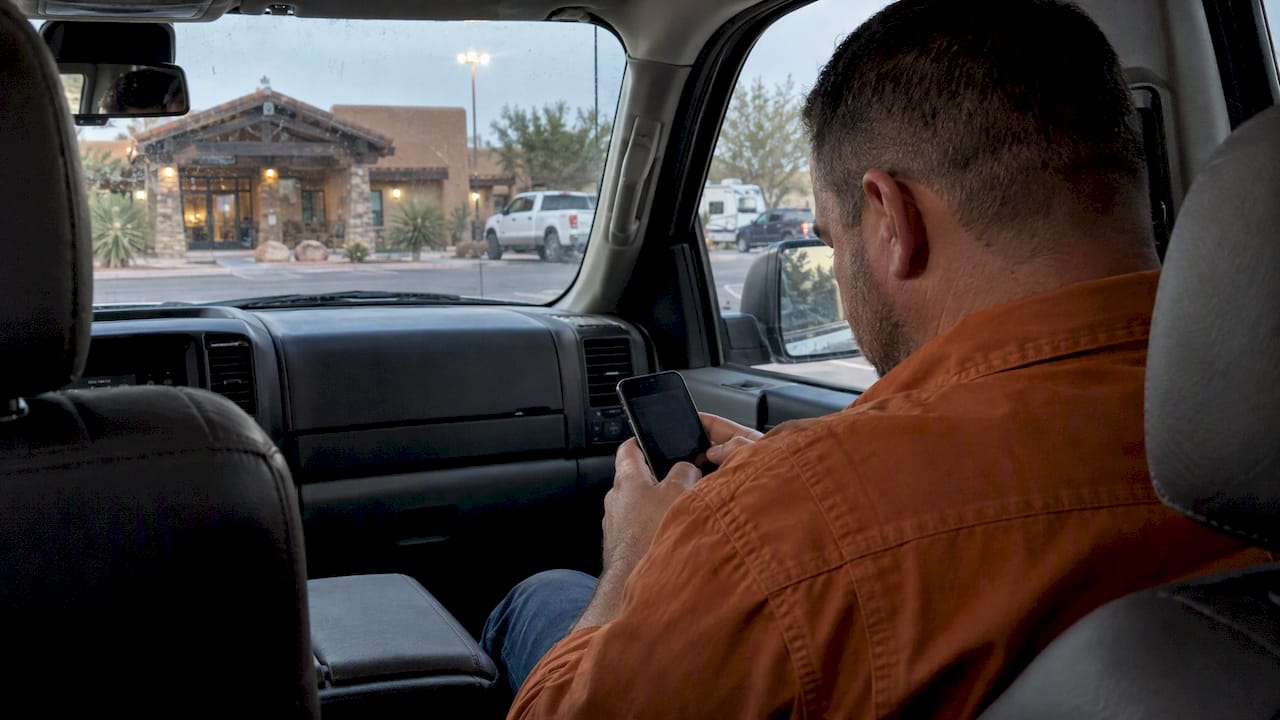
If you’re driving a work truck and need a place to park overnight, your best bets are truck-friendly RV parks and workforce lodges, private fenced truck lots, or hotels with confirmed oversized parking, in that order of reliability. Reserve ahead through the facility’s booking page or a parking app before you commit your route, since national truck parking shortages make first-come spots unpredictable. Workforce-focused properties like Mesquite Oasis, which handle applications and payment entirely online, solve this by letting you lock in a space before you’re on the clock.
TL;DR:
- Before booking, measure your rig’s length, wheelbase, and trailer overhang; confirm access type and request exact site dimensions in writing.
- For stays lasting weeks, check for full hookups, showers, and laundry; choose fenced lots with cameras and gated access when cargo security matters.
- Most truck stops do not take reservations, and public rest areas may limit stays and lack amenities, making both better for short breaks.
- Hotels can accommodate work trucks only if oversized parking is confirmed in writing; ask about length limits, arrival windows, and company billing for crews.
- Book assigned spaces through the facility when possible, use apps to check live route availability, and arrive before early evening, when lots begin filling.
Table of Contents
- Where you can park a work truck overnight
- How to evaluate a lodging site for a work truck
- Planning and booking a guaranteed truck parking spot
- Hours-of-service rules that shape your parking timeline
- What years on the road taught me about finding a spot fast
- Mesquite Oasis: workforce lodging built around your schedule
- FAQ
- Sources
Where you can park a work truck overnight
Not every lot that looks big enough actually works for a loaded work truck, and the gap between “technically legal” and “actually practical” matters once you’ve been driving all day.
- Truck stops: Some now offer reserved spots through apps, but most are still first-come, first-served; they carry showers, food, and fuel, which makes them a solid pick for a quick reset rather than a multi-night stay.
- Public rest areas: These work as a last resort for a short break, since many states cap parking duration and amenities are minimal to none.
- Hotels and lodges: A hotel lot can work if you call ahead and confirm oversized vehicle parking in writing, because plenty of “large lots” are built for pickup trucks, not full rigs.
- RV parks and workforce lodges: Full-hookup sites suit long assignments, with amenities built around drivers who need to actually live somewhere for weeks or months, not just sleep for eight hours.
- Private fenced truck lots: Operations in oilfield regions, including secure lots near Midland and Odessa, offer assigned spaces with cameras and gated access, which beats an open lot when your rig and cargo need real security.
Jason’s Law survey data counts over 300,000 truck parking spaces nationwide, with private truck stops supplying most of that total, but many of those facilities still lack reservation systems or active monitoring. That gap is exactly why assigned-space lodging and fenced private lots have become the more dependable choice for anyone running a predictable schedule.
How to evaluate a lodging site for a work truck
Before you commit to a site, run through a short checklist so you’re not discovering a tight turn radius with a trailer still hooked up.
- Measure your rig first. Confirm your overall length, wheelbase, and any trailer overhang, then check whether the site is pull-through or back-in before you commit.
- Ask about reservations. Find out whether the facility assigns a specific spot or just sells a general pass, since a reserved spot is worth paying extra for during peak season.
- Check security features. Look for fencing, cameras, and PIN-coded access rather than an open, unmonitored lot.
- Confirm reset amenities. Showers, laundry, and a driver lounge matter more over a multi-week stay than they do for one night.
- Review operational details. Ask about length limits, pet fees, arrival windows, and whether the facility can invoice a company directly for crew bookings.
Pro Tip: Call reception and ask for exact site dimensions in writing before you drive two hours out of your way, since “plenty of room” means different things to different front desks.
Our own guide to big rig length limits breaks down the math and gives you a script to use when you call ahead.
Planning and booking a guaranteed truck parking spot
Prebooking beats hoping. Industry reporting on driver planning notes that most drivers still decide where to park while they’re already on the road, but those who reserve ahead at truck-friendly facilities avoid the overcrowding and fit problems that come with winging it.
- Book directly through the facility’s site when one is available, since that’s usually where assigned spots live, not on a third-party listing.
- Use parking apps as a backup, not your primary plan, to check live availability along your route.
- Aim to arrive before early evening, when lots start filling, rather than rolling in at 9 p.m. hoping for the last open space.
- For crews, ask about block bookings and consolidated invoicing upfront, since a facility that can bill one invoice for multiple rooms or sites saves real administrative time.
Reservation apps help, but combining them with direct facility booking works better for crews and extended stays where you need a guaranteed, assigned space rather than a maybe.
Hours-of-service rules that shape your parking timeline
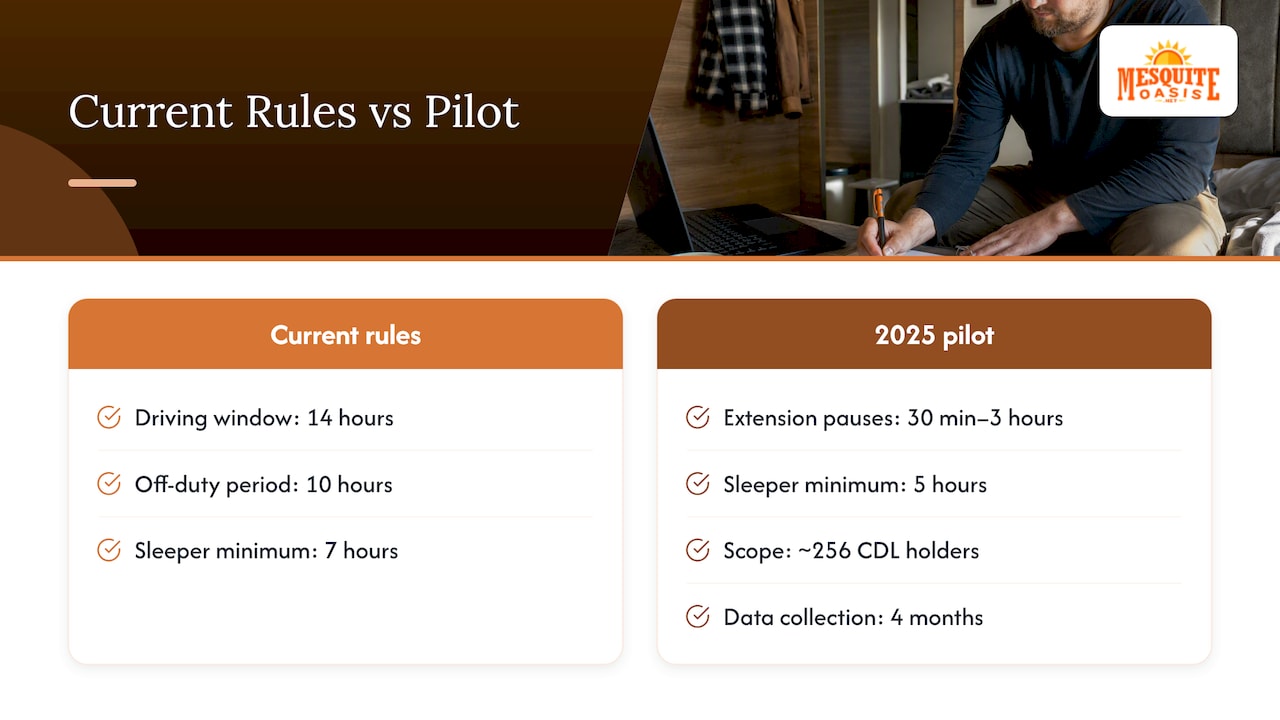
Your 14-hour driving window and required 10-hour off-duty period, under existing federal rules, mean the parking decision isn’t optional once your clock is running down, so plan conservatively rather than betting on finding something at the last minute.
FMCSA proposed a Split Duty and Flexible Sleeper Berth pilot program in 2025 that would let participating drivers take limited pauses of 30 minutes to 3 hours to extend that 14-hour window, and shorten the minimum single sleeper-berth period from 7 to 5 hours. The pilot covers roughly 256 CDL holders over a 4-month data-collection period, with eligibility rules for both drivers and carriers. It’s a narrow program, not a general rule change, so most drivers should keep planning parking and rest the way they always have: find your spot well before your window closes.
What years on the road taught me about finding a spot fast
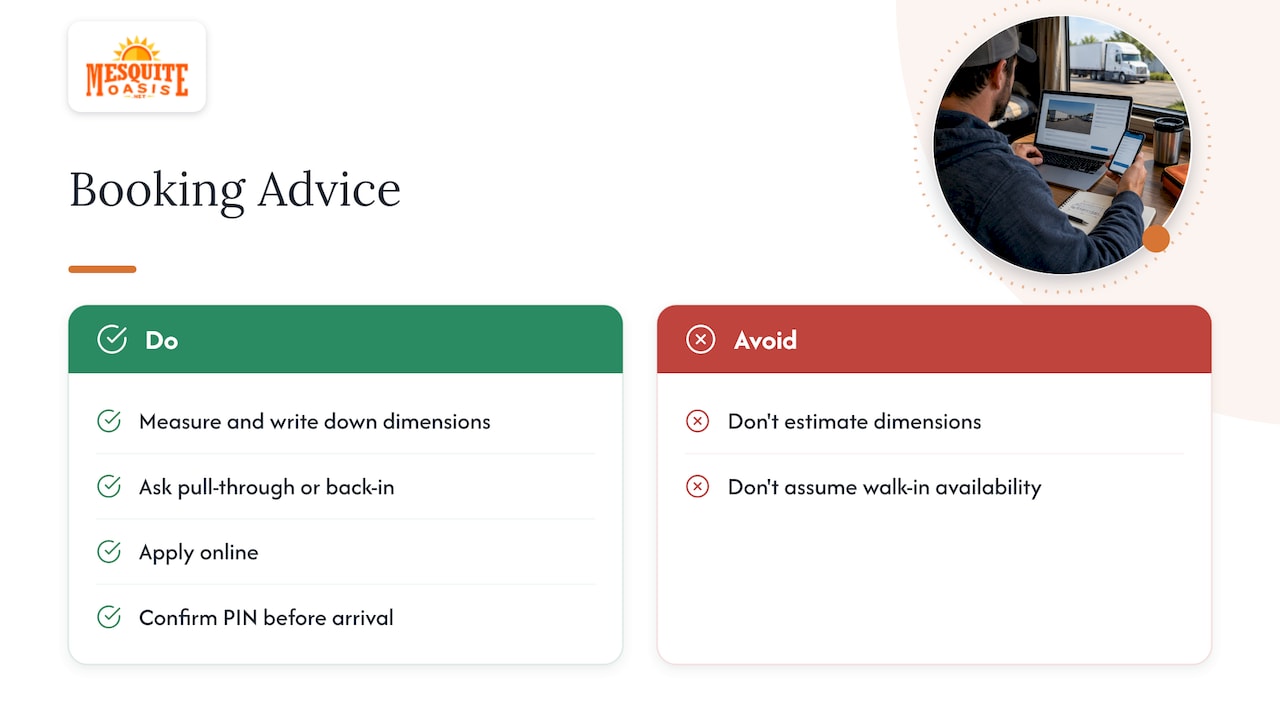
Measure twice before you call a facility: wheelbase, overall length, and overhang, written down, not estimated. When you call reception, ask directly whether a site is pull-through or back-in, because that one question saves you from backing a loaded rig into a space that was never built for it.
For solo drivers, a pull-through is almost always worth the extra cost. For crews coordinating multiple rigs, back-in assigned spaces often work better since they free up a pull-through lane for turnover. My own booking rule: apply online, get your PIN-code access confirmed before you arrive, and never show up assuming a walk-in spot will be waiting. Facilities built for shift workers, with full hookups and dozens of furnished rooms, tend to run tighter booking systems precisely because they’re built for exactly this kind of planning.
Mesquite Oasis: workforce lodging built around your schedule
We built our lodging and RV accommodations around the reality of shift work, offering full-hookup RV sites and furnished lodge rooms, with every application, payment, and booking handled online, 24/7, so you never have to time a phone call around your schedule. Once you’re approved, a personal PIN code gets you into laundry, the gym, and other amenities without another conversation.

- Assigned, secure sites help you avoid hunting for parking after a double shift.
- PIN-based access to laundry and the gym accommodates various work hours.
- Crew and company bookings may be consolidated into one invoice instead of several.
Check RV sites or lodge rooms for current availability, review rates, and apply directly through our application page to get your stay confirmed before your next assignment starts.
FAQ
What’s the most reliable place to park a work truck overnight?
A reserved spot at a truck-friendly RV park, workforce lodge, or fenced private lot is more reliable than a public rest area or an unconfirmed hotel lot. Industry data on pre-planning shows drivers who reserve ahead avoid the overcrowding that leads to unsafe last-minute parking.
How much does work truck parking and lodging typically cost?
At Mesquite Oasis, a 50 Amp Site or 30 Amp Site runs $300 per week or $795 per month, while a Single Room starts at $400 per week, and a Bunk Bedroom runs $550 per week. Pricing varies by facility elsewhere, so always confirm the current rate sheet before booking.
How long does booking typically take at a facility like Mesquite Oasis?
Our online application and payment process is designed to run in minutes rather than requiring a phone call, since everything from the initial application to final payment happens on one platform available 24/7. Check-in then relies on your assigned PIN code rather than waiting on office hours.
Is there really a shortage of truck parking?
Yes. FHWA’s Jason’s Law survey documents roughly 308,920 truck parking spaces nationwide, but many lack reservation systems, and shortages persist along major corridors.
Does a new hours-of-service rule let me drive longer before stopping?
Not for most drivers. The 2025 FMCSA pilot program only applies to about 256 participating CDL holders testing limited extensions to the 14-hour window, so the standard rules still apply to everyone outside that pilot.
Sources
For the latest on hours-of-service pilot rules, FMCSA’s Federal Register notice lays out the program’s scope and eligibility. FHWA’s truck parking planning resources and the Jason’s Law survey document national parking counts and shortages in detail. When you’re ready to book a verified, assigned space instead of hoping one turns up, our Mesquite Oasis landing page covers current availability for RV sites and lodge rooms. For quiet-hours expectations in shared or long-stay housing, this roommate scheduling guide offers scripts worth adapting.
- Federal Register / FMCSA — Hours of Service of Drivers; Pilot Program
- FHWA — Truck parking planning and resources (Jason’s Law materials)
- Jason’s Law Truck Parking Survey and Comparative Analysis (FHWA PDF)


