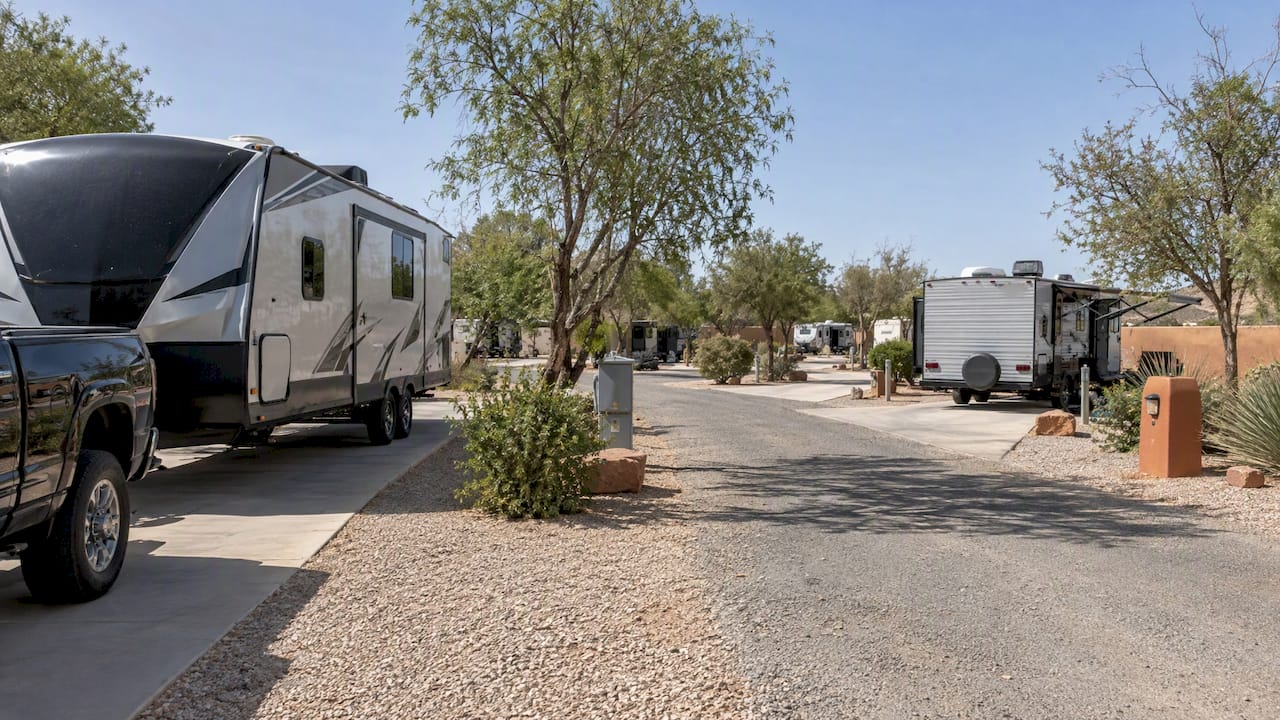
Choose a pull-through when you want the easiest arrival and departure, especially with a long rig or a tow vehicle you don’t want to unhitch. Choose a back-in when you want better control over orientation, a quieter or more scenic spot, or you’re staying put for weeks and the view or hookup placement matters more than convenience. Either way, confirm the exact site length, which side the hookups sit on, and any obstacles before you book. The site type label alone won’t tell you if your rig actually fits.
TL;DR:
- Pull-through sites are usually more expensive due to their convenience and limited availability, making early booking essential during peak seasons.
- Many pull-throughs are located near park entrances or main roads for quick access, while back-in sites tend to be in scenic, secluded areas for privacy and control.
- Always verify site length, width, and utility pedestal side based on detailed measurements rather than relying on site labels alone, to prevent fitting issues or extension costs.
- Okay, backing into a site requires practice and proper spotter communication, as it is generally safer and more controlled when done correctly.
- Extended-stay parks often list detailed site measurements and assign specific sites to avoid surprises, especially for long-term reservations.
Table of Contents
- Pull-through and back-in sites compared: layout, hookups, and trade-offs
- How to choose the right site: a booking checklist
- Site measurements and layout details worth confirming
- Backing, arrival, and departure safety
- How parks price and allocate pull-through and back-in sites
- Which site fits your trip: a quick scenario guide
- How managed parks handle site assignment
- Weighing convenience against the cost of skipping it
- Finding a verified site for your next extended stay
- Where these recommendations come from
- Sources
- FAQ
Pull-through and back-in sites compared: layout, hookups, and trade-offs
A pull-through site lets you drive in one end and out the other, with no need to reverse at all. A back-in site requires you to reverse your rig into a spot, usually nose-out toward the road, which means you need some backing skill or a patient co-pilot before you unhitch for the night.
The two layouts come from different design goals. Pull-throughs are built for turnover and speed, so parks tend to place them near entrances, dump stations, or main thoroughfares where quick access matters. Back-ins fit naturally into wooded loops, lakefront rows, or any layout where the park wants to preserve privacy or scenery between sites. That’s why public and wooded campgrounds lean back-in heavy, while highway-adjacent commercial parks often advertise more pull-throughs.
One detail trips up a lot of first-time bookers: site type and hookups are not the same thing. The Federal Camping Data Standard treats these as separate attributes on purpose, recording site dimensions and equipment limits independently of whether the site is a pull-through or a back-in. A pull-through can have water only. A back-in can carry full hookups. Never assume one implies the other. Always check the hookup list for the specific site number, not just the category it’s filed under.
Here’s how the trade-offs typically break down:
- Ease of use: Pull-throughs win for simple, low-stress arrivals, particularly after a long driving day or in the dark.
- Control over orientation: Back-ins let you choose which way your door, awning, or slide faces relative to the sun or view.
- Space efficiency: Pull-throughs need more total land per site, which is one reason parks offer fewer of them.
- Privacy: Back-ins nestled into loops or tree lines tend to feel more separated from road noise and passing traffic.
- Cost: Pull-throughs often carry a price premium tied to their convenience and limited supply, a pattern noted across RV travel guides comparing the two site types.
- Skill required: Back-ins demand some reversing competence, though that skill becomes routine with practice.
None of this means one type is universally better. A retiree parked for a season probably cares more about shade and orientation than about a thirty-second time save on departure day. A contractor rolling in after a twelve-hour shift cares about the opposite.
How to choose the right site: a booking checklist
Before you call or click reserve, know your numbers. Measure your total combination length bumper to bumper, including the tow vehicle, hitch, and any rear-mounted gear like bike racks or spare tire carriers. Add the length of your tow dolly or toad if you’re bringing one. This total, not just your RV’s listed length, is what you compare against the site’s pad length.
- Measure total length first. Add RV length, tow vehicle or toad length, and hitch gap, then round up.
- Ask for pad length and width. A site can be “long enough” but too narrow for slide-outs to clear fences or neighboring rigs.
- Ask about road width opposite the site. Tight turning radii on narrow interior roads can make a technically long-enough pull-through unusable for big rigs.
- Confirm the hookup pedestal side. Your shore power cord and sewer hose have fixed lengths, and the wrong side means buying extensions or sitting crooked.
- Ask about slope and grade. A sloped pad means more time leveling and, in bad cases, stabilizer jacks that won’t fully extend.
- Check for tree, pole, or retaining wall proximity. These don’t always show up in a site number or length listing but can block a swing path entirely.
- Request a site photo or map if anything is unclear. A five-minute delay beats arriving to a site that doesn’t work.
Convert your measurements into a simple yes/no rule: if your total length exceeds the listed pad length by less than the park’s stated margin, call and ask directly rather than guessing. If the park can’t answer basic pedestal-side or road-width questions, treat that as a flag to ask for an alternate site or a detailed map.
Pro Tip: Save a text note with your total combination length, height, and pedestal needs so you can paste it into any reservation chat or email in seconds.
Red flags worth pausing on: a park that labels sites only as “pull-through” or “back-in” with no measurements, a site photo that’s clearly old or seasonal, or a reservation system that won’t let you request a specific site number for a stay longer than a few nights.
Site measurements and layout details worth confirming
Numbers on a site listing only help if you know what to add to them. Here’s what to request and why each one matters:
- Pad length: The actual parking surface length, which should exceed your total combination length, not just your RV’s length.
- Pad width: Matters more than people expect once slide-outs extend, since a narrow pad can mean slides brushing fences or neighboring rigs.
- Road width opposite the site: Determines whether your rig can actually complete the turn into a pull-through or back-in without multiple pull-ups.
- Distance to the utility pedestal: Affects whether your standard-length power cord, water hose, and sewer hose will reach without extensions.
- Angled entry clearance: Some pull-throughs sit on a curve or diagonal, which shortens the usable straight-line length even if the listed length looks generous.
A rough but useful habit: add three to five feet of margin to both ends of your total rig length when comparing against a listed pad length, to cover approach swing and minor misalignment. Account separately for slide-out extension, awning clearance, and any folding steps that stick out past your bumper.
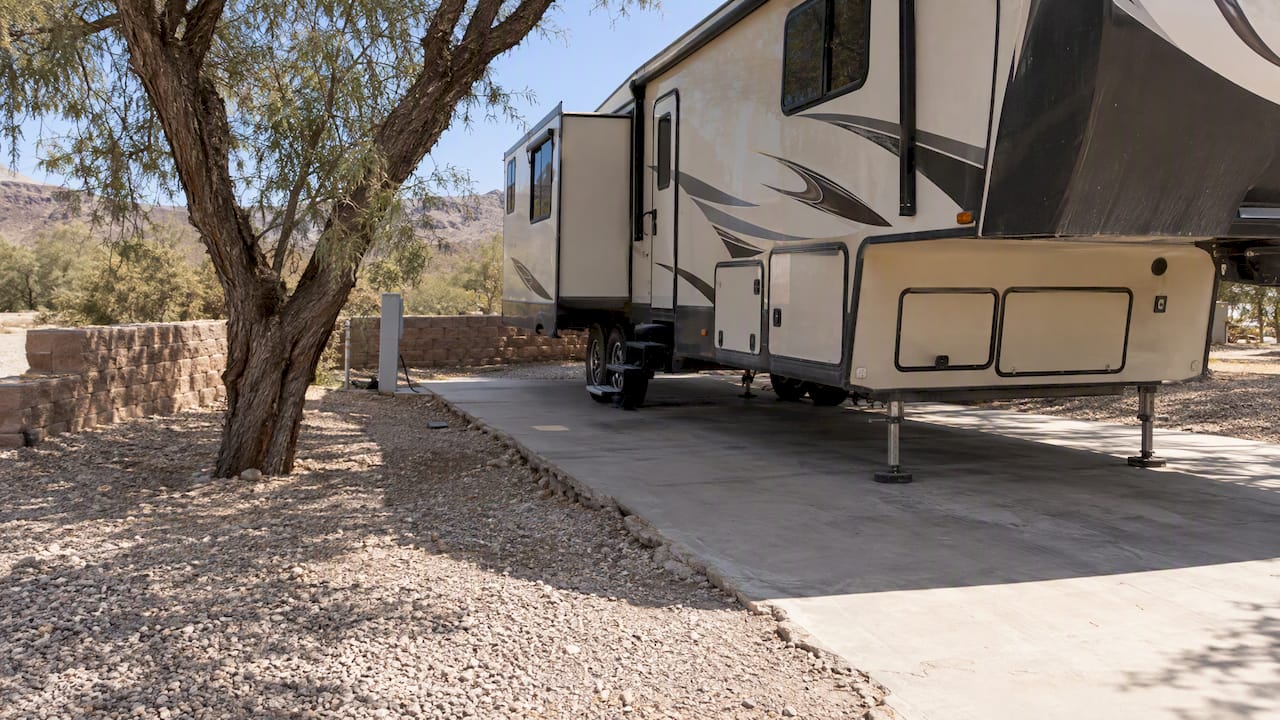
Site maps and photos can mislead in small ways. A retaining wall at the back of a back-in site might cut your usable length more than the posted number suggests. A tree that looks decorative in a photo might actually sit inside your turning radius. When a map shows a grade line or contour near a site, ask directly whether the pad itself is level or whether you’ll need extra leveling blocks.
Backing, arrival, and departure safety
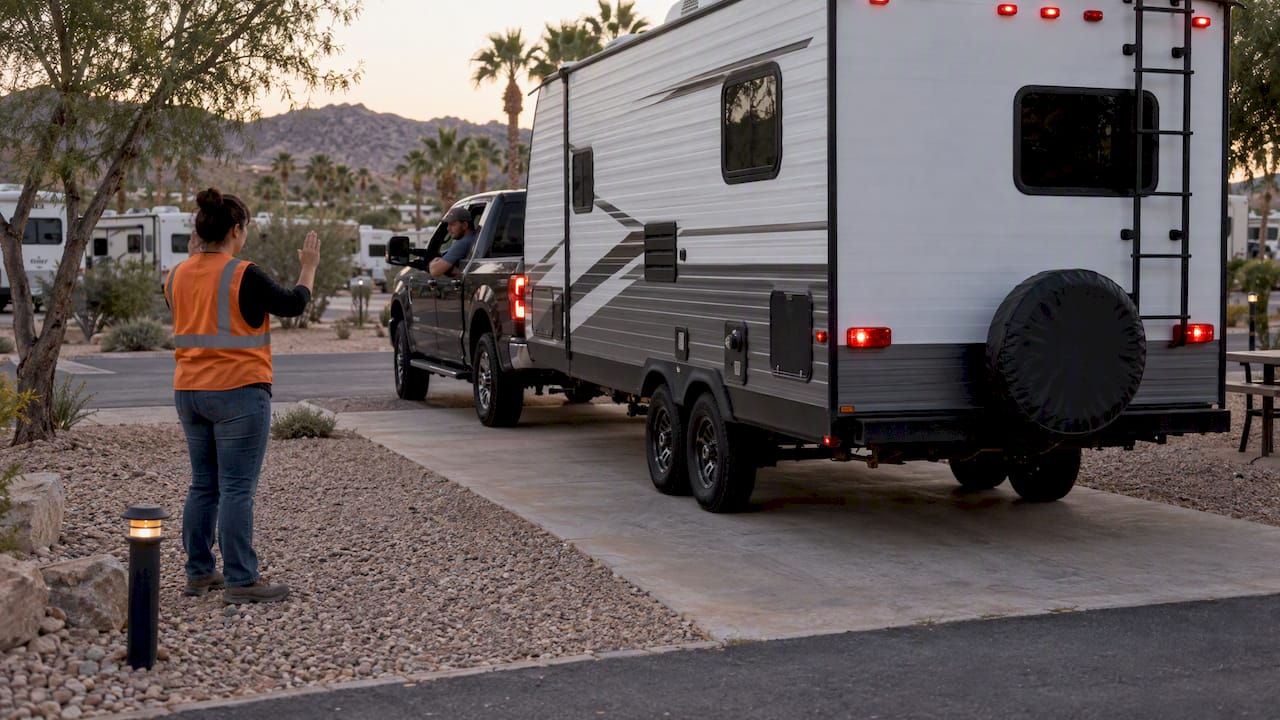
Good backing starts before you ever put the rig in reverse. Walk the site first if you can, noting obstacles, slope, and where your door and slides need to land. If you have a passenger, agree on hand signals before you start reversing, not mid-maneuver.
- Position your spotter where you can see them, ideally in your driver’s side mirror, never directly behind the rig.
- Move in short, slow increments, correcting with small steering inputs rather than large last-second turns.
- Set a reference point, like a post or site marker, and back toward it rather than guessing distance.
- Confirm all pedestrians are clear before the final few feet of reverse, since this is when visibility is worst.
This stepwise approach, built around a pre-arrival walk, a spotter, and small corrections, reflects guidance from backing instructors at Thor Industries, who emphasize procedure over natural talent. Backing is a learnable skill, not an innate one.
A parking maneuver study found that back-out maneuvers account for the large majority of fatal and serious parking-related injuries in the datasets studied, which is part of why forward departure from a pull-through can lower certain crash risks, according to research on parking maneuver safety. That matters most in crowded loops, parks with heavy pedestrian or pet traffic, or arrivals after dark when visibility is already compromised. A back-in executed with a spotter and a slow, deliberate approach can be just as safe, but it demands more attention from both driver and spotter than simply pulling through and out.
How parks price and allocate pull-through and back-in sites
Pull-throughs tend to cost more because they take up more land per site and turn over faster, which private parks treat as premium, limited inventory. Parks often lean on pull-throughs for overnight and transient guests who need quick turnaround, while reserving back-ins for extended stays where a guest will be parked for weeks or months anyway.
That allocation pattern affects availability more than most travelers expect. A park might hold its few pull-throughs for one-night bookings and release them last, meaning a long-stay guest booking months ahead sometimes has an easier time landing a pull-through than someone calling the week before a holiday weekend.
A few tactics help:
- Book early for peak periods, since pull-through inventory is smaller and fills first in busy seasons.
- Ask for a specific site number, not just a category, especially for stays longer than a few nights.
- Weigh the premium against your trip length, since paying extra for ease of departure makes more sense for a two-night stop than a two-month stay.
- Call ahead for last-minute arrivals, since pull-throughs sometimes free up from short-stay cancellations even when the online system shows the category full.
Which site fits your trip: a quick scenario guide
Match your situation to the site type before you book instead of defaulting to whatever shows up first in search results.
- Overnighters and tired drivers: choose a pull-through so you can set up fast and leave without unhitching in the morning.
- Full-timers and scenic or stay-put campers: choose a back-in for better orientation control, more privacy, and often a quieter spot in the loop.
- Workforce stays with repeated daily departures: choose a pull-through, since the time saved compounds over weeks of commuting in and out.
- Anyone towing a vehicle or trailer that’s hard to unhitch: choose a pull-through to avoid detaching and re-hitching every time you need to leave.
Trip length and how often you’ll be moving in and out matter more than personal preference alone. A single overnight stop rarely justifies passing up an available back-in just to wait for a pull-through, but a month-long workforce stay with daily shift changes usually does.
How managed parks handle site assignment
Well-run extended-stay parks document site dimensions ahead of time rather than leaving guests to guess from a category label. Extended-stay parks often list full-hookup 30 amp and 50 amp RV sites with site details available through their online booking systems, so guests can review specifics before arrival rather than discovering a mismatch on-site.
For long-stay bookings, it’s worth confirming the actual site number rather than just the site type, since pull-through and back-in designations can still vary in length and pedestal placement within the same park. A park built around extended stays, rather than overnight turnover, tends to assign sites with that longer-term use in mind, factoring in things like proximity to amenities or quieter rows for guests who’ll be parked for weeks or months. Guests booking through a system that shows site-specific information before payment have a clear advantage over blind category bookings.
Weighing convenience against the cost of skipping it
The real choice isn’t pull-through versus back-in. It’s convenience versus control, and that trade-off is worth taking seriously rather than defaulting to whichever site shows up first. Measuring your rig and asking pointed questions costs you five minutes. Guessing costs you an afternoon of re-leveling, or worse, a site that simply doesn’t fit.
Practicing backing technique pays off over a season of camping, since it opens up back-in sites you’d otherwise skip, often at a lower price than the pull-through next door.
Finding a verified site for your next extended stay
If you’re staying in the Permian Basin for work and want to skip the guesswork entirely, Mesquite Oasis lists its 30 amp and 50 amp full-hookup RV sites with site details available through online booking, so you can confirm length and hookup placement before you commit.

- Full-hookup RV sites in both 30 amp and 50 amp configurations, bookable entirely online.
- Furnished lodge rooms for guests who’d rather skip towing a rig altogether, including Single Room and Bunk Bedroom options.
- Amenities included like laundry, a gym, and secure access through a personal PIN code, all part of extended-stay life.
Some parks are built around long assignments and shift-based schedules, offering consolidated monthly billing for crews and a 24/7 online process for applications and payments. If you want to confirm a specific site’s dimensions before booking, review the RV site listings or check current rates and reservation details to lock in the right fit for your rig.
Where these recommendations come from
The site-type and hookup distinctions in this guide come from the Federal Camping Data Standard, which separates these attributes to keep bookings accurate. Backing procedure and spotter guidance draw on practitioner advice from Thor Industries, while the safety context around forward departure comes from parking maneuver crash research. Practical cost and layout patterns reflect comparisons published by RV travel guides. Readers preparing for long highway stretches before arrival may also find value in tire failure and driver safety guidance relevant to vehicle preparation.
Sources
- Federal Camping Data Standard 2.1
- Parking maneuver safety study (TRID)
- Tips for backing a travel trailer (Thor Industries)
- Pull Through vs Back In RV: Differences, Pros and Cons (TheCampingAdvisor)
FAQ
What are the differences between a pull-through and a back-in RV site?
A pull-through lets you drive straight in and straight out without reversing, while a back-in requires reversing your rig into the spot. Pull-throughs tend to be longer, cost more, and sit near park entrances, while back-ins are more common in wooded or scenic loops and often cost less.
What is the 10 year rule for RV?
This isn’t a formal regulation but a common park or resort policy restricting RVs over a certain age, often around ten years, unless they pass an inspection. Rules vary widely by individual park, so always check directly with the specific campground rather than assuming a universal standard applies.
What does “pull through” mean at a campsite?
A pull-through site has an entrance and exit on opposite ends, so you drive in one side and continue out the other without backing up. It’s designed for quick, simple arrivals and departures, which makes it popular with larger rigs and overnight stops.
What does “back-in campsite” mean?
A back-in site requires reversing your RV into the parking spot, typically nose-out toward the road or driveway. These sites are common in wooded or scenic campground loops and often offer more privacy than pull-throughs.
Does a pull-through site always include full hookups?
No, site type and hookups are recorded as separate details under the Federal Camping Data Standard, so a pull-through can have partial hookups just as a back-in can have full service. Always confirm the hookup list for the exact site number before booking.


