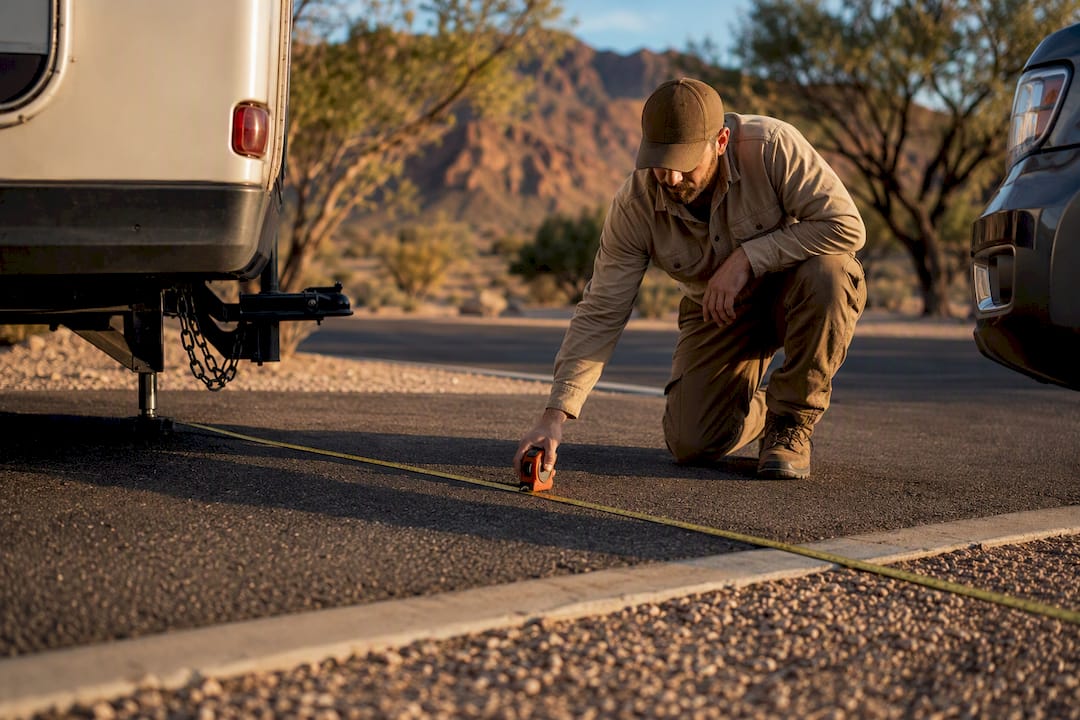
The check that decides whether your big rig fits a campsite is simple: compare your full arrival length, rig plus tow vehicle if you’re pulling one, against the specific number the reservation listing controls with, whether that’s driveway length, maximum vehicle length, or a combined figure. If the listing splits trailer and RV limits, follow that specific rule instead of a general headline number. Measure your arrival length now, copy the site’s key fields, and call ahead if anything is unclear.
TL;DR:
- Most campgrounds have site-specific length limits that differ from general claims, so always verify the actual driveway or pad length before booking.
- Measure your full arrival length, including tow vehicle and extra hardware, to ensure it matches the campground’s listed maximums and leaves at least 2 to 3 feet of margin.
- Check detailed site notes and photos for obstacles, slope, and utility hook-up placement to confirm your rig will fit comfortably and deploy slides without issues.
- Contact the campground directly with your precise measurements to clarify which limit (trailer, RV, driveway, or combined) controls your site instead of relying on vague or aggregate figures.
- Aim to reserve a site with clear margins, especially if the listing lacks detailed notes, to avoid tight fits that could require moving or additional fees on arrival.
Table of Contents
- How campgrounds define length and which field controls your booking
- How to measure your rig correctly before you compare anything
- A practical checklist for auditing any campsite listing
- Maneuvering and clearance issues that matter as much as length
- Exactly what to ask before you book
- Three common length scenarios and the math behind them
- How Mesquite Oasis approaches big rigs and booking clarity
- Confirm your fit before you book your next site
- Sources
- FAQ
How campgrounds define length and which field controls your booking
Campground listings often show several length numbers, and they don’t mean the same thing. Driveway or pad length is the paved or graded space your rig actually parks on. Site length sometimes refers to the whole site boundary, which can include unusable margin. Maximum vehicle length is the hard cap the campground enforces, and some listings add a separate “maximum vehicles” count for how many units or tow vehicles a site can hold.
Federal and state listings show how much these numbers can diverge within the same park. At Yosemite’s Hodgdon Meadow, some sites allow an RV up to 35 feet but cap trailers at 30 feet, and the park warns that showing up with different equipment than what you booked can mean being turned away entirely. At Denali’s Teklanika River Campground, the rule works differently again: no single vehicle or trailer may exceed 40 feet, and a towed car often needs separate handling.
That’s why the site-specific reservation record, not a campground’s general “we accept big rigs” claim, is the authority that decides fit:
- Driveway or pad length is the physical space your tires and stabilizers will occupy.
- Site length can include unusable margin and shouldn’t be treated as parkable space.
- Maximum vehicle length is the enforced cap, sometimes different for RVs versus trailers.
- Maximum vehicles tells you if a second unit, like a tow vehicle, needs its own spot.
How to measure your rig correctly before you compare anything
Before you compare your rig to any listing, you need two numbers: the labeled unit length and the full arrival length. The RV Industry Association standardized how manufacturers measure and label overall length, so a “32-foot” trailer from one brand means the same thing as a “32-foot” trailer from another. Travel trailers are measured bumper to hitch coupler, fifth-wheels from the pin box or front profile to the rear, and motorhomes from the front extreme to the rear bumper.
Brochure or floor-plan lengths sometimes describe interior living space rather than the RVIA overall figure, which can undercount your real footprint. Record both the labeled unit length and your arrival length, meaning the rig plus any tow vehicle or towed car, since that combined number is what a campsite actually has to hold.
- Measure your unit from its RVIA-defined endpoints, not the interior floor plan.
- Add hitch, tow bar, or coupler hardware if it extends beyond the bumper.
- Add your tow vehicle’s full length if you’re towing a trailer or fifth-wheel.
- Add a few inches of buffer for any rear-mounted bike rack, ladder, or spare tire.
Pro Tip: Keep a written card with both numbers, unit length and arrival length, in your glove box so you can answer a campground’s question instantly instead of guessing on the phone.
A practical checklist for auditing any campsite listing
Before you book, copy these fields directly from the listing rather than relying on a general description of the campground: driveway length, site length, site width, maximum vehicle length, maximum vehicles, overhead clearance, site type, surface, and any site notes. Site notes are often where the real restrictions live, even when the headline numbers look generous.
Photos deserve the same scrutiny. A wide-angle shot can make a short pad look longer, and a photo taken from ground level can hide a slope that will complicate leveling. Watch for trees, utility pedestals, or fire rings positioned inside what should be usable pad space, since those are common places where the visible length and the real parkable length don’t match. Practical guidance on reading campsite photos and dimensions before booking recommends copying the same fields listed above and pairing them with a specific script when you call, rather than asking a vague “will my rig fit?” question that invites a vague answer.
- Copy driveway length, site length, and maximum vehicle length as separate numbers, never one blended figure.
- Check whether the listing has a separate maximum for trailers versus motorhomes.
- Note overhead clearance and site surface, since gravel or dirt pads may limit stabilizer placement.
- Flag any listing that shows only one length number with no site notes as needing a phone call.
A margin of at least 2 to 3 feet beyond your arrival length gives you room to straighten, level, and deploy slides without hanging over the pad edge, according to practical RV-fit guidance. A site with zero stated margin, or one where the listed length matches your arrival length exactly, is a red flag worth a call before you commit.
Maneuvering and clearance issues that matter as much as length
Length is only part of the equation. A pull-through site is generally easier for a big rig because you drive in and out without backing, but pull-throughs sometimes have narrower width or shorter usable pad than a back-in site at the same park. Back-in sites can offer more length and better utility placement, but they demand tighter turning and more clearance from neighboring sites or trees.
Site maps and notes can reveal tight interior loops, narrow bridges, or low branches before you ever arrive, and arriving during daylight makes it far easier to judge these constraints in person rather than guessing in the dark. Overhead clearance matters for slide-out awnings, roof-mounted air conditioners, and satellite domes, not just for the rig’s cab height.
- Confirm whether your site is pull-through or back-in and match that to your comfort level backing a long trailer.
- Ask if slide-outs and awnings have full clearance to deploy without hitting a tree, post, or neighboring rig.
- Check grade and leveling room, since a sloped pad can eat into your usable length once blocks are placed.
- Note where utility hookups sit relative to the pad, since a hookup at the wrong end can shorten your usable parking space.
Exactly what to ask before you book
Call or message the campground with specific numbers, not a general question. Start by stating your unit length and full arrival length, then ask directly which field controls: trailer maximum, RV maximum, driveway length, or a combined limit.
- State your rig’s labeled unit length and total arrival length up front.
- Ask which listed field, trailer, RV, driveway, or combined, is the one that actually governs your site.
- Ask whether overflow or extra parking is guaranteed for a tow vehicle if it won’t fit on the pad.
- Ask whether slides and awnings can fully deploy given neighboring sites and fixed obstacles.
Only accept a site once you have an unambiguous controlling field and at least 2 to 3 feet of margin beyond your arrival length. If the answer is vague or the margin doesn’t exist, ask for a different site rather than hoping it works out.
Three common length scenarios and the math behind them
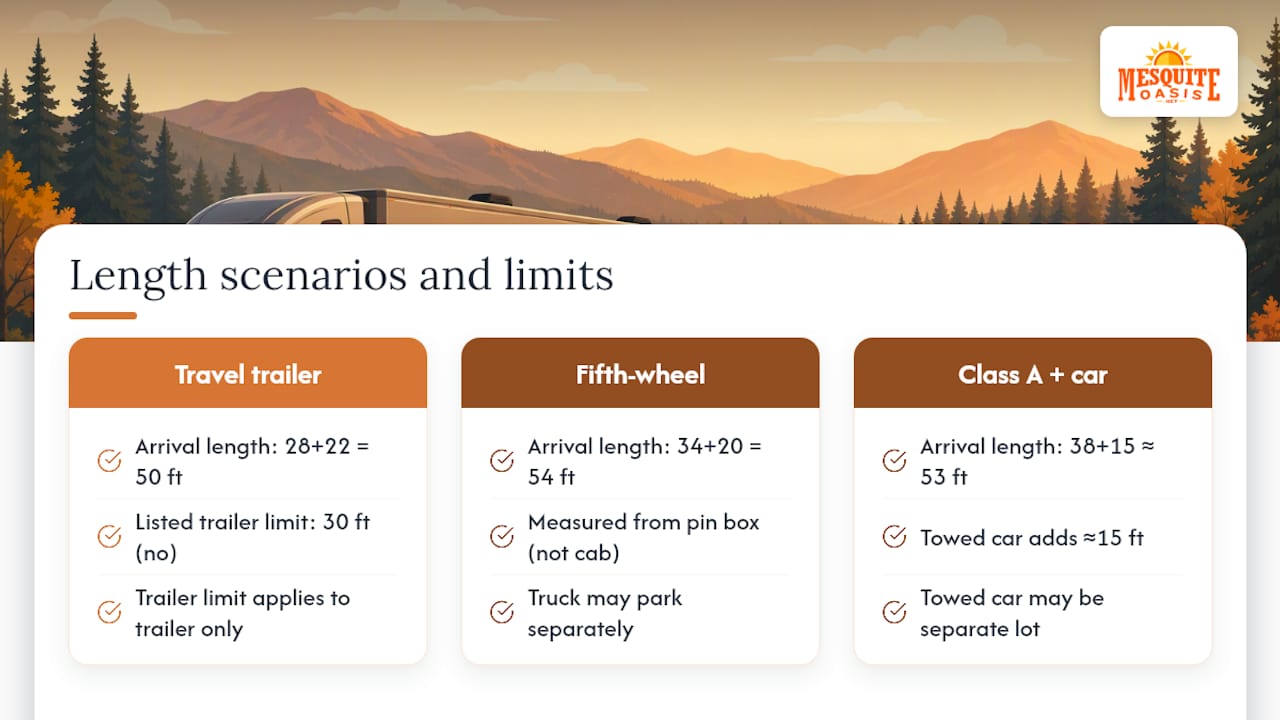
Travel trailer and truck: say your trailer is 28 feet and your truck is 22 feet, for a 50-foot arrival length. A site listed with a “50-foot driveway” is a tight fit with no margin, while a site listed with a “30-foot trailer maximum” is a hard no regardless of your truck’s length, since that field applies to the trailer alone.
Fifth-wheel and truck: fifth-wheel length is measured from the pin box, not the truck cab, so a 34-foot fifth-wheel with a 20-foot truck still means a 54-foot arrival length. Some parks let the truck park separately from the pad, which changes what field you’re checking against.
Class A motorhome towing a car: a 38-foot motorhome towing a car adds roughly 15 feet, but some campgrounds, including sites similar to Teklanika’s setup, require the towed car to be dropped at a separate lot rather than counted on the pad.
Pro Tip: Write out your arrival length math before you call, so you can state it in one sentence instead of working it out on the phone.
How Mesquite Oasis approaches big rigs and booking clarity
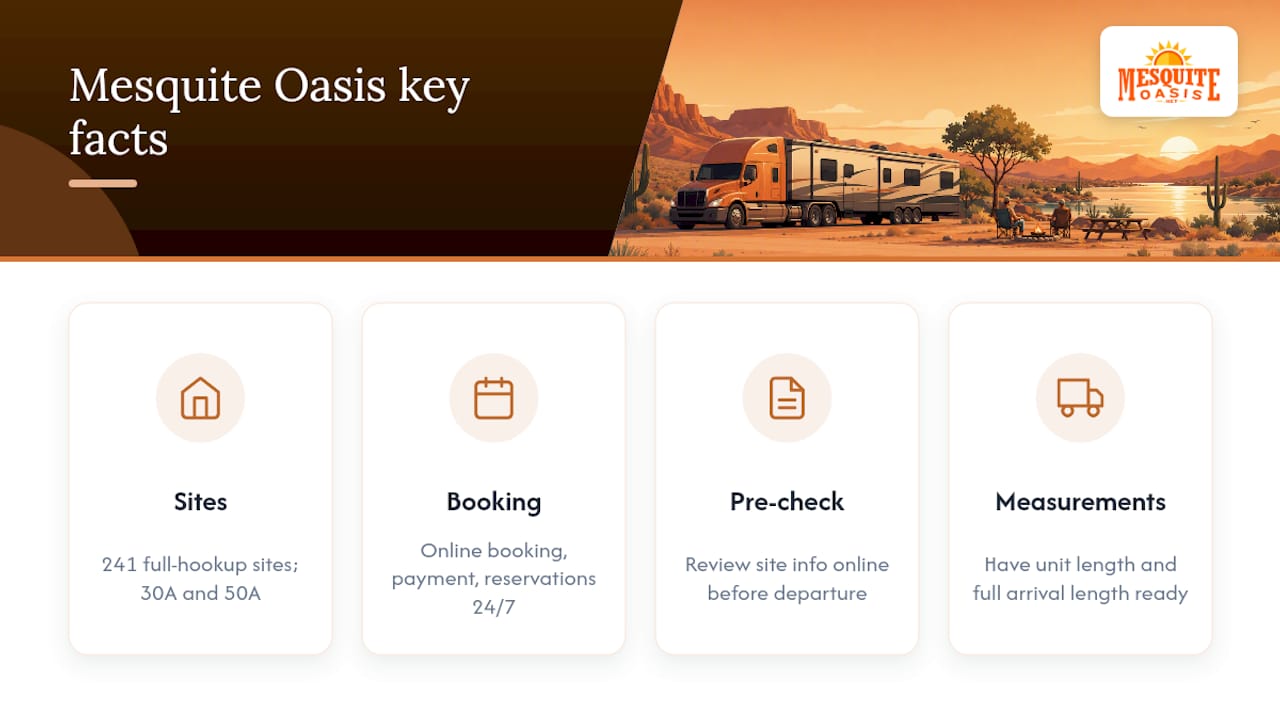
Mesquite Oasis Lodge & RV Park offers 241 full-hookup sites split between 30 amp and 50 amp service, and every application, payment, and reservation step happens online, available 24/7, so guests never have to call the office just to check a detail. That same online process gives big rig owners a way to review site information and confirm fit before they ever pack up to leave. Guests booking a site should have both their unit length and full arrival length ready when they register, the same numbers this guide walks through, since matching those figures to the site details is what prevents a mismatch on arrival.
Confirm your fit before you book your next site
Once you’ve measured your arrival length, the next step is matching it against real site details, and that’s exactly what our RV sites in Odessa page is built for. The campground offers 50 amp and 30 amp full-hookup sites with inclusive rates and a fully online booking process, allowing guests to complete applications and payments without needing to call.

A 50 Amp Site runs $300 per week or $795 per month, and a 30 Amp Site is priced the same, so the choice comes down to your rig’s power needs rather than budget. If you’d rather skip towing altogether during a long work assignment, our lodge rooms offer Single rooms and bunk bedrooms are offered at rates of several hundred dollars per week or over a thousand dollars per month.
| Site type | Weekly rate | Monthly rate |
|---|---|---|
| 50 Amp Site | $300 | $795 |
| 30 Amp Site | $300 | $795 |
| Single Room | $400 | $1,350 |
| Bunk Bedroom | $550 | $1,700 |
Measure your arrival length, then head to our registration form to confirm your site and lock in your stay.
Sources
For readers who want to verify rules directly, start with the Hodgdon Meadow and Teklanika River campground pages for examples of site-specific limits, the RVIA labeling announcement for measurement standards, and the campsite photo and dimension guide for auditing listings before you book.
- Hodgdon Meadow Campground - Yosemite National Park (U.S. National Park Service)
- RV Industry Association Board Of Directors Approves Requirement To Add Vehicle Length Labels To All Manufactured Units | RVIA
- How to read campsite photos and dimensions before booking
FAQ
What counts as my rig’s arrival length?
Arrival length is your RV’s labeled unit length plus any tow vehicle or towed car you bring with it. A 28-foot trailer with a 22-foot truck has a 50-foot arrival length, and that combined number is what a campsite has to hold, not just the trailer alone.
Does a campground’s advertised maximum apply to every site?
No, a campground’s headline maximum is a general figure, and individual sites can have shorter limits or different rules for trailers versus motorhomes. Yosemite’s Hodgdon Meadow shows this directly, with some sites allowing a 35-foot RV but only a 30-foot trailer.
How much margin should I leave beyond my arrival length?
Aim for at least 2 to 3 feet of unused pad beyond your arrival length so you have room to straighten, level, and deploy slides. A site with no stated margin is worth a call before you book it.
Do I need to measure my RV myself, or can I trust the brochure length?
You should measure or verify both numbers, since brochure figures sometimes describe interior living space rather than the standardized overall length. RVIA labeling defines travel trailers, fifth-wheels, and motorhomes by specific endpoints, and that labeled number is your starting point before adding a tow vehicle.
What should I ask a campground before booking if the listing seems unclear?
State your unit length and full arrival length, then ask directly which field controls your site: trailer maximum, RV maximum, driveway length, or a combined limit. Also ask whether a tow vehicle needs its own parking space, since some parks require it separately.


