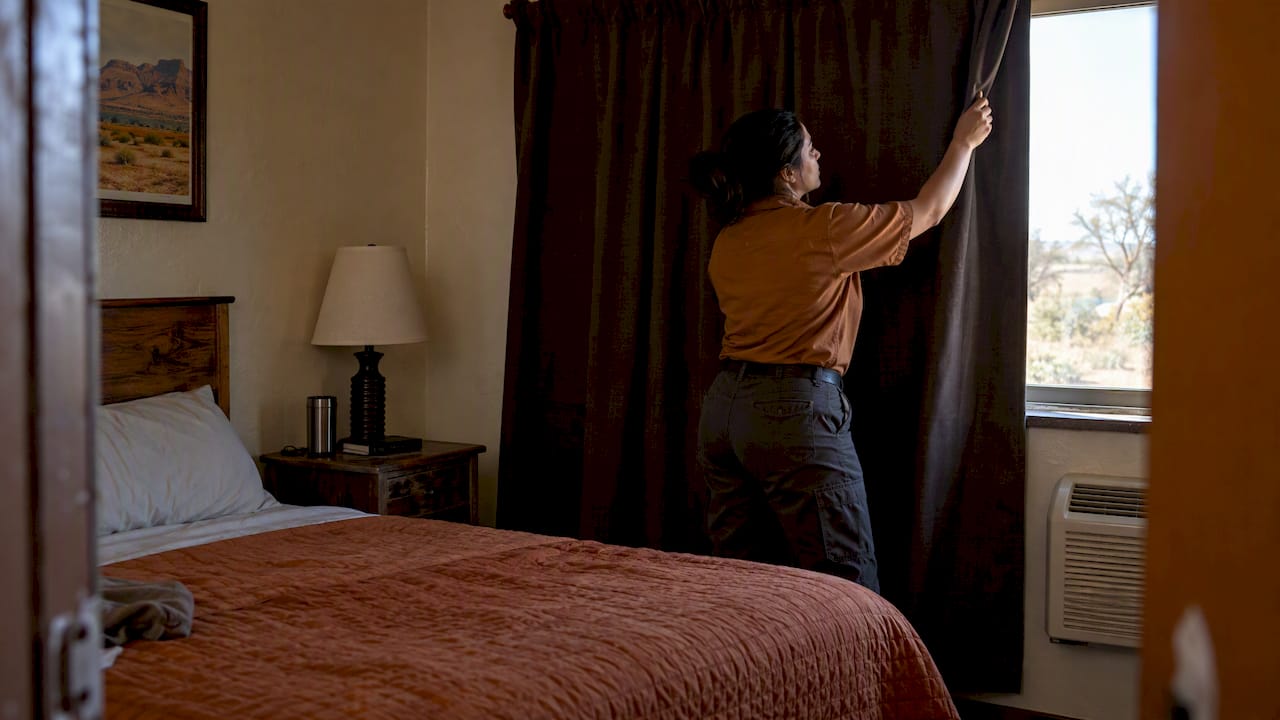
The best quiet housing for workers is furnished, workforce-focused temporary housing that gives you control over noise, light, and temperature, not a generic hotel or short-term rental. Mesquite Oasis Lodge & RV Park in Odessa, Texas is one example built around that standard, with private furnished rooms and RV sites made for people on irregular schedules. If you’re searching now, check availability and booking windows before your start date locks in.
TL;DR:
- Before booking, verify wall construction, bedroom placement, blackout curtains, independent quiet HVAC, ventilation, and mattress quality; advertised quiet alone does not guarantee daytime sleep.
- For remote or high demand markets, apply 30 to 60 days ahead; compare nightly, weekly, and monthly rates, including utilities and amenities.
- Check whether written rules cover daytime quiet hours, visitor and outdoor noise, and enforceable penalties; ask whether access codes are unique and entry points monitored.
- Mesquite Oasis has 110 furnished rooms and 241 full hookup RV sites; companies can ask about block bookings with consolidated monthly invoicing.
Table of Contents
- What Quiet Temporary Housing Is and Why It Beats Hotels for Shift Workers
- Your Quiet and Air Quality Checklist Before You Book
- How to Find and Book Quiet Housing Without the Guesswork
- A Closer Look at Mesquite Oasis: Furnished, Private, and Built for Shift Schedules
- Security Measures That Actually Matter for Quiet Housing
- Noise Policies and Community Rules Worth Checking Before You Sign
- Getting Help During Your Stay, Not Just at Booking
- What I’ve Learned About Choosing Quiet Housing on an Odd Schedule
- How We Can Help You Settle In
- FAQ
- Sources
What Quiet Temporary Housing Is and Why It Beats Hotels for Shift Workers
Quiet temporary or workforce housing means furnished rooms, studios, or RV sites rented for days, weeks, or months, built for people who need to sleep on a schedule that doesn’t match daylight hours. It’s different from a hotel room booked for a weekend or a short-term rental meant for tourists passing through.
The practical gap shows up fast once you’re staying more than a few nights. A furnished room or RV site gives you a kitchen instead of takeout every night, laundry instead of a suitcase of dirty scrubs, and a lease structure that gets cheaper per night the longer you stay. Hotels charge nightly rates that punish multi-week stays, and short-term rentals often come with thin walls, shared laundry rooms, or neighbors who have no idea you work nights.
The sleep stakes are real. NIOSH guidance on shift work describes circadian misalignment as a core challenge for people working nontraditional hours, and recommends choosing housing that cuts commute time and provides a quiet place to sleep during the day. That’s not a comfort preference, it’s a safety consideration tied to drowsy driving and on-the-job alertness.
What separates workforce housing from a standard rental:
- A private bedroom instead of a shared wall with unpredictable neighbors
- A kitchen and laundry on-site, cutting weekly costs on food and clothing care
- Lease terms built for weeks or months, not a two-night minimum
- Daytime-sleep accommodations like blackout options and quieter HVAC systems
Your Quiet and Air Quality Checklist Before You Book
Not every “quiet” listing actually is. A handful of physical details separate a room where you’ll sleep well from one where you’ll lie awake at 2 p.m. listening to a hallway.
- Check unit separation and wall type. Concrete block or double-stud walls block more sound than thin interior partitions, and double-pane windows cut traffic noise significantly.
- Ask about bedroom placement. A room facing a parking lot or main road carries more noise than one set back from traffic.
- Confirm light-blocking options. Blackout curtains or shutters matter more than people expect when you’re sleeping at noon.
- Ask about HVAC noise and control. An independent thermostat with a quiet fan beats a shared system you can’t adjust.
- Check ventilation and filtration. The ability to open a window or access a well-maintained air filter affects both comfort and air quality, a point the Department of Energy’s indoor environmental quality guidance ties directly to occupant well-being and performance.
- Check mattress and pillow quality. NIOSH notes that since people spend roughly a third of their life in bed, mattress and pillow choice is essential to actually restful sleep, along with tools like white noise machines and earplugs for daytime sleep.
Pro Tip: Call or message ahead and ask specifically whether the unit has independent climate control, not just “AC included,” since shared systems are a common source of noise complaints.
How to Find and Book Quiet Housing Without the Guesswork
Start your search on workforce housing listings, extended-stay property pages, and RV park or lodge sites built for long assignments rather than general vacation rental platforms. Employer housing portals, when available, are worth checking first since they often have pre-vetted options.
Timing matters more than most workers expect. Booking 30 to 60 days ahead in high-demand or remote markets reduces the risk of landing in a rushed, lower-quality placement, a pattern recommended for crew housing in fatigue-sensitive work.
One stat worth remembering: NIOSH recommends environment-focused countermeasures, dark, quiet, cool sleep spaces, as a workplace safety intervention for shift workers, not just a personal comfort choice, according to its coping strategies guidance.
Before booking, ask or verify:
- The property’s noise policy and quiet hours
- Nearby traffic, rail lines, or industrial noise sources
- Wi-Fi reliability and a workspace if you do paperwork or calls from home
- On-site laundry and secure, keyed or coded access
On cost, look at what’s bundled. Utilities, Wi-Fi, and amenity access folded into one rate are easier to budget than a base rent plus separate utility bills. Pricing typically drops per night as you move from a nightly rate to a weekly or monthly term, so confirm all three price points before deciding. Employers booking for crews should ask about block booking and consolidated monthly invoicing, which cuts administrative work compared with tracking individual worker receipts, an approach HUD’s workforce housing research associates with better outcomes when paired with transit access and shared amenities.
Our guide comparing Airbnb to extended-stay housing walks through the specific checks worth running before committing to either option for a multi-week stay.
A Closer Look at Mesquite Oasis: Furnished, Private, and Built for Shift Schedules
We built Mesquite Oasis Lodge & RV Park around the same criteria covered above because we designed it specifically for people working the Permian Basin’s long and irregular schedules. Our property includes:
- 241 full-hookup RV sites for workers who travel with their own rig
- 110 furnished lodge rooms for those who need a move-in-ready space
- A fully online application, payment, and account management system, available any time, with no phone call required
- PIN-coded access to amenities including laundry, a gym, and community spaces
Privacy and quiet aren’t accidental here. Separate RV sites and private lodge rooms mean you’re not sharing walls with strangers the way you might in a budget motel, and our gated property with PIN access limits foot traffic to people who actually live or work on-site. That combination, a private unit plus controlled access, is one of the more reliable ways to protect daytime sleep, since noise control and security tend to go hand in hand in workforce settings.
For timing, we recommend applying 30 to 60 days ahead of your start date when possible, especially during high-demand periods, and we offer block booking with consolidated monthly invoicing for companies housing multiple crew members at once.
Living closer to work and sleeping in a controlled, quiet environment are two of the most practical levers shift workers have over their own fatigue.
Security Measures That Actually Matter for Quiet Housing
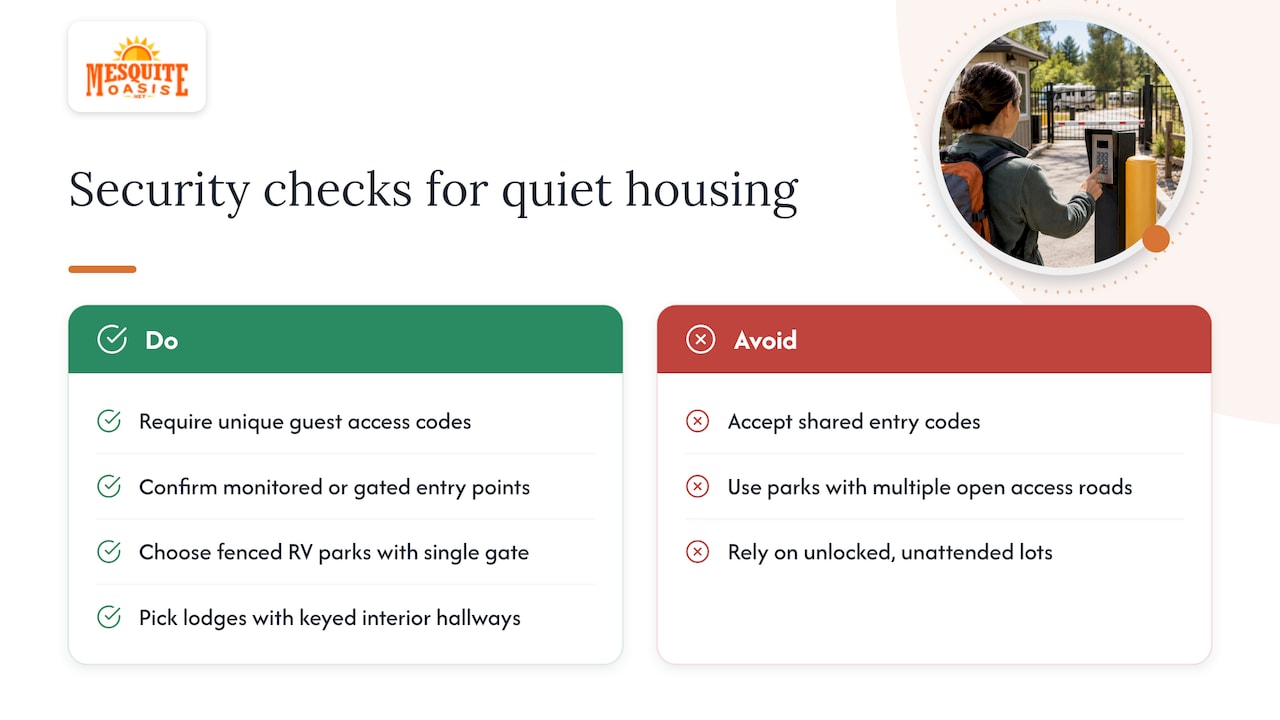
Quiet and safe tend to go together, since a secure property keeps out the foot traffic and disruptions that ruin daytime sleep in the first place. Look for gated entry, individual access codes rather than shared keys, and on-site staff or monitoring during off-hours, since workers coming off a night shift at 7 a.m. need a property that doesn’t require navigating an unlocked, unattended lot.
Ask directly about a few specifics: whether entry points are monitored, whether access codes are unique per guest or shared across units, and whether common areas like laundry rooms and gyms require the same credential as your front door. A single shared code defeats the purpose, since it means anyone who’s ever stayed can let themselves back in.
For RV sites specifically, check whether the park is fully fenced and whether vehicle access is controlled at a single gated entry point rather than multiple open access roads. For lodge rooms, ask whether interior hallways are keyed separately from exterior doors, which adds a second layer between you and the parking lot.
None of this is about assuming the worst. It’s about recognizing that a property with layered access control also tends to be quieter, because the same measures that keep out non-residents also cut down on the random foot traffic, idling cars, and late-night visitors that disrupt sleep for someone working a 6 p.m. to 6 a.m. rotation.
Noise Policies and Community Rules Worth Checking Before You Sign
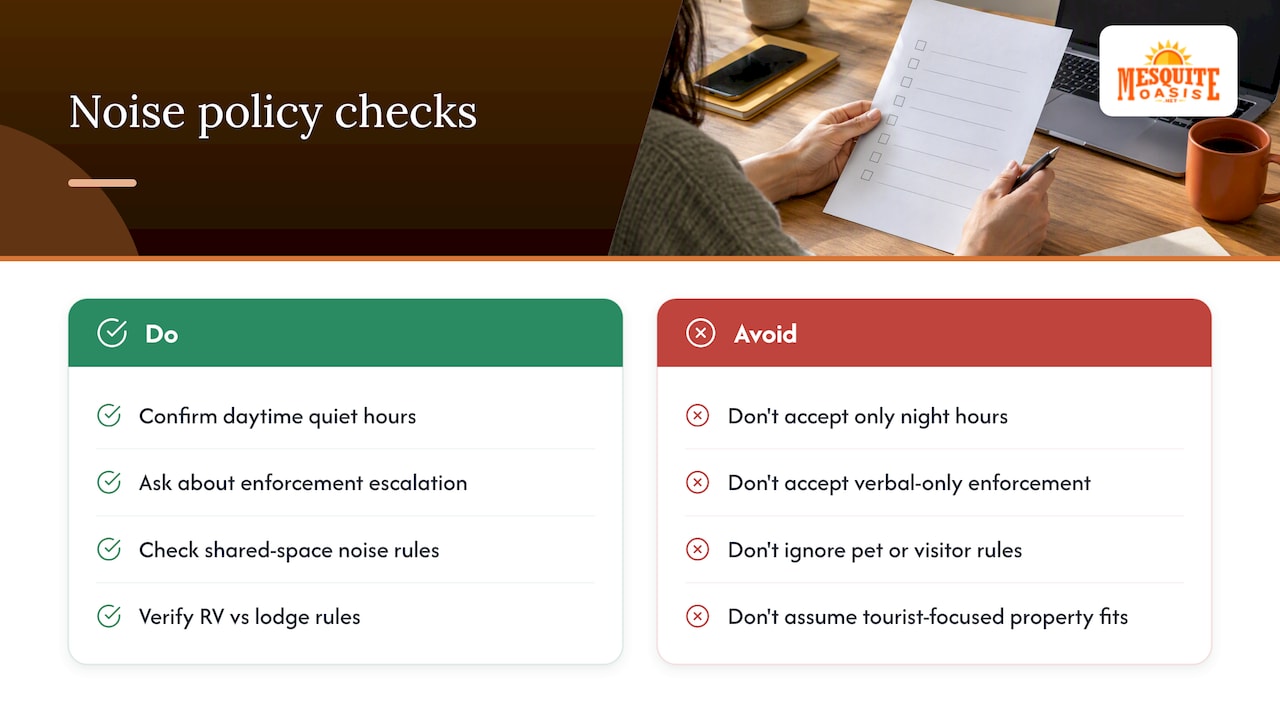
A property’s written noise policy tells you more about day-to-day life there than its marketing photos do. Look for defined quiet hours, especially daytime quiet hours if the property houses shift workers, since a policy only covering 10 p.m. to 7 a.m. does nothing for someone sleeping from 8 a.m. to 4 p.m.
Ask how violations are handled. A property that only issues a verbal warning after repeated complaints isn’t enforcing much, while one with a clear escalation process, warning, fine, lease review, signals that quiet actually gets protected.
Community rules around shared spaces matter too. Pet policies, visitor restrictions, and rules about outdoor noise (generators, car stereos, group gatherings) all affect how livable a property is for someone on an opposite-of-normal schedule. Ask whether rules differ for RV sites versus lodge rooms, since RV communities sometimes have separate generator-hour restrictions that lodge guests don’t need to worry about.
The property type itself can tell you something: developments built specifically for a working population, rather than general short-term renters, tend to have rules shaped around rest and reliability rather than tourism turnover. That distinction is part of why HUD’s workforce housing case studies highlight purpose-built developments as a better fit for essential workers than housing stock designed for a different population entirely.
Getting Help During Your Stay, Not Just at Booking
Support shouldn’t stop once you’ve signed a lease or paid your first month. Ask how a property handles maintenance requests, whether that’s a noisy HVAC unit, a broken lock, or a Wi-Fi outage, and how quickly those get addressed for someone working odd hours and sleeping during the day.
Check whether support is available outside standard business hours. A maintenance issue that happens at 9 a.m., right when a night-shift worker is trying to sleep, needs a faster response than one reported during a Tuesday afternoon.
Online account access matters here too. Being able to check your balance, submit a request, or review your lease terms without waiting on hold or playing phone tag fits the reality of a schedule that doesn’t line up with a typical office’s hours. Properties that let you manage applications, payments, and basic account questions digitally, any time, remove one more obstacle from an already demanding routine.
What I’ve Learned About Choosing Quiet Housing on an Odd Schedule
Commuting fatigue sneaks up on people. A 45-minute drive feels manageable until you’re doing it after a 12-hour shift at 6 a.m., half-asleep at the wheel. Living closer to work isn’t a luxury for shift workers, it’s one of the more direct ways to cut that risk.
The most common mistake I see is trusting a listing’s word for “quiet” without checking the specifics. Ask about HVAC noise before you sign anything, and confirm blackout curtains or shutters actually exist rather than assuming regular blinds will do the job.
Beyond that, use whatever online tools a property offers to plan ahead. Checking rates, availability, and lease terms digitally saves time and gives you a clearer picture before you commit to a schedule-disrupting move.
How We Can Help You Settle In
If you’re weighing furnished rooms against RV sites, we offer both: 110 furnished lodge rooms and 241 full-hookup RV sites, each with laundry, gym, and community amenities included through PIN-coded access.

Checking rates and availability takes a few minutes through our application and payment portal, with no phone call required at any step. Some companies housing multiple crew members can arrange block bookings with consolidated monthly invoicing, which simplifies billing compared with tracking individual worker payments. If you’re planning a move for work, visit our workforce housing page to compare room types and start an application for your preferred dates.
FAQ
Can I rent a house for my employee?
Yes, companies can rent housing for employees directly, including furnished rooms, apartments, or extended-stay units, and many workforce housing providers offer block booking specifically for this purpose. Consolidated monthly invoicing, where available, simplifies billing compared with reimbursing individual workers.
What hotels provide housing for employees?
Extended-stay hotel chains and workforce-focused lodging, such as furnished lodge rooms or RV parks built for long assignments, are commonly used for employee housing rather than standard tourist hotels. The right choice depends on stay length, since extended-stay and workforce housing typically cost less per night than a standard hotel over multiple weeks.
Can a company provide housing to employees?
Yes, employers routinely arrange housing for traveling or contract workers, often through direct leases, block bookings with a property, or housing stipends. Properties built for workforce stays, including RV sites and furnished rooms, often support this with group billing options.
Can you write off housing for employees?
Tax treatment of employer-provided housing depends on specific IRS rules around business necessity and location, so this is a question for a tax professional or the IRS directly rather than a general answer. Employers should confirm their situation before assuming housing costs qualify for a deduction.
Sources
- Module 6: Sleep and recovery considerations (NIOSH / CDC)
- Module 10: Coping strategies — Choose carefully where to live and work (NIOSH / CDC)
- Energy Efficiency and Indoor Environmental Quality Assessment Guide (U.S. Department of Energy)
- Steamboat Springs: 75-Unit development provides housing for tourism town’s local workforce (HUD USER)


