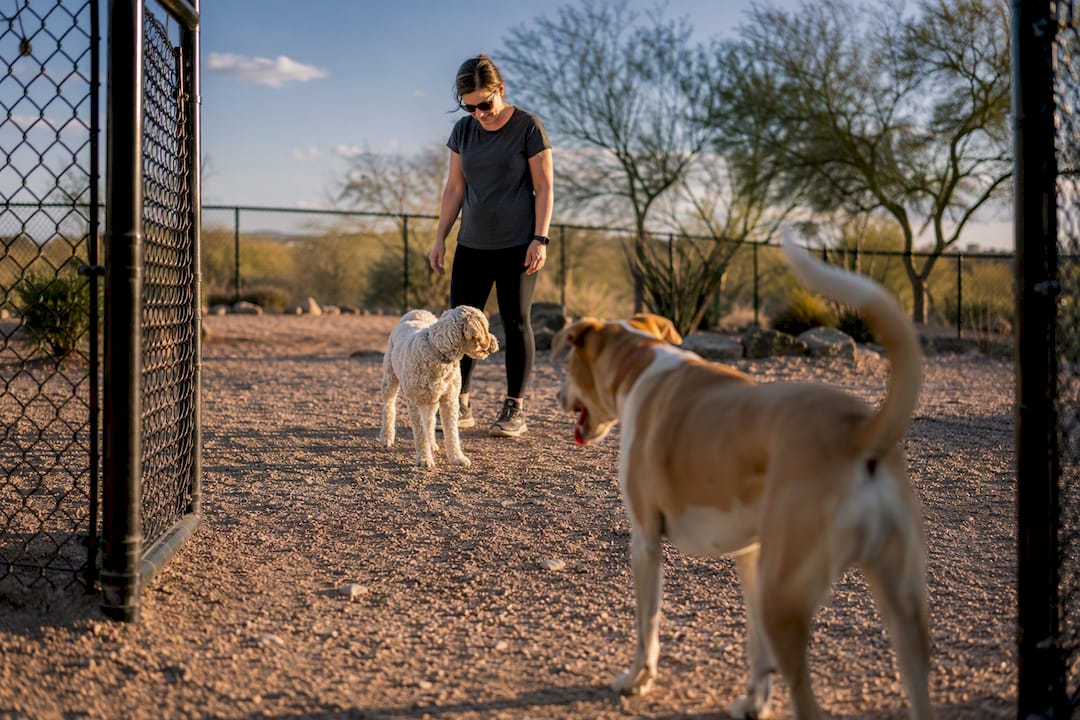
Good dog park etiquette comes down to five things: supervise your dog without distraction, clean up every mess, follow the posted rules for that specific park, leave the treats and toys in the car, and keep a sick or injured dog home. Dogs should be at least 6 months old and fully vaccinated before their first visit, and most trips should be limited to a moderate duration, avoiding full afternoon visits.
TL;DR:
- Most dogs should be at least 6 months old and fully vaccinated before their first off-leash park visit, with shorter, controlled sessions preferred.
- Observing early warning signals like lip licking, yawning, or stiff body language can help prevent fights before they start.
- Bringing your own water and avoiding high-value treats reduces health risks and resource guarding during play.
- Checking ground conditions, weather, and avoiding peak hours enhances safety and comfort for your dog and minimizes injury risks.
- Controlled, smaller spaces such as managed pet areas or private yards are better options for dogs that do not adapt well to crowded parks.
Table of Contents
- Is Your Dog Actually Ready for an Off-Leash Park?
- What to Do Before You Ever Reach the Gate
- Supervision, Greetings, and Sharing Space With Other Owners
- How to Read the Warning Signs Before a Fight Starts
- Managing Conflicts and Knowing When to Leave
- How Long to Stay, and What to Leave at Home
- Better Options When the Dog Park Isn’t the Answer
- Considerations for Dogs in Heat or Intact Females
- Why Water Matters More Than Most Owners Realize
- Checking Weather and Ground Conditions Before You Head Out
- Etiquette Doesn’t Stop at the Municipal Park Gate
- A Managed Alternative to the Busy Municipal Dog Park
- Sources
Is Your Dog Actually Ready for an Off-Leash Park?
Not every dog belongs at a dog park, and that has nothing to do with breed or size. It’s about age, health, and temperament.
The baseline most veterinarians and trainers agree on: your dog should be at least 6 months old and fully immunized before any off-leash group exposure. Spaying or neutering also lowers the odds of mounting behavior and same-sex conflict, which are two of the more common flashpoints in a crowded enclosure.
Before you load up the car, run through a quick mental checklist:
- Does your dog greet new dogs calmly on leash, without lunging or freezing?
- Does he respond to “sit,” “stay,” or “come” even with distractions around?
- Has he ever bitten or snapped at a person or another dog?
- Can he handle a short, supervised leash introduction to an unfamiliar dog without escalating?
If any answer worries you, that’s information, not a failure. It just means the park isn’t the right fit yet.
What to Do Before You Ever Reach the Gate
A good visit starts before you leave the driveway. A few minutes of prep prevents most of the problems that ruin a trip.
- Walk the fence line first, without your dog, so you can see who’s already inside and how crowded it is.
- Read the posted signage at the entrance. Many parks list size zones, age minimums, or hours you won’t find online, and the Chelmsford, Massachusetts municipal rules are a good example of how detailed these can get.
- Pack a leash, a well-fitted harness, current ID tags, waste bags, and water with a collapsible bowl.
- Pick an off-peak hour for a first visit rather than a Saturday afternoon rush.
- Bring no more than one or two dogs per handler. Beyond that, you can’t watch closely enough.
Skip any of these and you’re gambling on a smooth visit instead of setting one up.
Supervision, Greetings, and Sharing Space With Other Owners
Constant supervision is the actual job here, not a suggestion. That means the phone stays in your pocket, and you stay close enough to call your dog off in two seconds if something looks wrong.
Gate etiquette matters more than people realize. Most parks work on a one-dog-at-a-time system at entry, giving the dogs already inside a chance to notice and adjust before another one crowds through. Rushing the gate with an excited dog is one of the fastest ways to spark a scuffle before you’ve even taken your leash off.
Let greetings happen on the dog’s terms, not yours:
- Keep the first few seconds brief. Long, stiff face-to-face sniffing tends to escalate faster than a quick sniff-and-move-on.
- Never drag a nervous dog toward another dog “to get it over with.”
- Respect posted size zones, since a rambunctious 70-pound lab in the small-dog area is a liability even with good intentions.
- Give other owners physical space, especially if their dog seems tense or they’re actively working on a training issue.
Pro Tip: If you notice another owner glued to their phone while their dog gets pushy with yours, don’t wait for them to look up. Call your own dog to you first. You can’t control their attention, but you can control the distance.
How to Read the Warning Signs Before a Fight Starts
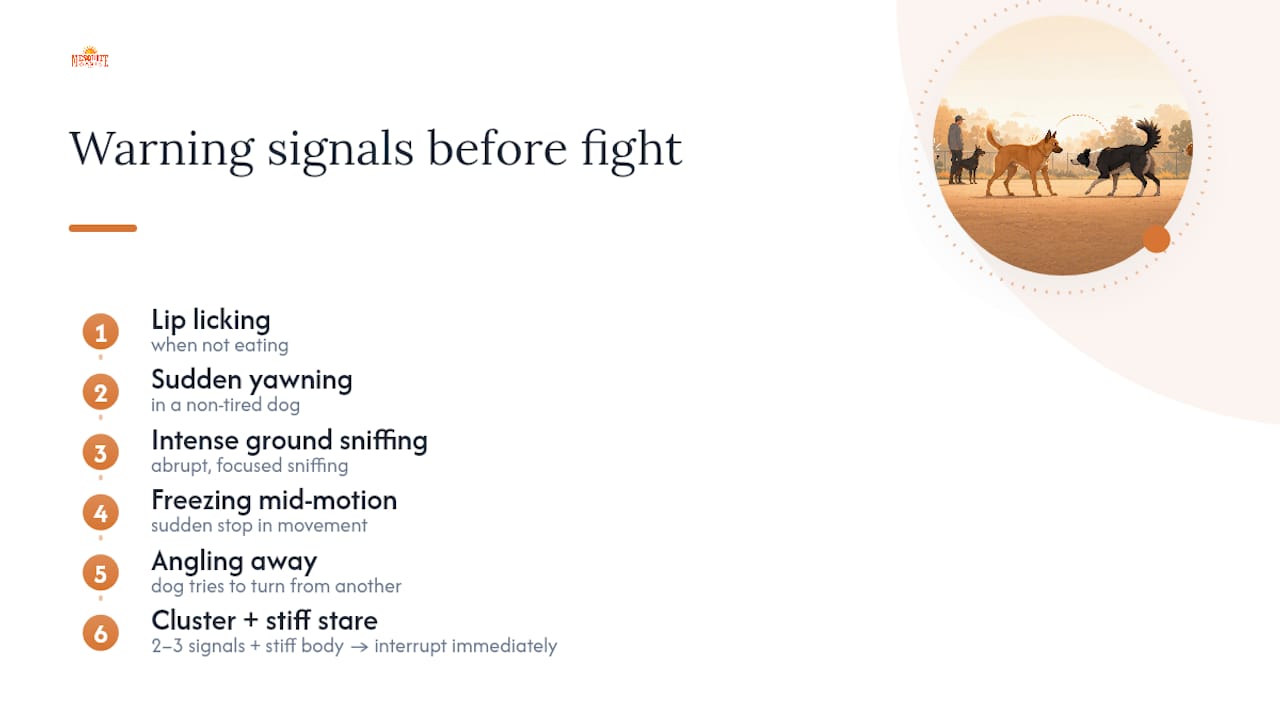
Dogs rarely go from calm to aggressive with no warning. They flash a series of small, easy-to-miss signals first, and catching them early is the single biggest skill separating a smooth dog park visit from a bad one.
Watch for lip licking outside of eating, sudden yawning in a non-tired dog, abrupt intense sniffing of the ground, freezing mid-motion, or a dog trying to angle away from another. Behaviorists call these displacement behaviors, and they show up when a dog is uncomfortable but not yet ready to react outright.
One signal alone usually means nothing. A dog yawning once might just be tired. The trouble starts when two or three of these signals cluster together in a short window, or when you see them paired with a stiff body and a hard stare. That combination is your cue to step in immediately, not to wait and see what happens.
Interrupting doesn’t require drama. Call your dog in a cheerful, upbeat voice, clip the leash back on, and walk a short distance away. Offer water and a minute to decompress outside the gate. If your dog stays fixated on the other dog even after that break, the visit is over for today, and that’s a fine outcome.
Managing Conflicts and Knowing When to Leave
Play looks rough even when it’s healthy: growling, mouthing, one dog pinning another. The line between rowdy fun and real trouble is whether both dogs keep coming back for more or one is trying to escape.
The right move is a cheerful recall or a calm leash step-away, never yelling or chasing. Both of those responses ramp up arousal instead of lowering it, and a chasing owner often looks like part of the game to a keyed-up dog.
- Call your dog’s name in a happy tone rather than an alarmed one.
- Step between dogs only if you can do it without grabbing collars in the middle of contact.
- If a bite happens or one dog is repeatedly bullying another, separate all dogs immediately and exchange contact information with the other owner.
- Report a serious incident to the park’s managing agency, since a pattern with one dog matters for everyone who visits after you.
If your dog was on the receiving end of a scare, or if he was the one who escalated, a session with a trainer or a check-in with your vet is worth scheduling before the next visit.
How Long to Stay, and What to Leave at Home
Thirty to 45 minutes is enough for most dogs, and pushing past that is where things tend to go sideways. Watch for the tells: your dog stops responding to his name, or he swings into a wired, can’t-settle-down state that looks like fun but isn’t.
- Set a rough time limit before you go in, and stick to it even if your dog seems fine.
- Leave toys and high-value treats in the car. Both are common triggers for resource guarding in a group setting, per AKC guidance.
- Skip bringing young children who aren’t old enough to follow instructions around fast-moving dogs.
- Favor two or three short visits a week over one long marathon session, since regulated, shorter exposure tends to produce calmer, more predictable behavior over time.
An overtired dog isn’t having more fun. He’s just closer to a bad decision.
Better Options When the Dog Park Isn’t the Answer
Some dogs never settle into open, chaotic off-leash spaces, and that’s not a training failure on your part. It just means their socialization should happen somewhere quieter.
- Set up a playdate with one known, calm dog instead of a crowd of strangers.
- Enroll in a structured training class where interactions are managed by an instructor.
- Take a long walk on a sniffing-focused route with no off-leash contact at all.
- Look for a fenced private play yard you can rent by the hour for one-on-one exercise.
If your dog shows displacement behaviors on every single visit, that’s a pattern worth addressing with graduated, low-pressure exposure rather than repeated trips to a public park hoping he’ll adjust on his own.
Considerations for Dogs in Heat or Intact Females
A female dog in heat should not visit a dog park, full stop. The scent draws intense interest from intact males, and that attention frequently turns into mounting attempts, guarding behavior, or outright fights, even among dogs who are normally easygoing.
Heat cycles typically last two to three weeks, and the discharge itself can also be an unpleasant surprise for other owners and their dogs sharing the same grass and equipment. If you’re not sure whether your dog is cycling, a quick check with your vet before a planned visit costs you nothing and avoids an awkward scene at the gate.
Spaying reduces this risk entirely and is one of the reasons many parks post age and reproductive status alongside their other rules. Even outside of a heat cycle, an intact female can still draw more attention from intact males than a spayed dog would, so pay closer attention to how other dogs approach her, not just how she responds.
None of this means intact dogs are banned from every park. It means the timing matters more for a female in heat than almost any other single factor on this list, and skipping a visit during that window is the easiest decision you’ll make all week. If you’re managing a female close to her cycle, watch for early signs like swelling or spotting so you can plan around it rather than finding out mid visit.
Why Water Matters More Than Most Owners Realize
Dogs running, wrestling, and chasing for even twenty minutes lose fluid fast, especially in warm weather, and most public dog parks don’t reliably stock working water fountains. Bring your own water and a collapsible bowl every single time, no exceptions.
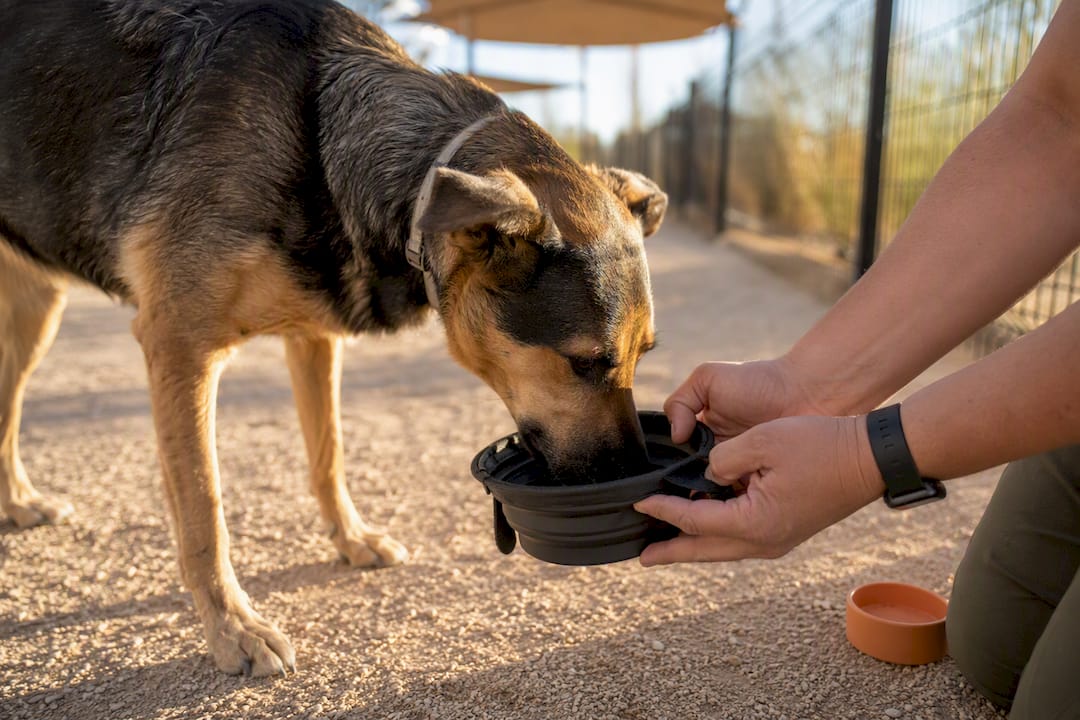
Watch for the early signs of dehydration: heavy panting that doesn’t ease up during a break, dry or sticky gums, or a sudden drop in energy after a burst of play. Any of those is your signal to pull your dog aside for a water break immediately, not to wait until the visit naturally winds down.
Shared water bowls at the park entrance are a genuine health risk. Dogs drink from a communal bowl, drool into it, and the next dog drinks right after. That’s a straightforward way for kennel cough, giardia, and other easily transmitted illnesses to spread through a group of dogs who’ve never even played together. Bringing your own bowl isn’t overly cautious. It’s a basic part of keeping your dog, and everyone else’s, healthy.
Hydration matters just as much on cooler days as hot ones, since active play still burns through fluid regardless of the temperature outside. Offer water at least once during any visit longer than 20 minutes, even if your dog doesn’t seem to be asking for it.
Checking Weather and Ground Conditions Before You Head Out
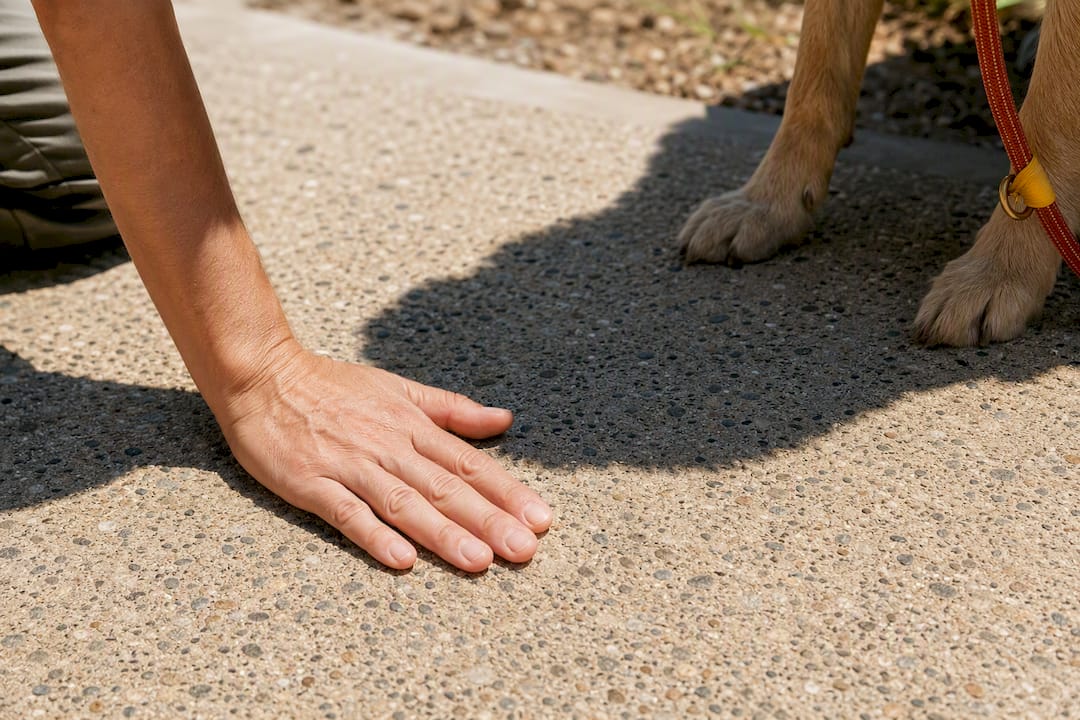
A sunny day doesn’t automatically mean a good day to visit. Surface temperature on asphalt or artificial turf can climb well above the air temperature, and that’s enough to burn a dog’s paw pads on a walk to the entrance gate alone. If you can’t hold your palm on the ground comfortably for five seconds, it’s too hot for your dog’s feet.
Rain and mud change the calculation in a different way. A soaked, slick park turns normal play into a slip-and-fall risk, and mud pits tend to concentrate bacteria and parasites that a quick toweling off at home won’t fully address. Heavy rain in the days before your visit is worth checking on too, since standing water is a breeding ground for issues you won’t notice until your dog is sick a few days later.
Wind and storms carry their own risk, mostly around anxious dogs who become harder to control and more likely to bolt at a sudden noise. If a storm is rolling in, that’s a day to skip the park entirely rather than risk it.
Cold weather has a shorter fuse than most owners expect too. Small or short-coated breeds can start showing discomfort in under 15 minutes in freezing temperatures, well before most owners think to head back to the car. Check the forecast, check the ground, and when in doubt, shorten the visit rather than pushing through conditions that aren’t working in your dog’s favor.
Etiquette Doesn’t Stop at the Municipal Park Gate
Shared pet spaces at an extended-stay property work on a different rhythm than a public park. There’s no gate-crowd dynamic, but the rules around noise, hours, and waste cleanup still apply, often more strictly because you’re sharing the space with the same small group of neighbors for weeks or months at a time.
Around a pool or a community area, a leash stays on unless you’re in a designated off-leash zone, and that’s not up for interpretation. For those traveling with pets, finding Best Pet Friendly Hotel Deals can make managing such shared spaces much easier. Pick up immediately, every time, even if no one’s watching. Quiet hours matter more in a residential-style setting than they ever do at a public park, since the person next door might be sleeping before an early shift. The short version: treat a managed pet area like your own backyard, not a free-for-all, and everyone’s stay goes smoother.
A Managed Alternative to the Busy Municipal Dog Park
If your dog does better with a smaller, calmer space than a crowded public park, a managed property can give traveling and long-stay pet owners that option without the drive across town. The property includes dedicated pet areas alongside the pool, gym, and fishing pond, and the booking process can be handled online, from application to payment, eliminating phone calls.

For those on extended assignments, that means fewer variables to manage on top of an already packed schedule. You can check RV site availability or browse the on-site amenities, including the dog areas, before you commit to a length of stay. If you’re weighing a public park against a quieter, gated space for your dog’s daily exercise, consider checking dates and applying online with the property.
Sources
- Should You Take Your Dog to a Dog Park? - American Kennel Club
- Dog body language at park: what to watch | Bark Park Finder


