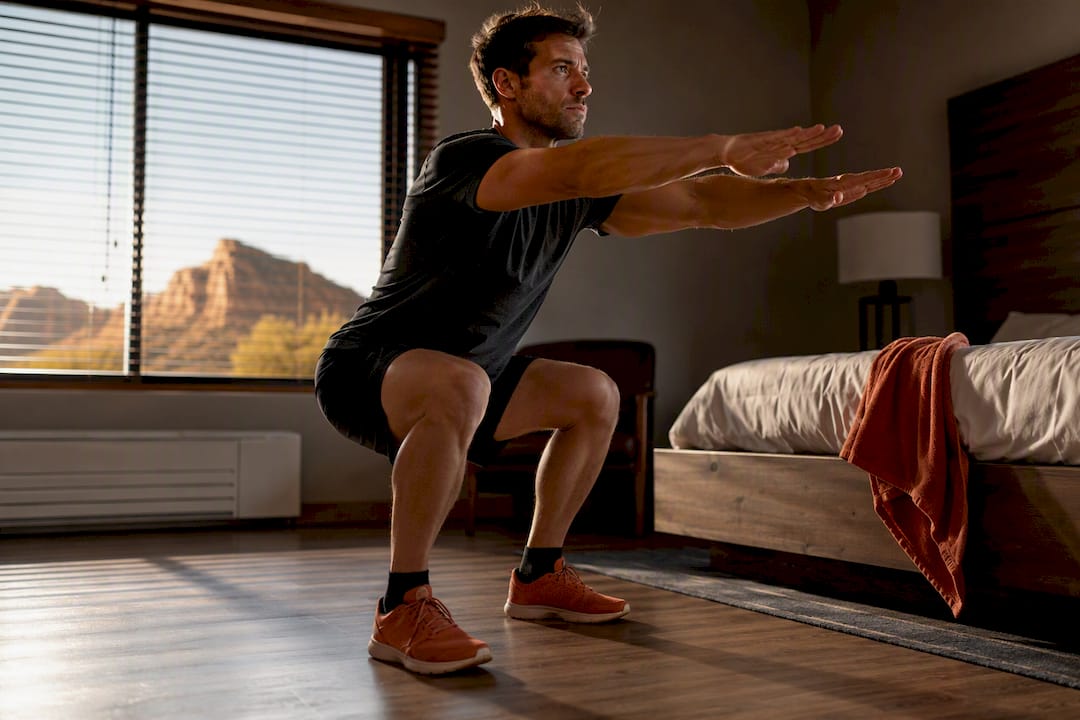
Fitness while traveling comes down to one shift in mindset: stop chasing progress and start protecting what you already built. That means two short strength sessions a week, daily movement of some kind, and tight control over your first meal of the day. Pack a resistance band, learn one 20-minute bodyweight circuit, and treat both like appointments you don’t cancel.
TL;DR:
- Short maintenance workouts, such as two strength sessions and daily movement, can preserve muscle and strength for up to a week of travel without failure.
- Effective no-equipment routines focus on five key movements—squat, push, hinge, pull, and core—that can be performed anywhere in 20 minutes.
- Packing lightweight resistance bands, a jump rope, and a lacrosse ball covers most training needs, even with minimal gear.
- Controlled breakfast choices high in protein and fat, along with strategic hydration, support nutrition and hydration goals during travel.
- Consistent scheduling, such as morning workouts and arrival day routines, helps maintain discipline despite unpredictable travel plans.
Table of Contents
- How Maintenance-First Fitness While Traveling Actually Works
- Quick, No-Equipment Routines You Can Do Anywhere
- Portable Kit: What to Pack (and What to Skip)
- Nutrition While Traveling: Simple Rules That Preserve Results
- Scheduling and Consistency: Make Workouts Non-Negotiable
- Recovery, Sleep, and Jet Lag: Small Habits That Matter
- Three Ready-to-Run 20 to 30 Minute Sample Workouts
- Author Perspective and Practical Notes from Mesquite Oasis
- Staying Active During Long Travel Days
- Mental Health and Stress Management Techniques While Traveling
- Safety Considerations for Exercising in Unfamiliar Places
- A Short Reflection on Staying Consistent
- Extended Stays Built Around a Real Fitness Routine
- Sources
How Maintenance-First Fitness While Traveling Actually Works
Most travelers ruin their routine by trying to replicate their home gym schedule on the road, then quitting entirely when that fails. The smarter approach flips the goal. You’re not trying to get stronger this month. You’re trying to lose as little as possible until you’re back to a normal schedule.
That distinction changes everything about how you train. A review of rest periods and training interruptions found that short breaks and maintenance-level work preserve muscle and strength surprisingly well, and even a full week of rest doesn’t necessarily undo months of progress. Travel workout tips built around this idea stop feeling like a compromise and start feeling like common sense.
Fitness organizations that specialize in travel advice generally recommend a simple floor: two strength sessions plus a walking or step target for most trips. Anything above that is a bonus, not a requirement. If you land in a new city and your only workout that week is a 20-minute hotel room circuit and a couple of long walks, you’ve done the job.
Quick, No-Equipment Routines You Can Do Anywhere
Every effective bodyweight workout on the road follows the same skeleton: squat, push, hinge, pull, and a core or conditioning finisher. Learn this five-movement framework once and you can build a fresh workout in any room, any city, with zero planning.
Squat covers anything that loads your legs through a bend at the knee and hip. Bodyweight squats, lunges, and step-ups on a hotel chair all count. Push means pressing weight away from your body. Push-ups are the default, but you can shift the angle (incline against a bed, decline with feet elevated) to change difficulty. Hinge is the hip-dominant movement, usually a Romanian deadlift pattern, glute bridge, or single-leg deadlift for balance work. Pull is trickier without equipment. This is where a resistance band or a sturdy luggage strap looped around a door earns its space in your bag. Core or conditioning closes the session. Planks, mountain climbers, or a short burst of jumping jacks all fit.
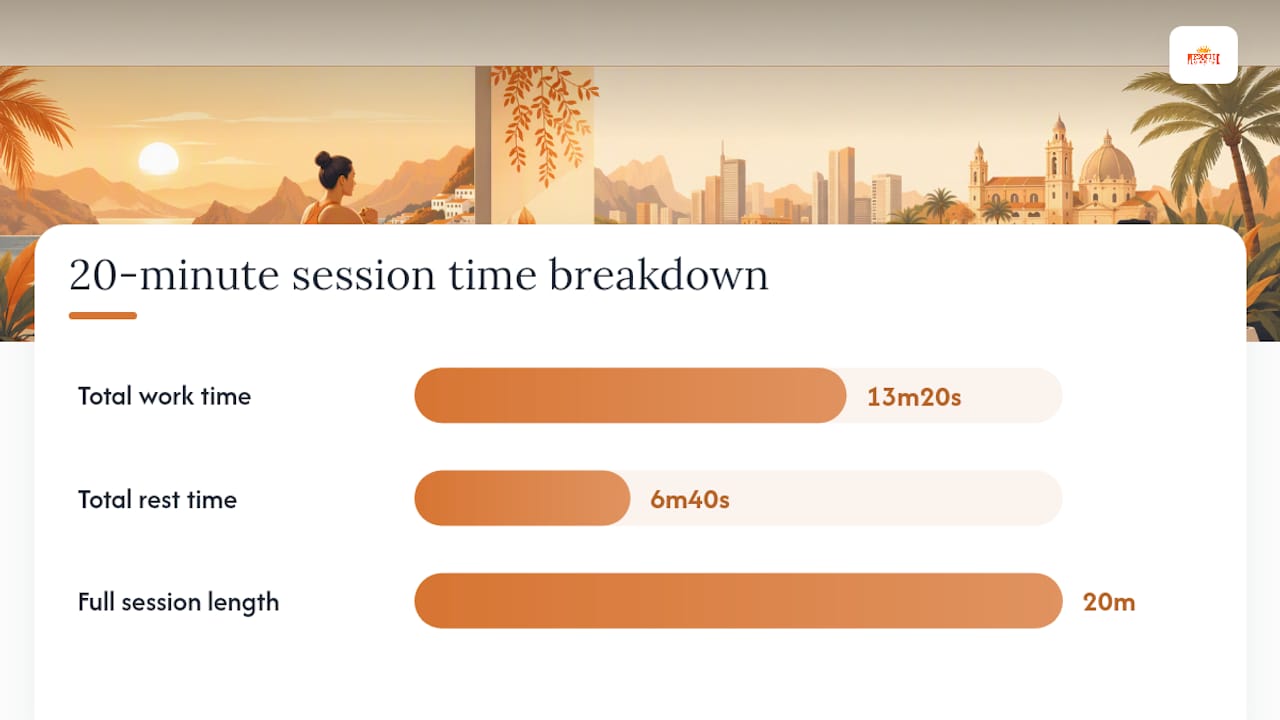
A 20-minute, no-equipment workout is genuinely enough to maintain both strength and conditioning while you’re away from home, according to reporting in The New York Times, and that number lines up with what most maintenance-focused programs recommend.
Here’s how to turn that five-movement framework into an actual workout.
- Time-based circuit. Set a timer for 40 seconds of work, 20 seconds of rest, and cycle through all five movements twice. That’s a complete 10-minute round; run it twice for a full 20-minute session. Squats, push-ups, glute bridges, band rows, and mountain climbers work well here.
- Rep-matching rounds. Pick a rep target (12 to 15 per movement) and complete four total rounds, resting only as needed between exercises. This version rewards control over speed and tends to hit muscles a little harder per rep.
- Progression option. Slow the eccentric (lowering) phase of any movement to three or four seconds. A slow push-up or squat descent adds real difficulty without any equipment, and it’s often enough stimulus to maintain or even build a little muscle when nothing else is available.
- Regression option. Drop to knee push-ups, shorten your squat range, or reduce circuit rounds from four to two. A shorter, easier session you actually finish beats an ambitious one you skip.
- Hotel-room substitutions. No pull-up bar, no problem. Use a sturdy chair for tricep dips, loop a resistance band around a bathroom door handle for rows, or fill your carry-on with clothes and use it as a light weighted object for goblet squats and overhead presses.
The point of this template isn’t variety for its own sake. It’s that you never again have an excuse rooted in “I don’t have a plan.” You always have one.
Portable Kit: What to Pack (and What to Skip)
You don’t need a gym bag’s worth of gear to add real training variety on the road. Three or four small items cover almost every gap that bodyweight training leaves.
- Resistance bands fill the “pull” gap in the five-movement framework and let you load push and hinge movements too. Beginners generally do well starting with light resistance bands, while more advanced lifters use moderately heavier bands, aiming for controlled sets of multiple repetitions. Bands pack flat, weigh almost nothing, and clear airport security without a second look.
- A jump rope is the single best conditioning tool you can pack. Ten minutes of intervals raises your heart rate faster than almost anything else that fits in a side pocket.
- A lacrosse ball doubles as a recovery tool for tight feet, glutes, and upper back after long flights or drives. It’s cheap, small, and does double duty as a warm-up tool before a workout.
- A suspension trainer (the compact TRX GO style is a common choice) is optional but worth it if you travel often. It turns any door or sturdy beam into a full pulley system for rows, presses, and core work.
Pack workout clothes that dry fast and pack small, and bring a mesh bag or scent-neutralizing pouch to keep sweaty gear from contaminating the rest of your suitcase. Rotate two pairs of training shoes if you have room. One stays dedicated to outdoor walking or running, the other stays clean for indoor circuits.
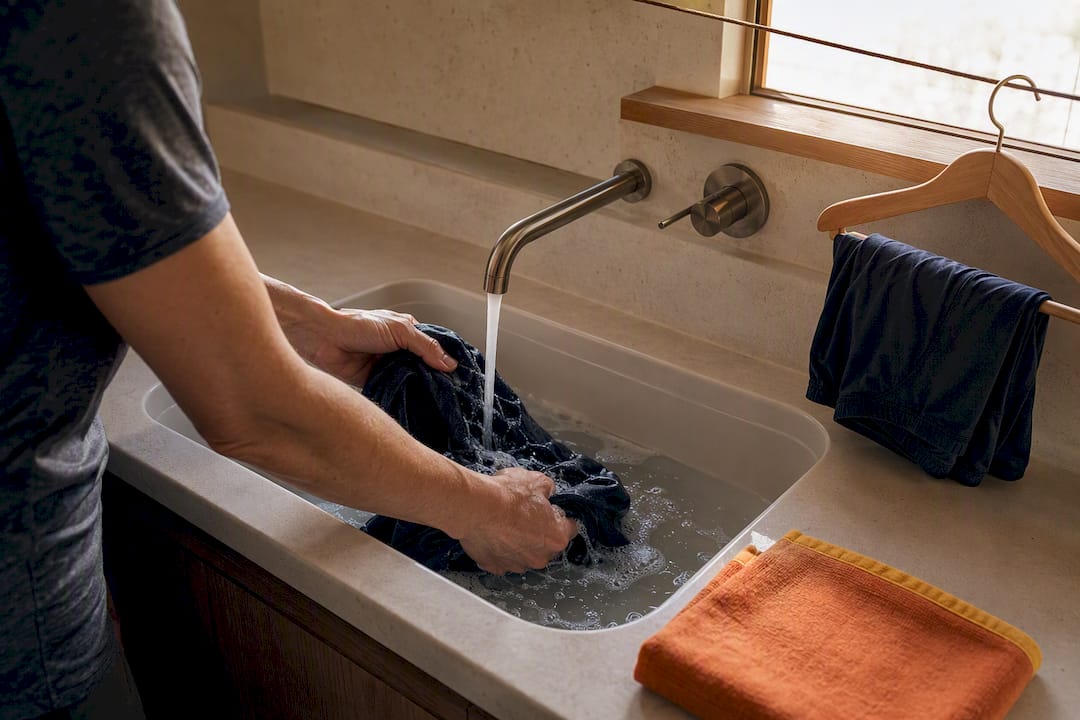
Pro Tip: Wash a single set of workout clothes in the sink with a travel-size packet of detergent and hang them to dry overnight. It solves the “no clean gear” excuse permanently and takes about five minutes.
Nutrition While Traveling: Simple Rules That Preserve Results
Breakfast is the one meal you can almost fully control, even on the road, and controlling it does more for your nutrition than any other single habit. A protein-and-fat combination (eggs, Greek yogurt, nuts, or a protein shake) keeps you full longer and reduces the odds you overcorrect at lunch. Save your discretionary calories for dinners, client meetings, or meals you can’t avoid.
A quick stop at any grocery store near your hotel solves most of the rest:
- Greek yogurt or cottage cheese for protein without cooking
- Beef jerky or turkey sticks for a shelf-stable protein source
- Fresh fruit for fiber and easy snacking between meetings
- A reusable water bottle you refill instead of relying on minibar prices
Hydration deserves special attention on flights. Cabin air runs drier than most environments, making dehydration common even on shorter flights. Staying ahead of that means drinking water steadily throughout the flight rather than catching up after landing.
By the numbers: Cabin humidity on a typical flight runs well below what your body is used to at sea level, which is part of why so many travelers land feeling foggy and drained even on short flights.
Practical scheduling and hydration strategies for travelers consistently point to the same fix: build hydration into your routine before you feel thirsty, not after.
Alcohol and nightlife are where most travel nutrition plans quietly fall apart. One drink with dinner is rarely the problem. The problem is treating every night on the road like a night out, which stacks calories, wrecks sleep, and makes the next morning’s workout feel impossible. If you’re traveling for work and want food ideas that hold up over long stretches away from home, a trucker’s guide to eating well on the road covers strategies that apply just as well to anyone living out of hotels or an RV for weeks at a time.
Scheduling and Consistency: Make Workouts Non-Negotiable
A workout that isn’t on your calendar competes with every meeting, flight delay, and dinner invite that comes up during the day, and it usually loses. Block your training time the same way you’d block a client call. Once it’s written down, it stops being optional.
- Claim the 6 to 8 AM window. Morning sessions have a real logistical advantage: nothing has gone wrong yet. Meetings run long, flights get delayed, and dinners run late, but a 6 AM slot rarely gets stolen by anything.
- Build a 10 to 20 minute fallback plan. Some days won’t allow a full session. Have a shorter version ready (10 minutes of the five-movement circuit at a faster pace) so a busy day doesn’t turn into a skipped day.
- Run an arrival-day circuit. After a long flight or drive, a light 20-minute bodyweight session helps your body transition out of travel mode and counters hours of sitting. Keep intensity low. This is about circulation and posture, not performance.
- Adapt when the hotel gym is a disappointment. A single treadmill and a rack of dumbbells missing every plate above 20 pounds is common. When that happens, default to your bodyweight template instead of wasting time waiting for equipment.
Recovery, Sleep, and Jet Lag: Small Habits That Matter
Recovery on the road hinges on three things: hydration, light exposure, and permission to rest without guilt.
For flights, a rough guideline is to drink water regularly during the flight, increasing intake if consuming coffee or alcohol, which can increase fluid loss. Long drives deserve the same attention. It’s easy to go three or four hours between sips when you’re focused on the road.
Sleep hygiene matters more when you’re jet-lagged or sleeping in an unfamiliar bed:
- Get outside in daylight as soon as possible after arrival, especially if you’ve crossed multiple time zones.
- Pack an eye mask and earplugs. Hotel curtains rarely block light as well as your bedroom does.
- Keep the room cooler than feels natural at bedtime. Most people sleep better a few degrees below their normal home setting.
Pro Tip: If a travel day wrecks your schedule completely, take the rest day without guilt. A single missed week doesn’t meaningfully set back your long-term strength or muscle , so there’s no reason to force a bad workout just to avoid a zero.
Three Ready-to-Run 20 to 30 Minute Sample Workouts
Each of these routines uses the five-movement framework, requires little to no noise, and fits in a standard hotel room.
1. Bodyweight AMRAP (As Many Rounds As Possible) Goal: general maintenance, minimal space, zero noise.
- Warm-up: 2 minutes of marching in place plus 10 arm circles each direction
- 20 minutes on the clock, complete as many rounds as possible: 10 squats, 8 push-ups, 10 glute bridges, 30-second plank, 10 alternating reverse lunges per leg
- Scaling: drop to knee push-ups or shorten the plank to 15 seconds if needed
- Cool-down: 3 minutes of hamstring and hip flexor stretching
This format rewards pacing. If you go too hard in round one, you’ll pay for it by round four. Aim for a rhythm you could sustain for the full session, not a sprint.
2. Band Strength Circuit Goal: strength maintenance using a packed resistance band.
- Warm-up: 2 minutes of band pull-aparts and bodyweight squats
- 4 rounds of: 15 to 20 band rows, 15 band squats, 12 band overhead presses per arm, 15 band deadlifts, resting 60 seconds between rounds
- Scaling: advanced travelers use an 8 to 10 pound band; beginners start around 3 to 5 pounds
- Cool-down: band-assisted shoulder and hip stretches, holding each for 20 seconds
This one is quiet enough for a shared wall and takes almost no floor space, which makes it the best fit for a lodge room or a shared RV site.
3. Low-Rest HIIT (High-Intensity Interval Training) Goal: conditioning and calorie burn in a short window.
- Warm-up: 3 minutes of light jogging in place plus dynamic leg swings
- 30 seconds of work, 15 seconds of rest, six exercises per round, four total rounds: jumping jacks, mountain climbers, squat jumps, push-ups, high knees, plank shoulder taps
- Scaling: swap jump variations for step-back versions to keep it low-impact on carpeted floors or upper-level rooms
- Cool-down: 4 minutes of full-body stretching, focusing on calves and shoulders
Mobility mini-session for arrival days: After a flight or a long drive, skip the intensity entirely. Spend 10 minutes moving through cat-cow stretches, hip circles, standing hamstring stretches, and shoulder rolls. It won’t feel like a workout, but it resets your posture and primes you for a real session the next morning. If you want more structured options here, short mobility flows built for people working on the road offer a good template to follow.
Author Perspective and Practical Notes from Mesquite Oasis
Guests staying with us for weeks or months at a time, mostly people working long assignments in the Permian Basin, face a version of this problem that’s less about vacation disruption and more about sustaining a routine over a long stretch. What tends to work:
- Treat the on-site gym like a shift. Crews on early call times often train in the evening; night-shift workers use the early morning hours before the property gets busy.
- The pool and outdoor recreational space work well for low-impact recovery days between harder training sessions.
- Laundry access on-site means gear rotation isn’t a logistics problem the way it can be at a standard hotel. You can wash training clothes the same day you sweat through them.
- Secure PIN-code access to amenities means no waiting on staff or coordinating hours around a front desk, which matters when your schedule doesn’t look like everyone else’s.
The online application and payment system also removes a layer of friction that has nothing to do with fitness directly but affects it anyway. Handling everything digitally, from applications to payments, means you’re not burning evening hours on paperwork that could go toward a workout or actual sleep.
Staying Active During Long Travel Days
Airport layovers and long drives are dead time you can reclaim without breaking a sweat in public. Most airports have long, straight concourses built for exactly this. Walk the length of your terminal once or twice between checking your phone and boarding, and you’ve covered more ground than most travelers do in a day.
If you have real space near your gate, calf raises, standing hip circles, and a set of bodyweight squats hidden near a wall don’t draw much attention and keep your legs from stiffening up before a flight. Once you’re seated, ankle circles, seated marches, and shoulder rolls every hour or so counter the circulation problems that come from sitting still for hours at altitude.
Long drives deserve the same treatment. Stop every two hours if you can, and use five minutes to walk, stretch your hip flexors, and do a short set of bodyweight squats at the rest stop. It sounds minor, but it adds up over a full day of driving, and it makes the eventual workout that evening feel far less like starting from zero.
The goal here isn’t fitness in the traditional sense. It’s keeping your body from stiffening into a shape that makes tomorrow’s real workout harder than it needs to be.
Mental Health and Stress Management Techniques While Traveling
Travel stress compounds fast: disrupted sleep, unfamiliar food, packed schedules, and the low hum of navigating a new place all pull on the same mental reserves. Exercise helps here, but it’s not the only lever worth pulling.
A short walk outside, even without any fitness goal attached, does real work for stress regulation, especially after a stretch of sitting in meetings or a car. Pair it with a few minutes of quiet, phone-free time and you get most of the benefit people chase through longer meditation sessions.
Keeping a loose but real routine, same wake time, same rough workout window, same first meal, gives your brain a sense of structure even when the location keeps changing. That predictability matters more than people expect. It’s one reason the scheduling habits covered earlier do double duty: they protect your training and quietly protect your mood.
If a trip runs long enough that isolation becomes its own problem, staying in touch with people back home on a regular schedule, rather than sporadically, tends to matter more than any single wellness habit. Fitness routines for travelers work best when they’re one piece of a broader routine, not a stand-in for everything else that keeps you steady.
Safety Considerations for Exercising in Unfamiliar Places
Running or walking in a city you don’t know carries different risks than your usual route at home, and it’s worth adjusting for that rather than assuming your normal habits transfer directly.
Check with hotel or lodging staff about safe times and areas for outdoor exercise before you head out, especially early morning or after dark. Carry your phone, skip both headphones at full volume, and let someone know your rough route and expected return time if you’re heading out alone in an unfamiliar area.
Hotel gyms carry their own small risks: unfamiliar equipment, poor lighting in early morning hours, and machines that haven’t been maintained as well as a commercial gym’s. Check equipment before loading it up, and don’t assume a hotel gym’s dumbbells or bands match the quality you’re used to.
If you’re staying somewhere with a controlled-access facility, the practical risks drop considerably. Gated access and PIN-controlled amenities remove a lot of the guesswork that comes with wandering into an unfamiliar public gym or an unlit street at 5 AM.
A Short Reflection on Staying Consistent
The travelers who keep their fitness intact aren’t the ones with the most willpower. They’re the ones who lowered the bar to something they’ll actually hit. Maintenance, not progress, is the entire goal while you’re away from your normal setup.
Start today with three things: pack a resistance band, block your workout on the calendar before anything else fills that slot, and control your breakfast. That’s genuinely enough most weeks.
Give yourself room to miss a day. One skipped session isn’t a failure. It’s just a Tuesday.
Extended Stays Built Around a Real Fitness Routine
If you’re on a long assignment and tired of treating fitness like something you’ll “get back to” once you’re settled, A facility with a gym, pool, and recreational space accessible by a personal PIN code and available on your schedule helps maintain a fitness routine without coordinating around others’ hours.

That matters more than it sounds like when you’re working shift work in the Permian Basin. A facility you can use at 5 AM before a shift or 9 PM after one, without waiting on staff, is the difference between a routine that survives a long assignment and one that quietly dies in week three. The amenities page lays out what’s available across both the RV sites and the furnished lodge rooms, and the entire booking process, from application to payment, runs online any hour of the day. If you’re planning an extended stay in Odessa and want a place where staying active doesn’t require a second plan, start your reservation and get your dates locked in.


