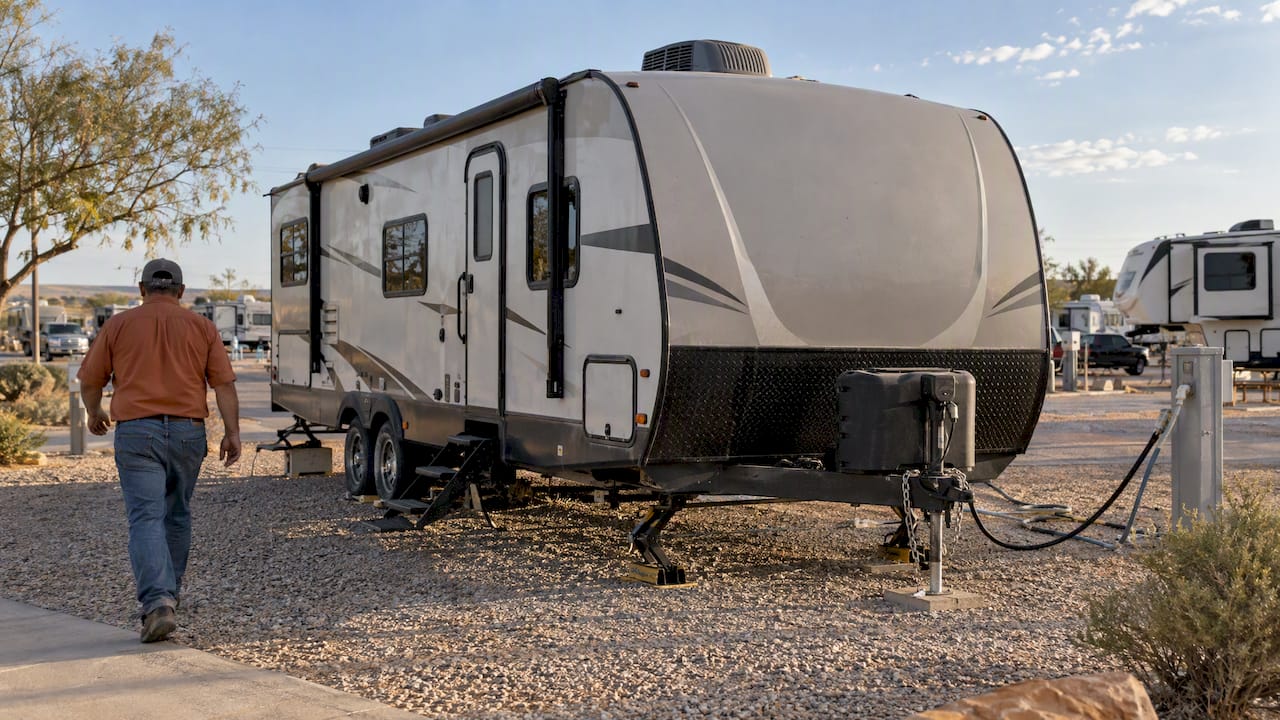
Most full-time RV residents use somewhere between 300 and 900 kWh a month, which translates to roughly $50 to $160 at typical residential electricity rates, though heavy air conditioning use or a park’s billing structure can push that higher. The biggest swing factors are your hookup type, climate, and how often the AC runs. This guide breaks down per-appliance wattage so you can estimate your own number and find where to trim it.
TL;DR:
- A 30-amp site caps simultaneous appliance load at roughly 3,600 watts, while a 50-amp hookup provides about 12,000 watts, allowing more appliances to run together without tripping.
- Behavior changes, such as raising the thermostat a few degrees or staggering high-draw appliance use, can reduce monthly costs more than hardware upgrades.
- Park billing methods vary, with some charging a flat fee and others billing per kWh, making it essential to clarify rates before booking a stay.
Table of Contents
- Typical monthly kWh and cost ranges: how to read your bill
- What uses the most electricity in an RV: appliance by appliance
- 30-amp vs. 50-amp hookups: what the numbers mean
- How climate and season change your monthly electricity usage
- Practical, high-impact ways to reduce monthly electricity use
- How electricity is metered and billed at RV parks
- Mesquite Oasis perspective: managing monthly utility costs for long-stay guests
- What the usage numbers actually tell you
- Predictable monthly stays and site options at Mesquite Oasis
- FAQ
- Sources
Typical monthly kWh and cost ranges: how to read your bill
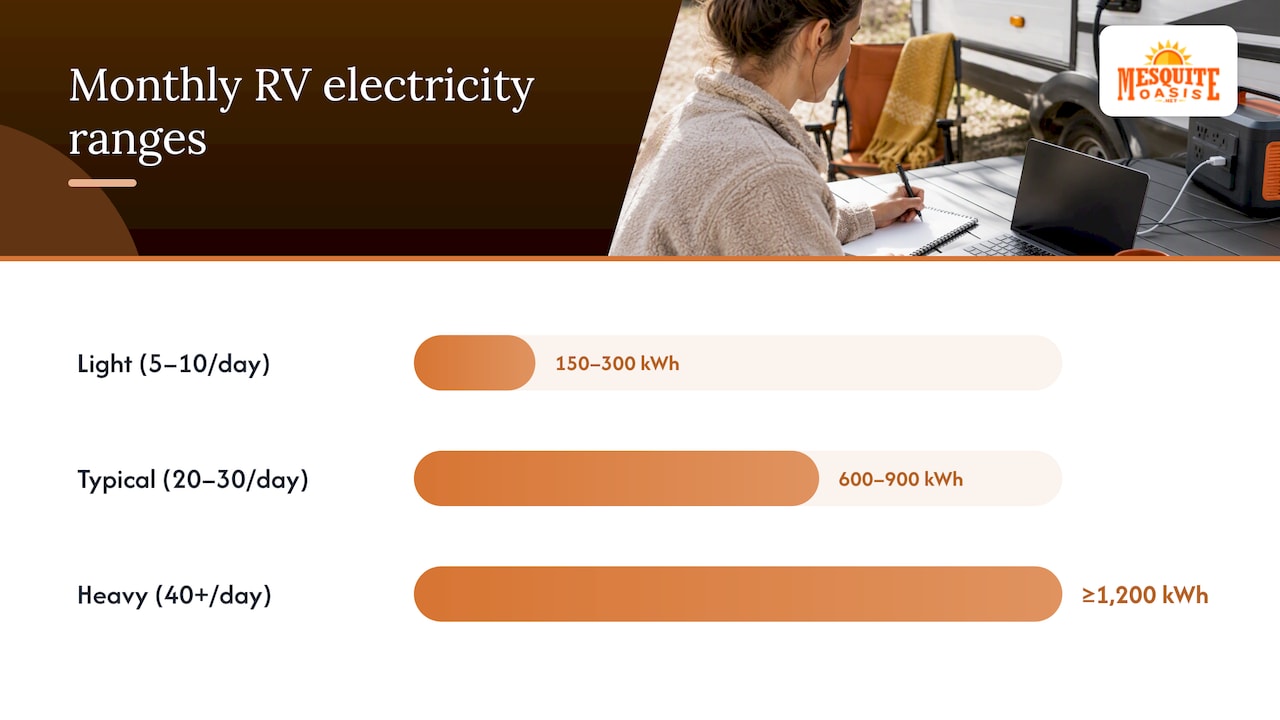
A light user, someone boondocking occasionally or running mostly lights and a laptop, might use 5 to 10 kWh a day, or 150 to 300 kWh a month. A typical full-time RV resident with a fridge, occasional AC, and normal electronics tends to land between 20 and 30 kWh a day, or 600 to 900 kWh monthly. A heavy user running AC most of the day in hot weather can climb past 40 kWh a day, pushing 1,200 kWh or more in a single month.
To turn kWh into dollars, the U.S. Energy Information Administration’s residential price table shows preliminary 2026 residential electricity prices running around 17 to 18 cents per kWh nationally.
A typical 750 kWh month costs about $131, while a light 200 kWh month runs closer to $35, based on the EIA’s residential rate data.
Park billing complicates this math. Some parks fold electricity into a flat site fee, some submeter and bill per kWh, and others add a flat utility surcharge regardless of actual draw. A fixed fee can work in your favor during a mild month and against you during a heavy AC month.
What uses the most electricity in an RV: appliance by appliance
Air conditioning dominates most RV electric bills. A typical rooftop unit runs at roughly 1,400 to 2,000 watts once compressing, with a running average near 1,700 watts, according to the RV Tech Library’s appliance load chart. Starting surge can hit several times that figure for a fraction of a second, which matters more for hookup capacity than for your monthly total.
Beyond the AC, a handful of appliances account for most of the rest of your draw:
- A refrigerator cycles on and off but averages 600 to 1,000 watts when running, adding up over a full day of intermittent cycling.
- A microwave draws 1,000 to 1,500 watts but only for minutes at a time, so its monthly kWh contribution stays small.
- A battery charger or inverter can pull 1,000 to 2,000 watts depending on the model and how depleted your batteries are.
Multiply any row by your own typical hours to get a personal daily estimate, then multiply by 30 for a monthly figure.
30-amp vs. 50-amp hookups: what the numbers mean
A 30-amp hookup delivers about 3,600 watts at 120 volts, while a 50-amp hookup provides two 120-volt legs for roughly 12,000 watts total. The amperage caps how much you can run at once, but it does not directly set your monthly kWh total, which depends on hours of use, not peak capacity.
- Running an AC (1,700 watts), a microwave (1,200 watts), and a water heater element (1,200 watts) simultaneously approaches or exceeds 30-amp capacity and commonly trips the breaker.
- The same combination sits comfortably within a 50-amp hookup’s higher ceiling, leaving room for a second AC unit or additional electronics.
- Staggering appliance use, running the microwave before or after the AC cycles, lets 30-amp sites handle most normal RV loads without tripping.
Choosing the right hookup matters more for avoiding interruptions than for controlling your bill, since a 50-amp site that runs the same appliances for the same hours uses the same kWh as a 30-amp site would.
How climate and season change your monthly electricity usage
Summer and winter push RV electricity use in opposite directions but for similar reasons: climate control. A full-timer in a hot climate running AC most of the day can see monthly kWh double or triple compared to spring or fall months. A full-timer using electric space heaters through a cold winter sees a similar spike, since resistance heating draws heavily and runs for long stretches.
- A hot-climate full-timer might use 400 kWh in a mild month and 1,000 kWh or more in peak summer.
- A temperate-climate full-timer often stays within a narrower 500 to 700 kWh band year-round.
- Shaded sites, good awnings, and east-west orientation that limits afternoon sun exposure all reduce how hard an AC has to work.
Planning travel around these patterns, or choosing a well-shaded site, smooths out the swings between your lowest and highest months — and knowing where to charge your EV near Red River Gorge can help plan your power needs on the road.
Practical, high-impact ways to reduce monthly electricity use
Cutting your electric bill works best when you start with free behavioral changes before spending money on upgrades.
- Raise your AC setpoint by a couple of degrees and use roof vents or fans to move air instead of running the compressor harder.
- Run high-draw appliances like the microwave or hair dryer at different times rather than stacking them with AC cycles.
- Keep the refrigerator door sealed tight and avoid overpacking it, since poor airflow makes the compressor run longer.
- Switch remaining incandescent bulbs to LEDs, which draw a fraction of the wattage for the same light output.
- Use a smart power strip to cut phantom draw from chargers and electronics left plugged in overnight.
- Check door seals, skylight gaskets, and vent covers for leaks that let conditioned air escape.
- Consider rooftop solar paired with a battery bank if you boondock often, or upgrade to a more efficient AC unit if you rely on shore power daily.
Pro Tip: A plug-in power meter or clamp meter costs very little and tells you exactly which appliance is driving your bill, turning guesswork into a number you can act on.
How electricity is metered and billed at RV parks
Parks handle electricity billing in a few common ways, and knowing which one applies to you changes how you budget. Some include electricity in a flat site rate regardless of usage. Others submeter each site and bill per kWh, often with a markup over the park’s own utility rate. Larger parks sometimes aggregate usage across a section and divide costs among residents.
- Ask management for the per-kWh rate and any fixed utility fee before booking a monthly stay.
- Request a copy of your meter readings periodically so you can track usage against your own appliance estimates.
- If a bill looks high, compare it to your appliance sum from the table above and ask for a meter check if the numbers don’t line up.
Learning how RV systems work in general, including guides like GoRVing’s water hookup walkthrough, helps new owners get comfortable verifying utility setups before relying on them for a full season.
Mesquite Oasis perspective: managing monthly utility costs for long-stay guests
Guests booking at this RV park’s 241 full-hookup sites handle applications and payments entirely online, so utility and site charges appear in a single predictable monthly statement rather than scattered invoices. Shift workers and crews on extended assignments benefit from that consolidation, especially when companies cover housing for multiple workers at once. On-site amenities such as laundry and gym facilities can reduce the need to spend on offsite services, helping keep total monthly costs easier to track. For site-specific billing questions, it is recommended to reach out directly through the property’s registration portal.
What the usage numbers actually tell you
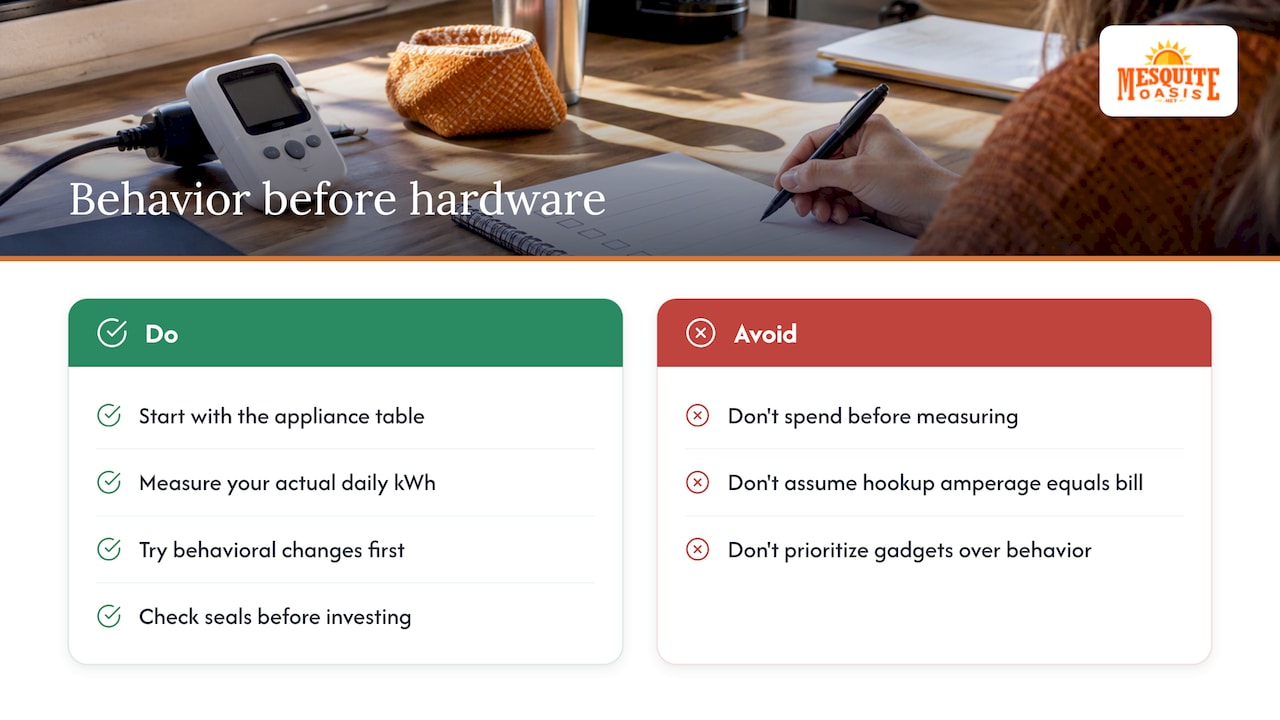
The conventional advice on RV electricity, buy solar, upgrade your AC, chase efficiency gadgets, skips the cheapest lever: behavior. A thermostat set two degrees higher or a microwave run at a different hour costs nothing and often saves more over a month than a hardware swap that takes years to pay for itself. Most guides also treat hookup amperage as if it controls your bill, when it really just controls what you can run at once without tripping a breaker.
If you’re estimating your own usage for the first time, start with the appliance table, not a park average. Averages hide wide differences between a boondocker running a laptop and a full-timer running AC ten hours a day in a hot climate. Once you know your actual daily kWh, decide whether a behavioral fix, a seal check, or a bigger investment like solar makes sense for your situation. Spending money before measuring is the single most common and avoidable mistake.
Predictable monthly stays and site options at Mesquite Oasis
Knowing your likely kWh range helps most when your monthly site cost is also predictable. Mesquite Oasis offers both 30-amp and 50-amp full-hookup sites, so you can match your hookup to your appliance load before you arrive, and the entire application and payment process happens online with no phone call required.

- 50 Amp and 30 Amp full-hookup RV sites are available for weekly or monthly stays.
- Furnished lodge rooms offer an alternative for crews who prefer a room over a site.
- Rates and fee details, including current pricing and fees, are listed online for easy comparison before you book.
Check availability and apply directly through our online registration portal to lock in a site that fits your power needs and your schedule.
FAQ
What is the average monthly electric bill for an RV?
Most full-time RV residents see electric costs between roughly $35 and $160 a month, depending on kWh usage and local rates, based on EIA residential price data. Heavy AC use or park markups can push bills higher, while light boondocking use keeps them near the low end.
What is the 3-3-3 rule for RV?
The 3-3-3 rule is a travel guideline, not an electricity rule: drive no more than 300 miles a day, stop by 3 PM, and stay at least three nights to rest. It doesn’t relate to power usage, but staying longer at one site does make it easier to track and manage your electricity costs.
Is it good to leave your RV plugged in all the time?
Staying plugged into shore power is common for full-time and extended-stay RV residents and generally fine for the RV’s electrical system. The main consideration is cost, since continuous AC or heater use while plugged in is what drives most of the monthly kWh totals discussed above.
How much is a monthly payment on a $100,000 RV?
Monthly RV loan payments depend on your interest rate, loan term, and down payment, so there is no single fixed number for any specific unit. A lender or RV dealer can provide an exact figure based on your credit and loan terms, which is separate from ongoing electricity and site costs.
Sources
- Electric Power Monthly - U.S. Energy Information Administration (EIA)
- RV Tech Library - Appliance load chart
- Water 101: How to Hook Up Water to Your RV Like a Pro | GoRVing


