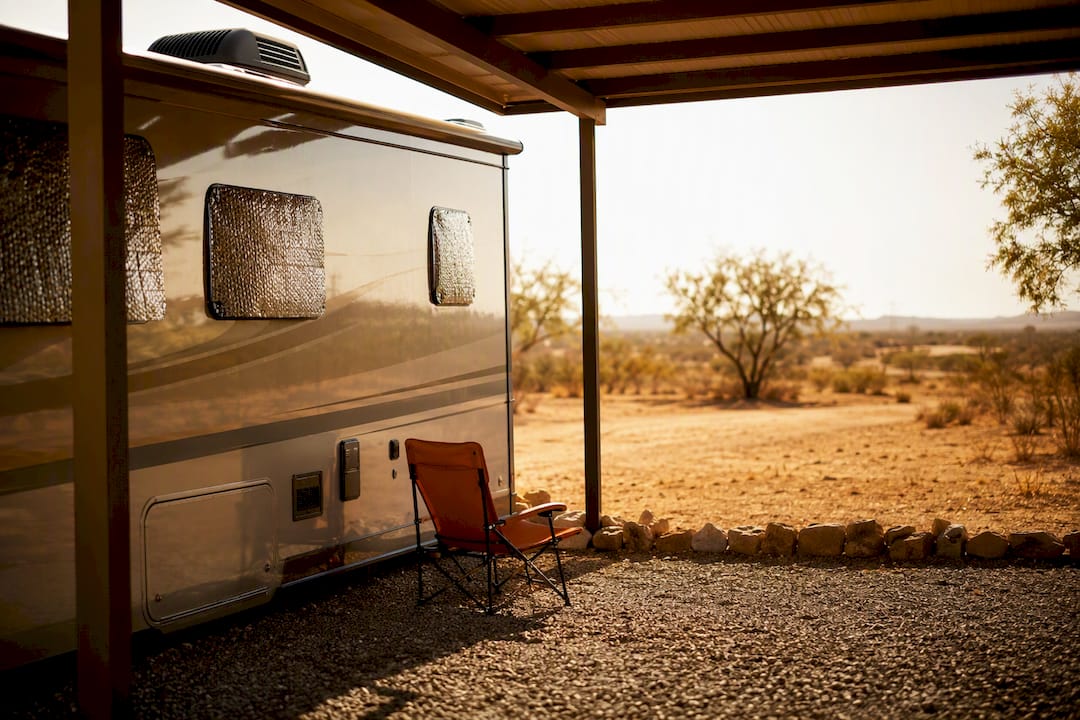
Win the heat before your air conditioner has to: block solar gain before it enters, keep the AC unit healthy, and time your ventilation to the outdoor air. The DOE’s ventilation-cooling guidance and CDC heat-safety guidance both point the same direction: passive defense first, mechanical cooling second. Parks like Mesquite Oasis that offer shaded, full-hookup sites make that sequence far easier to accomplish.
TL;DR:
- Proper maintenance, including frequent filter and coil cleaning, is essential for an RV air conditioner to operate efficiently during peak heat.
- Shaded parking, reflective window covers, and insulative layers significantly reduce solar heat gain, easing the cooling load on the AC.
- Timed ventilation, opening windows during cooler nights and sealing the rig during the hottest parts of the day, helps manage indoor temperatures effectively.
- Evaporative coolers work well only in dry climates; in humid areas, they add moisture and reduce comfort rather than improve cooling.
- Connecting to full-hookup sites with stable power and amenities like pools or showers provides the best relief from extreme heat and avoids power limitations.
Table of Contents
- Help your RV air conditioner perform
- Reduce incoming heat before it reaches your walls
- Time your ventilation to the outdoor air
- When evaporative cooling helps, and when it backfires
- Power realities: what your electrical setup can actually run
- A simple routine for extreme-heat days
- Insulation upgrades that keep the heat out longer
- Portable evaporative coolers and fans as backup cooling
- Safety when you’re cooling an enclosed space in extreme heat
- Why site choice changes the whole cooling equation
- Check availability at a shaded, full-hookup site
- Where this guidance comes from
- Sources
- FAQ
Help your RV air conditioner perform
An RV air conditioner that is clean and properly powered will always outcool a neglected one, no matter how expensive it was. Filters clogged with dust choke airflow and force the compressor to work harder for a smaller temperature drop, so Furrion recommends regularly checking or cleaning the return-air filter during peak season. The same guidance calls for inspecting coils, clearing rooftop debris around the condenser, and leaving 3 to 5 minutes between mode changes so the compressor doesn’t short-cycle.
A few habits protect the unit and your comfort at the same time.
- Clean or replace the filter every two weeks in peak heat, more often if you’re near dust or gravel roads.
- Clear leaves, pollen, and debris from the rooftop shroud and condenser fins each week.
- Check that the duct divider inside the unit is seated correctly, since a loose one lets cold air leak back into the return side.
- Run an EMS or plug-in voltage monitor to catch brownouts before they damage the compressor.
- Consider a soft-start device, which lowers the startup amperage and lets the AC run more reliably on weaker power sources.
Turbo mode pulls the temperature down fastest but draws the most power. Once the space is cool, switching to Eco or Sleep mode holds that temperature with less cycling, which is usually the better long-run setting during a multi-day heat spell. Ice on the coil, water dripping inside instead of outside, repeated circuit trips, or a weak temperature drop across the vents are all signs that call for a professional check rather than another filter swap.
Pro Tip: If your AC keeps tripping the breaker on hot afternoons, suspect voltage before you suspect the compressor. Check it with a plug-in monitor first.
Reduce incoming heat before it reaches your walls
The cheapest cooling you’ll ever get is the heat that never gets inside. Where you park matters as much as any appliance: a shaded site, or simply turning the RV so its longest wall faces away from the afternoon sun, cuts the solar load hitting the biggest surface of the rig. Boondocking guides note that this kind of site selection, weighed against solar charging needs, is one of the first calls to make before you even set up camp, per DoItYourselfRV’s boondocking advice.
From there, a few layers do most of the work.
- Deploy your awning or a portable canopy to shade the wall that takes the worst afternoon sun.
- Cover the windshield and cab windows, which are usually the least insulated glass on the rig.
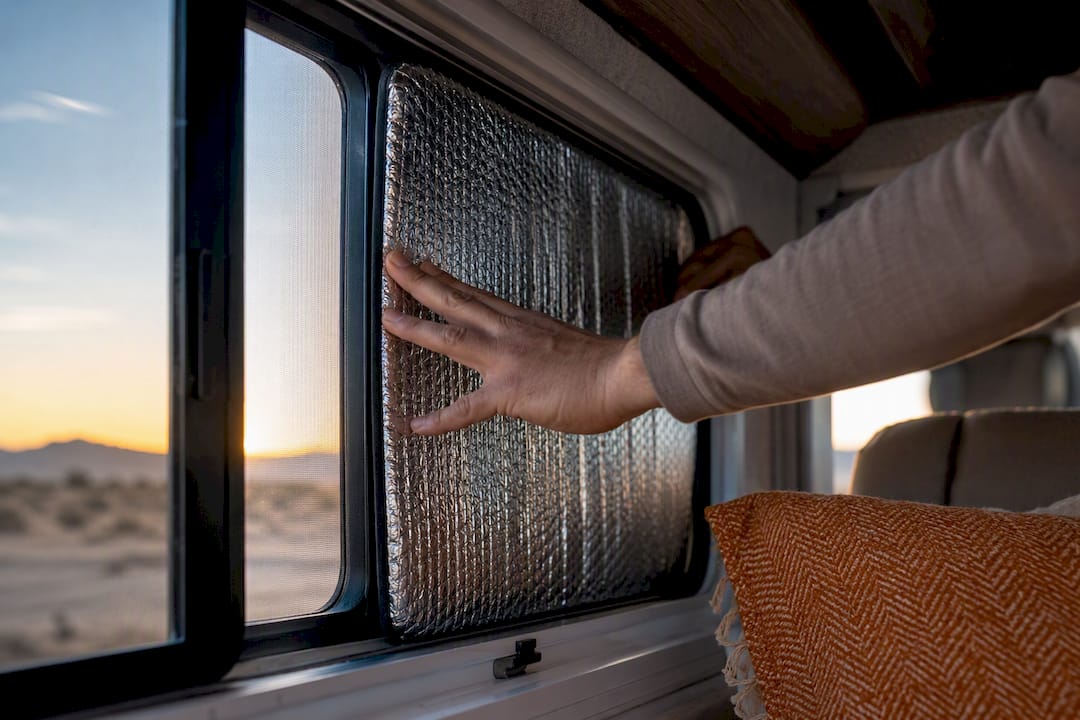
- Add reflective window inserts such as Reflectix behind curtains to block radiant heat without losing privacy.
- Fit insulated cushions or covers over roof vents and skylights, another major point of heat entry.
- Look at reflective or light-colored roof coatings, since a white roof absorbs far less heat than a dark one.
None of these single-handedly solves extreme heat, but stacked together they lower how hard the AC has to work.
Pro Tip: Put the reflective covers up before sunrise. Once the glass and roof are already hot, insulation only slows the bleed inward, it doesn’t undo it.
Time your ventilation to the outdoor air
Ventilation only helps when the air coming in is actually better than the air already inside. The DOE’s Measure Guideline on ventilation cooling explains that night ventilation works when overnight lows drop low enough and the day-night swing is large, roughly a low near 65°F with a swing of about 20°F or more. Below that threshold, opening up just invites heat and humidity back in.
A workable routine for an RV:
- Seal the rig, close vents and shades, once the outside temperature climbs above the inside temperature.
- Reopen everything in the evening as soon as outdoor air drops below the indoor reading.
- Run a roof fan in exhaust mode and crack a shaded window on the opposite side to create real cross-flow, not just noise.
- Aim portable fans at people and pets in beds or the dinette rather than trying to cool empty air in the middle of the rig.
- Close back up before sunrise, while the trapped night air is still the coolest air you’ll have all day.
This is timing, not gear. The fan and vent placement matter less than doing it on the right schedule.
When evaporative cooling helps, and when it backfires
Evaporative coolers, often called swamp coolers, work by adding moisture to dry air as it evaporates, which pulls the temperature down. That mechanism only pays off in hot, dry climates. In humid regions, adding more moisture to already damp air makes the space feel stickier rather than cooler, and it raises the odds of microbial growth if pads and tanks aren’t cleaned often.
Research into evaporative cooler environments found different fungal populations in homes using evaporative coolers compared to homes using standard air conditioning, a signal that the added moisture changes what grows indoors, according to CDC-stacked research.
- Evaporative coolers suit arid climates where the outdoor air is already dry.
- In humid conditions, prioritize AC and nighttime ventilation timing over adding a swamp cooler.
- Clean pads and tanks on a strict schedule if you do run one, since standing water invites mold and allergens.
Power realities: what your electrical setup can actually run
A single rooftop AC unit typically pulls a heavy surge on startup and a lower but steady draw once running, which is why 30-amp and 50-amp service behave so differently once you add a microwave, fridge, or second AC to the circuit. On 30-amp shore power, running one rooftop AC often leaves little headroom for anything else; 50-amp splits the load across two legs and gives more breathing room.
- Use an EMS or plug-in voltage monitor any time you’re on campground power, since low voltage from an overloaded pedestal damages compressors faster than heat does.
- A soft-start device cuts the startup amp spike, which helps a rooftop AC run on a smaller generator or a source that’s already stretched thin.
- Off-grid, running a single rooftop AC for meaningful hours generally requires a large lithium bank paired with a substantial solar array. Smaller battery setups are better suited to a portable or DC-powered unit cooling one sleeping area, per field guidance on 12-volt AC survival setups.
- If you plan to rely on a generator, load-test the entire setup, AC included, before the heat actually arrives, not during it.
Pro Tip: Pre-cool your rig in the morning while power and battery charge are both easiest to spare, then hold the temperature with Eco mode instead of restarting Turbo again and again.
A simple routine for extreme-heat days
Extreme heat rewards a routine more than any single gadget.
- Pre-day: pre-cool the rig, deploy the awning and window covers, check the filter, and confirm your EMS is reading normal voltage.
- During the day: seal the rig, cook outside when you can, cut back on electronics that add heat, and point fans at people and pets rather than empty space.
- Evening: open up once outdoor air drops below indoor air, pull in any damp towels or gear, and drop the AC to a low-power hold mode overnight.
- If it becomes dangerous: move to a site with full hookups, a public cooling space, or higher elevation rather than pushing through.
Pro Tip: Treat “move to hookups” as a real option, not a last resort. A stretched off-grid system in triple-digit heat is a bad place to discover its limits.
Insulation upgrades that keep the heat out longer
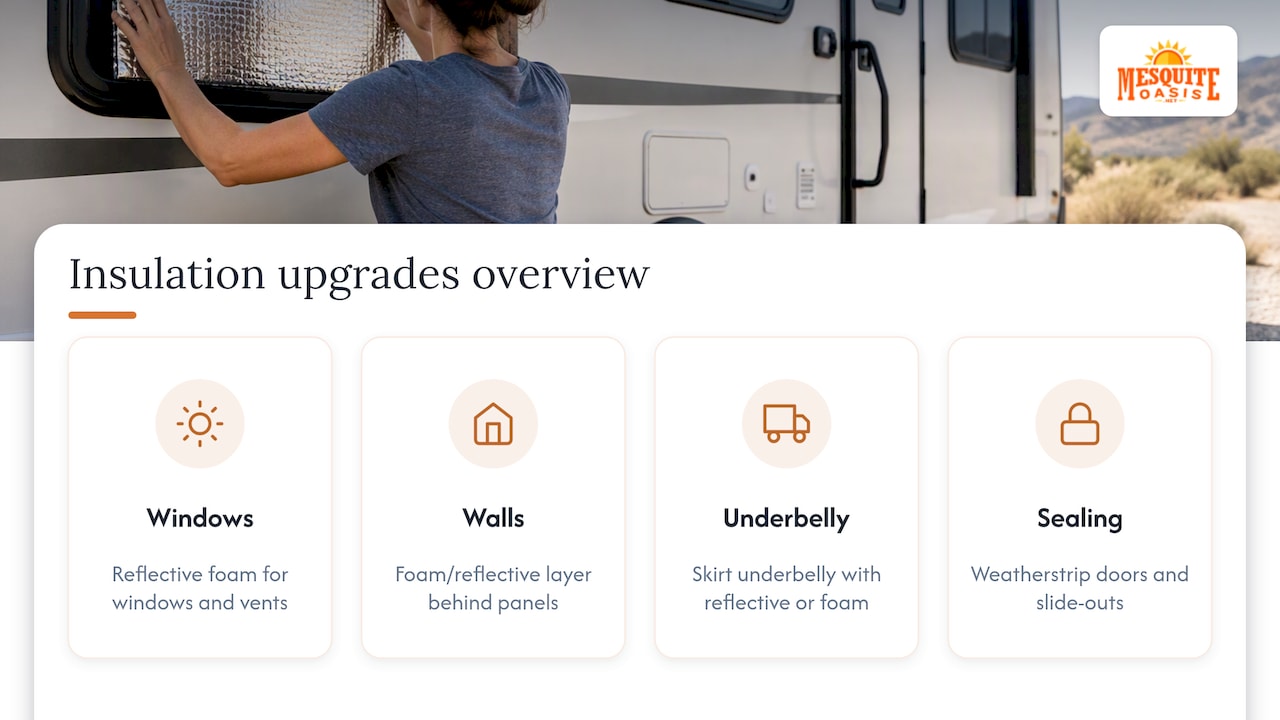
Insulation doesn’t cool an RV, it slows how fast outside heat becomes your problem, and in most rigs the weak points are the roof, the windows, and the underbelly. Factory insulation in many travel trailers and fifth wheels is thin compared to a house, so small upgrades tend to pay off disproportionately.
Reflective foam board cut to fit windows, cabinets, and the underside of roof vents blocks radiant heat cheaply and can be pulled out and stored when not needed. Adding a layer of foam board or reflective barrier behind interior wall panels, where accessible, reduces heat transfer through the thinnest sections of wall. Skirting the underbelly, even with a temporary reflective or foam skirt, cuts the heat radiating up from hot pavement or desert ground into the floor.
Weatherstripping around doors and slide-outs closes the small gaps that let hot air leak in continuously, undoing whatever the AC just accomplished. None of these fixes match the effect of shade or a healthy compressor, but they compound: a rig that’s shaded, skirted, vent-covered, and weatherstripped starts each afternoon several degrees behind one that has none of that in place, and the AC that follows has a much easier job.
Portable evaporative coolers and fans as backup cooling
Portable evaporative coolers and fans earn their place as supplemental tools, not replacements for a working rooftop AC. A portable evaporative unit makes sense in dry climates, especially for cooling one zone like a bedroom or an awning-covered outdoor space, and it draws far less power than a compressor-based AC, which matters when you’re watching a battery bank.
Fans do a different job entirely: they move air across skin to speed evaporation of sweat, which feels cooler even when the air temperature hasn’t dropped. That’s useful, but it has a hard limit.
- Choose an evaporative cooler only if your climate is dry; in humid conditions it adds discomfort instead of removing it.
- Pick a portable AC or evaporative unit sized for the one space you’re actually trying to cool, like a single bedroom, rather than the whole rig.
- Point fans directly at occupants, beds, or the dinette instead of running them to circulate the whole cabin.
- Clean and dry evaporative pads between uses to keep mold and mineral buildup from taking hold.
None of these tools substitute for the safety guidance below when temperatures turn dangerous.
Safety when you’re cooling an enclosed space in extreme heat
Fans and evaporative coolers can make a space feel more bearable, but they don’t lower core body temperature the way air conditioning or shade and hydration do. The CDC is direct about this: fans moving hot air around do not prevent heat-related illness, and relying on them alone during extreme heat is a real risk, especially for older adults, young children, and anyone with existing health conditions.
A few precautions matter more in an RV’s small volume than they would in a house. Never run a generator inside or right against the RV, since exhaust can seep in through vents and floor gaps. If you’re using a propane appliance for any reason during a heat event, keep a working carbon monoxide detector active, since sealed-up windows for AC efficiency also trap fumes. Drink water on a schedule rather than waiting to feel thirsty, since thirst lags dehydration in heat. Check on pets and anyone sleeping in a bunk or slide-out area, since heat collects unevenly in an RV and the highest bunk is often the hottest spot. If the AC fails or the rig can’t hold a safe temperature, treat that as a reason to relocate immediately rather than wait it out.
Why site choice changes the whole cooling equation
A shaded, full-hookup site removes half the problem before you touch a single setting. Reliable 30-amp or 50-amp power means the AC actually gets to run at full capacity instead of browning out, and on-site amenities like a pool, showers, and laundry give people a way to cool down and reset when the rig itself is fighting a 105-degree afternoon. A park offering full-hookup RV sites and furnished lodge rooms with PIN-protected access to amenities can simplify booking with an online system.
Check availability at a shaded, full-hookup site
Off-grid cooling has real ceilings: limited battery capacity, generators that can’t be tested until you need them, and shade you can’t always find on your own. A full-hookup site removes those constraints outright, giving your AC steady 30-amp or 50-amp power instead of a stretched inverter, and giving you a pool, showers, and laundry to fall back on when the afternoon heat wins anyway.

Mesquite Oasis manages the entire process online, application, approval, and payment, so there’s no need to call ahead during a heat wave just to confirm a site. Rates run 300 USD per week or 795 USD per month for a 50 Amp Site or 30 Amp Site, and lodge rooms with climate control start at 400 USD per week or 1,350 USD per month for a Single Room. For crews or extended stretches in extreme heat, check current availability and book directly at Mesquite Oasis.
Where this guidance comes from
The maintenance, power, and ventilation guidance here draws on a mix of federal building-science and public-health sources, RV manufacturer advice, and field-tested practitioner guides.
- DOE’s Measure Guideline on ventilation cooling, for night-ventilation timing and qualification criteria.
- CDC heat-safety guidance, for the limits of fans and the case for AC and hydration.
- CDC-stacked research on evaporative cooler environments, for moisture and fungal-risk findings.
- Furrion’s RV AC guidance, for filter, coil, and mode-switching maintenance schedules.
- DoItYourselfRV’s boondocking guide, for site selection and solar-versus-shade tradeoffs.
Sources
- How to use RV AC (Furrion blog)
- Heat and people without air conditioning | CDC
- Measure Guideline: Ventilation Cooling (DOE/Building America)
- Microbial rRNA sequencing analysis of evaporative cooler indoor environments (CDC-stacked data)
FAQ
How do I keep my RV cool in extreme heat?
Block solar gain first with shade, awnings, and reflective covers, then keep the AC clean and properly powered, and ventilate only when outdoor air is cooler than indoor air. The DOE’s ventilation-cooling guidance and CDC heat guidance both back this sequence: passive defense, healthy equipment, then timed airflow.
What is the 3-3-3 rule for RV?
Definitions of this rule vary across the RV community and it isn’t a formal cooling standard, so treat any version you see as informal guidance rather than an official rule. It’s more commonly cited for driving distance planning than for heat management, and it isn’t covered by the sources behind this guide.
How can I cool my RV without using an air conditioner?
Combine shade, reflective window and vent covers, and cross-ventilation timed to cooler outdoor air, using a roof fan in exhaust mode with a shaded intake open on the opposite side. In hot, dry climates a portable evaporative cooler can supplement this; in humid climates it tends to make comfort worse instead of better.
How to make your RV AC colder?
Start with the basics: a clean filter, a clear condenser and coil, and a properly seated duct divider, since Furrion notes many performance complaints trace back to these simple issues. Pair that with shade and reflective covers to cut the heat load the AC has to fight, and confirm you’re getting full voltage with an EMS or plug-in monitor.
Do I need full hookups to run my RV AC reliably in extreme heat?
Full hookups aren’t strictly required, but they remove the biggest constraints on off-grid cooling. A rooftop AC needs steady 30-amp or 50-amp power to run at full capacity without tripping breakers or straining a battery bank. Sites with shade and hookups, like those at Mesquite Oasis, make consistent AC performance far easier during a heat wave than relying on solar and batteries alone.


