A lodging receipt that gets reimbursed is an itemized folio from the place you stayed. It shows the property’s name and address, your name, the dates, the room rate and tax for each night, and proof that you paid. A credit card slip or a booking confirmation usually isn’t enough. If you travel for work in the Permian Basin, or you approve other people’s expense reports, this guide covers what to collect, what to do when something goes wrong, and how long stays change the paperwork.
TL;DR
- Lodging almost always needs a receipt, even for small amounts. The IRS instructions require records for travel expenses, and the $75 exception for other business costs doesn’t cover lodging.
- A good receipt is an itemized folio with the property name and address, traveler name, check-in and check-out dates, nightly rate and tax, and a zero balance or paid-in-full statement.
- A card statement proves you paid, but it doesn’t replace the folio. Third-party booking confirmations often fail too.
- Sharing a room, losing a receipt, or staying a month or longer each needs its own handling. Fix it before you leave, not after you file.
Table of Contents
- What counts as a lodging receipt
- Why an itemized folio, not a card statement
- The IRS side: why lodging gets stricter treatment
- Step by step: getting the receipt right at the property
- Sharing a room with coworkers
- When you lose the receipt
- Long stays: what changes after 30 days
- Receipt checklist for contractors and crew leads
- Perspective: what we see on long assignments
- Staying with us in Odessa
- FAQ
- Sources
What counts as a lodging receipt
People use “receipt” loosely. Finance offices don’t. The Texas Comptroller’s travel guidance says a valid lodging receipt comes from the lodging provider or an authorized broker and includes:
- The name and address of the establishment.
- The name of the traveler.
- Check-in and check-out dates.
- A daily itemization of room rate and taxes.
- Proof of payment, often a zero balance or a statement that the amount was paid in full.
That Texas page is written for state employees, so your employer’s policy may differ in the details. The pattern is the same almost everywhere, though. Indiana University’s travel office tells travelers to collect the hotel folio and notes that receipts are always required for lodging. The receipt must also name the person being reimbursed.
A useful test: could an auditor who has never met you rebuild your stay from this page alone? Where, who, when, how much per night, how much tax, and was it paid? If any answer is missing, get a better document.
Why an itemized folio, not a card statement
A card statement shows a merchant name and a total. It doesn’t show the nightly breakdown. Finance teams use the breakdown to separate the room from things most policies won’t pay for, such as room service or alcohol. Indiana University’s guidance is explicit that a card statement doesn’t replace an itemized lodging receipt.
Booking platforms add another trap. Utah’s state finance rules point out that some third-party sites issue itineraries rather than itemized receipts. If you booked through one, request the final zero-balance folio from the property or pull it from the platform’s billing section. Do it before you check out, while the front desk or the portal can still help you.
Here is how common documents compare:
| Document | Usually accepted? | Why |
|---|---|---|
| Itemized folio, zero balance | Yes | Shows nightly rate, tax, traveler and payment |
| Booking confirmation or itinerary | Usually no | Shows a plan, not what was charged or paid |
| Credit card statement alone | No | Proves payment but not the breakdown |
| Folio with a handwritten correction | Often yes | Fine if the note clarifies and doesn’t contradict the original |
| Altered or retyped receipt | No | Can’t be trusted as evidence |
The handwriting point matters. The Texas guidance says a folio is useless if altered, but a handwritten note is generally fine when it clarifies without contradicting. For example, you can subtract a meal charge that was billed to the room but isn’t reimbursable. Don’t scribble over amounts or white anything out.
The IRS side: why lodging gets stricter treatment
Most people have heard of the $75 rule: you don’t need a receipt for business expenses under $75. That rule is real but narrow. The IRS instructions say you can’t deduct travel expenses unless you keep records that prove the time, place, business purpose and amount. Lodging is an exception to the $75 threshold. A $60 room still needs a receipt.
If you’re an employee, the bigger issue is how your employer reimburses you. For reimbursements to be tax-free, they need to run through an accountable plan. Under Rev. Proc. 2019-48, that means substantiating the expense, returning excess advances within a reasonable time, and showing a business connection. If the arrangement doesn’t require that, the payments can be treated as taxable wages.
So a missing or sloppy lodging receipt can cost more than a delayed payment. It can turn a tax-free reimbursement into income on your W-2. For employers, that’s why finance teams are strict about folios.
Tax rules vary with your situation. If you’re unsure how your reimbursements are treated, ask your payroll department or a tax professional.
Step by step: getting the receipt right at the property
Most problems are cheap to fix on the day you check out and expensive to fix three months later.
- Give the right name at booking. The receipt must carry the traveler’s name. If your company books for you, make sure your name is on the reservation, not just the company’s.
- Ask what the receipt will show before you pay. You want the property’s name and address, your dates, and nightly rate and tax broken out.
- Request the final folio at check-out. Ask for a copy showing a zero balance. An interim bill from mid-stay isn’t proof of full payment.
- Check the details on the spot. Dates, spelling of your name, and the rate. Corrections are easy while you’re there.
- Photograph or scan it right away. Paper fades and gets lost in truck cabs. Most expense systems accept scans, but check yours. Harvard’s policy on electronic receipts is one example of how institutions define what a digital copy must show.
- Mark non-reimbursable items. If your policy excludes certain charges, note them on the copy you submit, in a way that doesn’t change the original figures.
- Submit within your policy window. Many employers set a deadline after the trip ends. Check yours.
Sharing a room with coworkers
Crews often split rooms. That’s where reimbursement gets messy, because one folio has one name on it.
Iowa’s state travel rules address shared stays: the primary guest keeps the original itemized folio, and the others need a copy or cross-referenced documentation to show their portion of the cost. In practice:
- Decide before check-in who is the registered guest.
- Ask the property to list occupants if it can, or write the names of the other travelers on a copy.
- Keep a short record of how the cost was split, signed by everyone involved.
- Check your employer’s policy. Some pay only a single-occupancy rate even when two people share.
See the Iowa Department of Administrative Services rule for one state’s wording. Your employer’s rules are the ones that apply to you.
When you lose the receipt
Contact the property first. Most can reissue a final folio, especially if you ask soon. Only if that fails should you reach for a missing receipt affidavit.
Affidavits are a last resort. UC Riverside’s accounting office expects travelers to try to get a replacement first, and frequent use can trigger management review or a denied claim. A typical affidavit asks for the date, amount, vendor, what happened to the receipt, and your signature. Don’t treat it as a shortcut.
Long stays: what changes after 30 days
Travel-policy examples assume a few nights. Rotational and project work in the Permian Basin often means weeks or months in one place. A few things change.
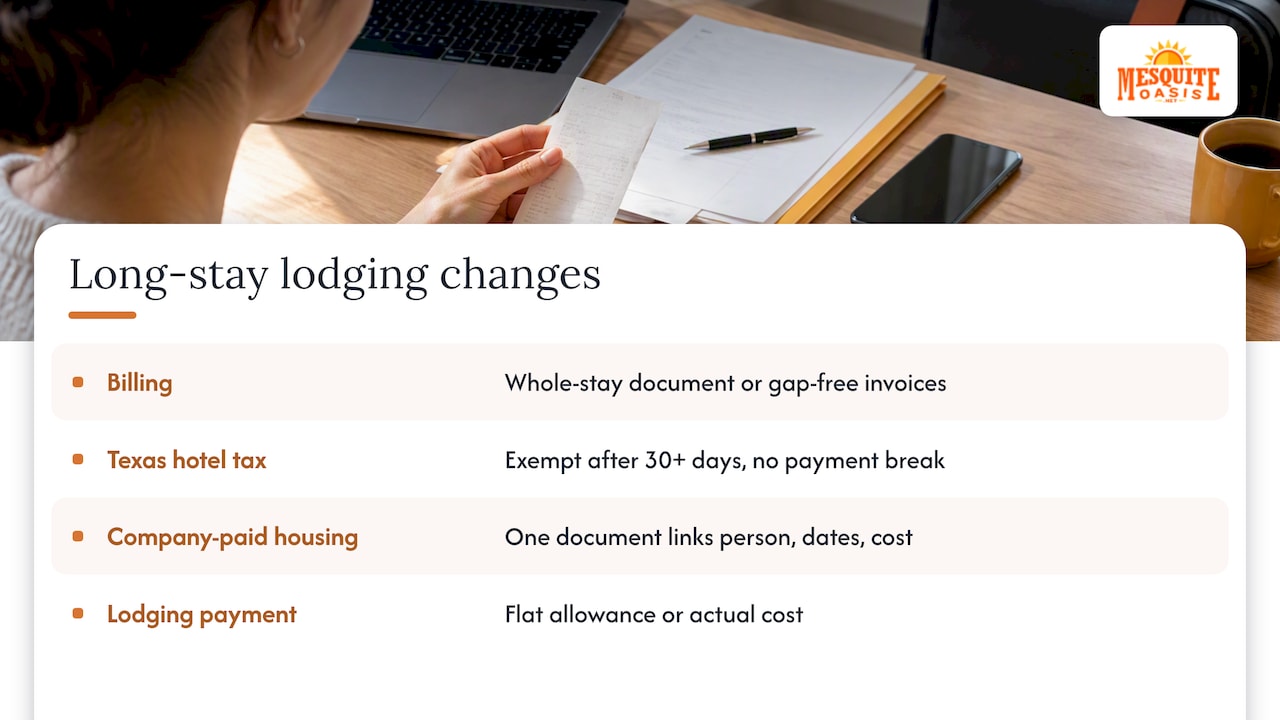
One stay, many documents. Weekly or monthly billing can produce several invoices or a single consolidated one. Ask what your employer prefers. Finance teams generally want a document that covers the whole stay with dates and amounts clearly shown, or a clean series of invoices with no gaps.
Hotel tax. In Texas, guests who occupy a room for 30 or more consecutive days with no break in payment are treated as permanent residents and exempt from hotel tax. That changes what shows up on your receipt. If the tax line disappears after day 30, that’s expected, not an error. Our own explainer covers who qualifies and how to claim the exemption.
Company-paid housing. When an employer pays the housing provider directly, the employee may never hold a receipt. The finance team needs one document that ties each person to dates and cost. We’ve written about how consolidated lodging invoices support IRS records for travel teams, and about what a company housing policy should say.
Per diem versus actual cost. Some employers pay a flat lodging allowance instead of actual costs. Ask which applies to you and whether receipts are still required. Federal travel uses published GSA per diem rates by location, but private employers set their own rules. Don’t assume the federal approach applies to your job.
Receipt checklist for contractors and crew leads
Before you leave a property or approve a stay, run through this:
- Property name and address on the document
- Traveler’s full name, matching your ID and expense profile
- Arrival and departure dates
- Rate per night or per week, plus any taxes or fees listed separately
- Proof of payment, such as a zero balance
- A note for any shared occupancy
- A digital copy saved the same day
If you manage a crew, add one more step. Collect receipts weekly, not at the end of a job. A crew of ten with a month of lodging between them is a lot to untangle later.
Perspective: what we see on long assignments
We house people who work in the Permian Basin, many of them for weeks or months at a time. The same pattern repeats. Reimbursement problems rarely come from dishonesty. They come from stays set up without anyone asking what finance will need.
Two things help most. First, put the traveler’s name on the booking from the start, so the paperwork matches the person. Second, decide early whether the company pays directly or the worker pays and is reimbursed. Those two paths produce different documents, and mixing them is how receipts go missing.
That’s why we built our process around doing everything online: application, invoice approval and payment, any time of day. A worker coming off a shift shouldn’t need to catch an office during business hours to sort out paperwork. For companies housing crews, we offer block booking and consolidated monthly invoicing, which keeps the housing record in one place. What your finance team accepts is their call, so ask them what they need before you book. Then ask us for it.
Staying with us in Odessa
Mesquite Oasis Lodge & RV Park has 241 full-hookup RV sites and 110 furnished lodge rooms, with utilities and WiFi included. You can apply, pay and manage your stay online, any time. Published rates:
| Option | Weekly | Monthly |
|---|---|---|
| 30 Amp or 50 Amp RV site | $300 | $795 |
| Single lodge room | $400 | $1,350 |
| Bunk bedroom | $550 | $1,700 |
See the RV site details, the lodge rooms, and the full rates and fees before you book. If your company needs housing for a crew, start from our workforce housing page, and read the contractor lodging guide to compare stay types and the fees nightly rates can hide.
FAQ
Do I need a receipt for a small lodging charge?
Yes, in most cases. The IRS $75 exception applies to other business expenses, not lodging, and employers following an accountable plan generally require a receipt for every lodging charge. Check your own policy, but plan to keep one every time.
Is a booking confirmation enough?
Usually not. A confirmation shows what you planned to pay, not what was charged or settled. Get the final itemized folio showing nightly rates, taxes and a zero balance.
What if my receipt shows a charge my employer won’t pay for?
Submit the original folio and annotate a copy to show the excluded item, such as a meal billed to the room. Handwritten clarifications are generally acceptable when they don’t contradict the original. Never alter the printed amounts.
What if I split a room with a coworker?
One person keeps the original folio. The other gets a copy or a written cross-reference showing their share. Confirm with your employer that shared rooms are covered before you book.
Can I use a credit card statement instead?
Not for lodging, in most policies. It proves you paid but doesn’t show the room rate and tax by night, which finance teams need to screen out non-reimbursable charges.
Sources
- Instructions for Form 2106 (2025), Internal Revenue Service
- Rev. Proc. 2019-48, Internal Revenue Service
- Textravel: Lodging Receipt Requirements, Texas Comptroller
- Reimburse Lodging, Indiana University
- Prepare & Submit a Travel Expense Report, UC Riverside
- 210.405 Travel, Iowa Department of Administrative Services
- Hotel Occupancy Tax Exemptions, Texas Comptroller
- FY 2026 per diem rates for Texas, GSA